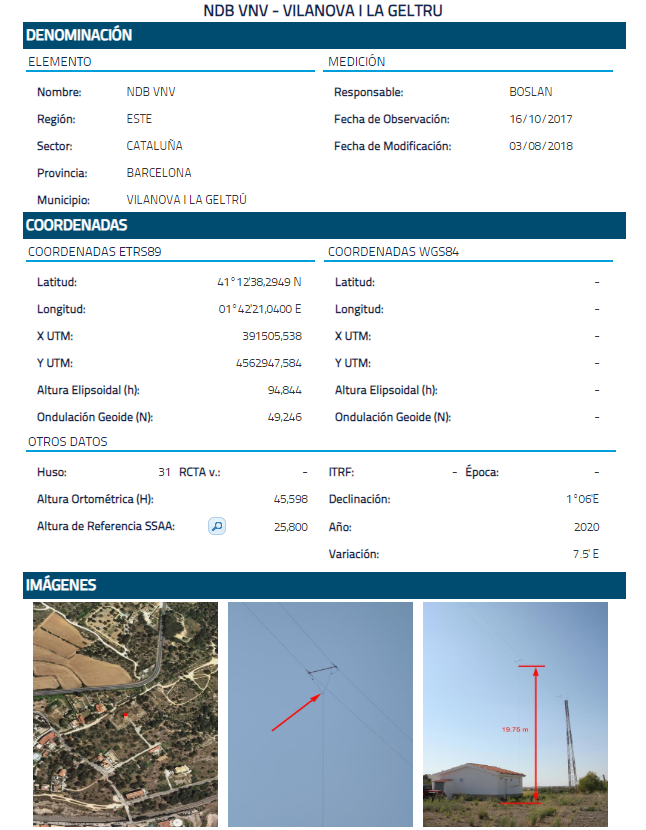
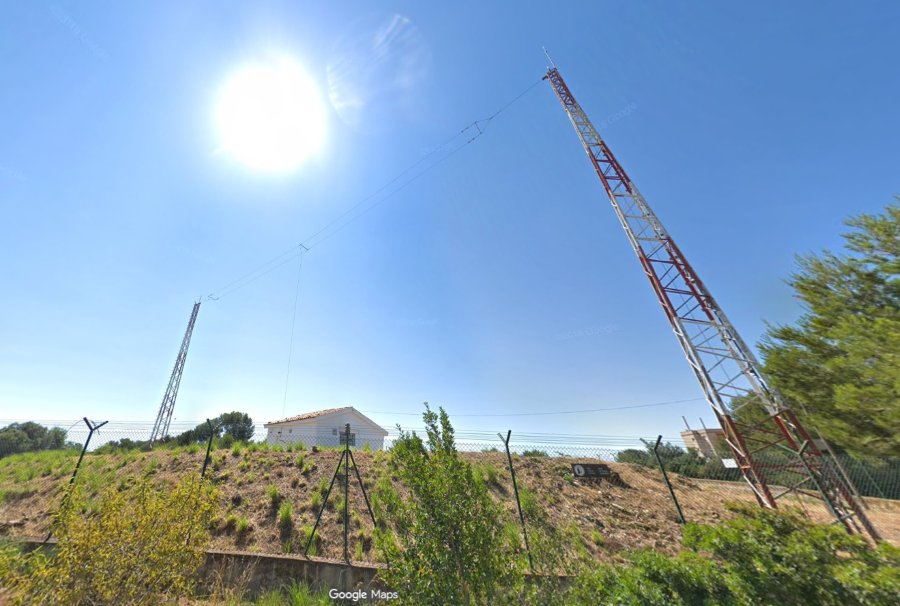
A QSL for NDB VNV from Vilanova i la Geltrú. Confirmed by Enaire the QSL shows the typical set-up for a Spanish beacon: 200W and a T-type antenna.
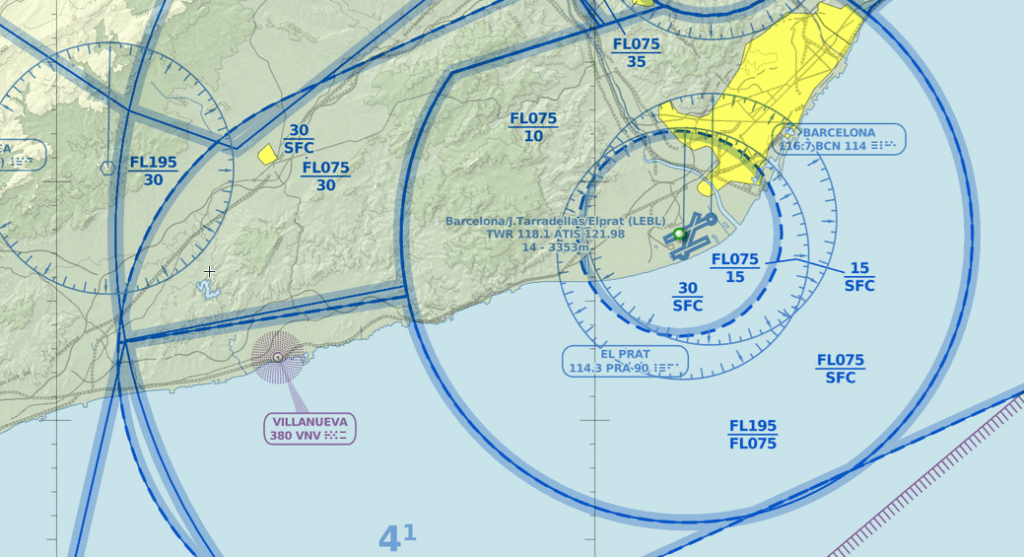
VNV is a beacon is associated with Barcelona Taradellas-El Prat airport. Not exactly in line with the runway. The Barcelona El Prat airport was renamed by the central Government of Spain to its current name on 21 December 2018 in honour of the first Catalan president under the current Spanish Constitution, Josep Tarradellas – a move widely criticised by the Generalitat de Catalunya and separatists due to non-consultation.
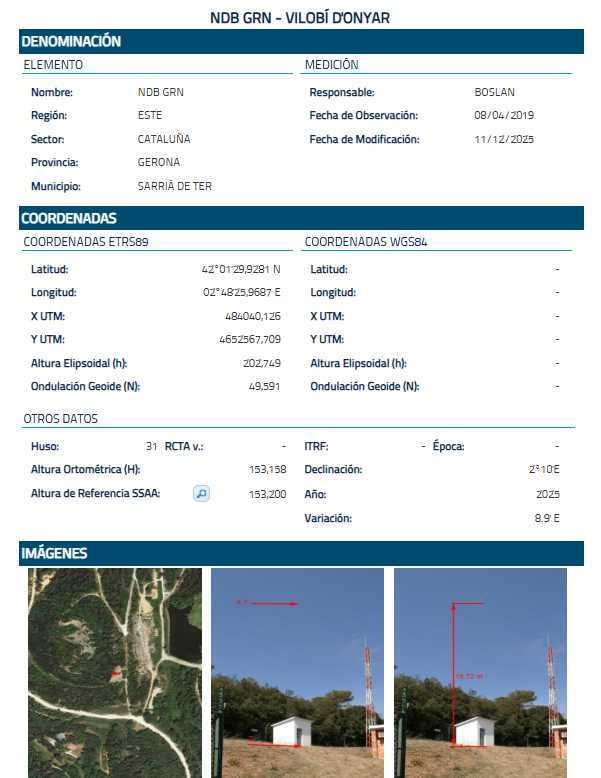
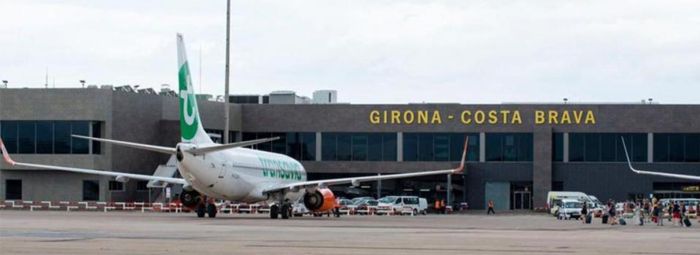
NDB GRN on 412 kHz is a beacon situated north of Girona Airport, in line with the runway. It is often listed as Gerona, which is the Spanish name for the city of Girona in Catalunya, but I prefer to use the name that the local population uses. My reception report was verified by Enaire via informacion@enaire.es .
The set-up of the beacon is typical for most of the Spanish NDBs: a 200 W transmitter with a “Sistema radiante de tipo T”:
Girona Airport was built in 1965 when there was not a lot of traffic. Passenger numbers grew spectacularly after Ryanair chose Girona as one of its European hubs, marketing it as ‘Barcelona-Girona’. In 1993, Girona Airport dealt with only 275,000 passengers; in 2008 passenger numbers increased to more than 5.5 million. But when Ryanair moved their Barcelona operations from Girona to the larger El Prat International Airport much of this was lost again. In 2024 around 2 million passengers used Girona Airport.
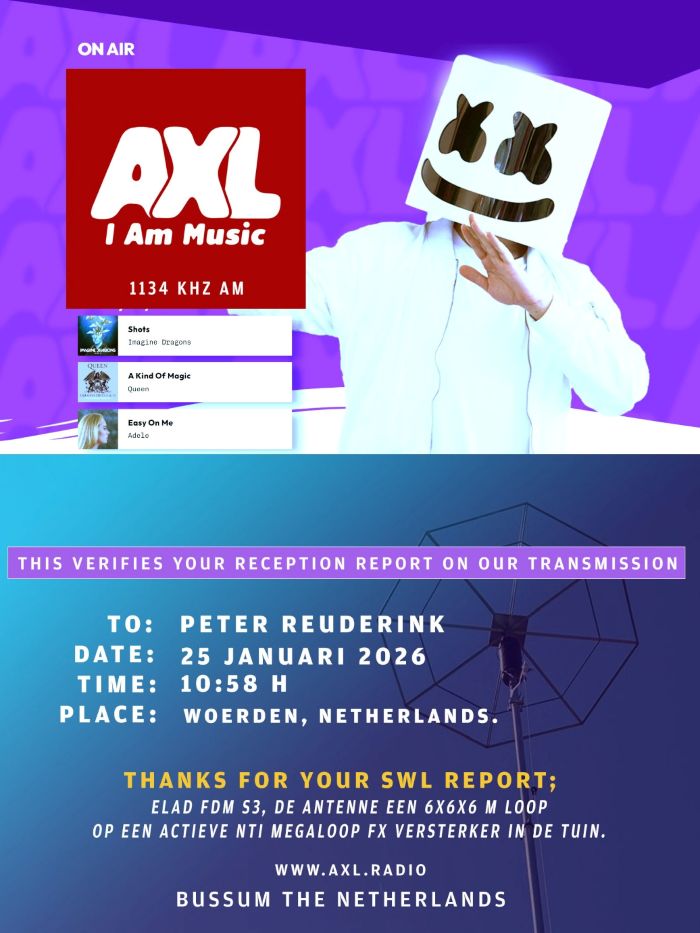
AXL Bussum is a relatively new LPAM station that started in 2025. While it is only 28 kilometers from my QTH I was not able to receive this station until now: Polderpop Radio 1134 was always dominant. As I had my antenna N/S again this weekend I tried again. And AXL was there in good quality:
Now AXL has a cool website. But the focus is on streaming their music selection, which is nice, but doesn’t give a clue about whom to contact for a QSL. Fortunately my DX friend Ruud Vos helped me out with a Whatsapp phone number. And the funny thing is that Henry Luchtmeijer, the man behind AXL, is very friendly to DX-ers and offers a beautiful QSL.
QSL AXL 1134 AM from Bussum
I have to applaud Henry for the initiative. Receiving a station from Bussum is not without significance: Bussum played a crucial role in the early history of Dutch television. On 2 October 1951, the very first official nationwide television broadcast in the Netherlands took place from Studio Irene in Bussum, marking the start of public television in the country. This was a true milestone: after years of experiments and test transmissions, regular television programmes were broadcast here for the first time to a national audience. Until around 1964, the national TV studios remained largely based in Bussum, before most activities were moved to Hilversum (the present-day Media Park) – partly due to a devastating fire in the Irene studio in 1971 that effectively ended the television era there. Although Hilversum later became the centre of Dutch broadcasting, Bussum remains historically the birthplace of Dutch television and an important symbol of the early years of this medium in our country.
Wow, this one was a bit unexpected. During my stay on Curacao, March 2025, I received Radio Nacional on 1380 AM, broadcasting from Santiago with 5 kW (1 kW night time).
But this week I received a nice, be it somewhat “cryptic” email from Radio Nacional confirming my reception report sent to 1380@radionacional.net
Radio Nacional is part of Grupo Medios del Norte, operating a few TV channels and 10 FM stations. Despite their name “Radio Nacional”, the station is a more modern or regional commercial station, likely established in the mid-to-late 20th century or later, as part of the growth of private radio in the Cibao region. It is not the same as any government “Radio Nacional”. References to it as “la emisora del pueblo” (the people’s station) suggest a community-oriented role in Santiago.
In October 2025 I received WSKW from Skowhegan on 1160 AM. My report via their website remained unanswered. Thanks to a tip from Arild’s DX diary I got a lead to Mrs. Gracie Johnston from Mix Maine Media. She was so kind to confirm my report:
WSKW is not an easy catch. I received this station quite early for TA DX when they were most likely still broadcasting with 10 kW. Night time operation is 730 Watts only to avoid interference with “Class A station” KSL from Salt Lake City, which makes reception a challenge.
The audioclip above is my reception of sports talk and at 33 seconds: “Coast to Coast Infinity Sports Network”. This is the brand they go by since 2022 when WSKW dropped the oldies and talk programming and returned to sports, branded as “1160 The Score”. As you can see in Mrs. Dellandrea’s reply, high school sports coverage is retained, with the remainder of the station’s programming being supplied by CBS Sports Radio (now Infinity Sports Network).
Below you see the old brand when they were still on a mix of oldies and sports. I don’t mind the new brand, but I wish they had retained the WSKW call sign in their logo.
With the closure of the powerful RNE stations from Bilbao and La Coruña on 639 kHz it is easier to catch CBN from St. John’s, Newfoundland on 640 kHz. Despite average conditions I could pick up a decent ID, “This is CBC Radio 1, 640 AM, Saint John’s”:
Mrs. Dellandrea was so kind to confirm my reception report within a day with a fully detailed email:
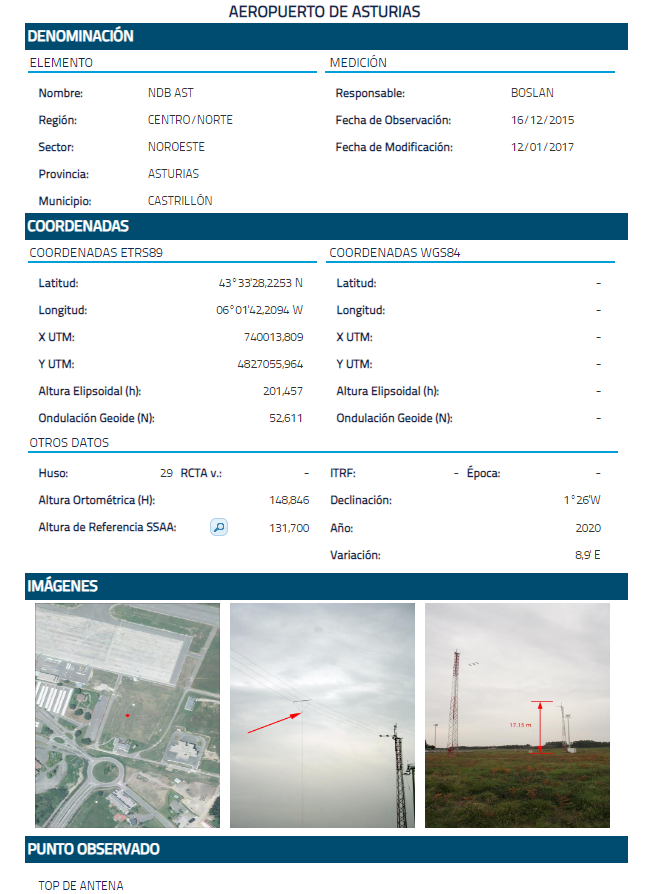
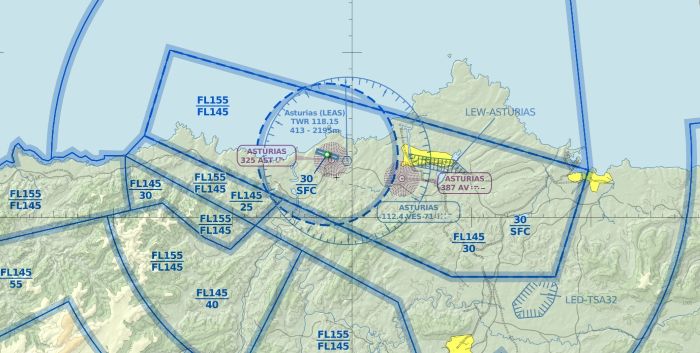
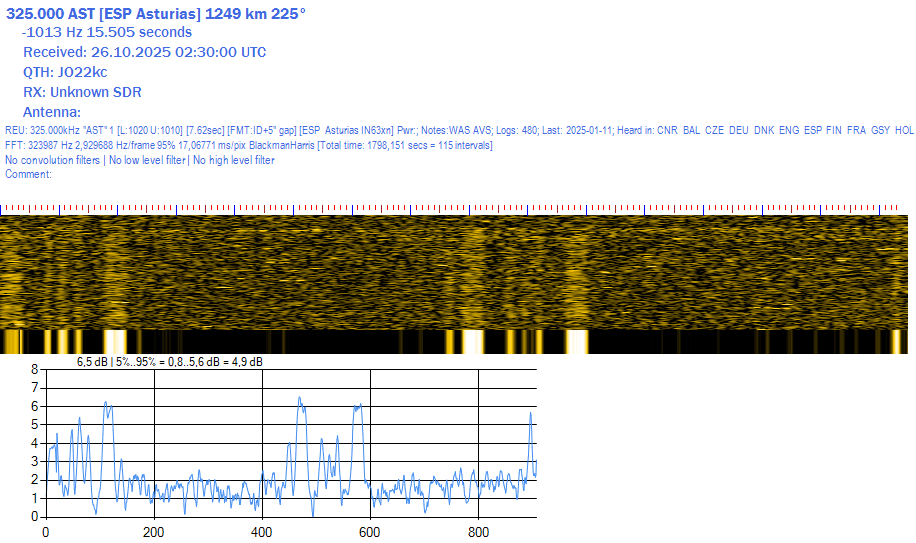
A QSL for my reception of NDB AST on 325 via Enaire: informacion@enaire.es. It is one of two beacons for Aeropuerto de Asturias in Northern Spain. The other one is AV-387 which I got confirmed earlier.
Power 927 broadcasts from Abbiategrasso, south west of Milan. I’ts a pity that a station that boasts that it “brings the medium waves back to life” doesn’t foster the DX community that supports exactly this purpose. I heard Power 927 since 2022 and sent multiple reports. Never got a reply.
The good news is that Antonello Napolitano, the man behind DX Fanzine, runs a DX program “Bande Rumorose” on a couple of Italian LPAM stations. Power 927 is one of them. And he does QSL!
This is what Antonello wrote:
Thank you very much for your report on the reception of the DX Show in Italian “Bande Rumorose”. It has been checked and agrees with our log.
Attached please find a F/D eQSL for listening to the DX Show “Bande Rumorose” (If it contains errors, don’t hesitate to write to me again!). Let’s explain the meaning of the QSL’s cartoon.
“Bande Rumorose” literally translates as “Noisy Bands” and means “Rumble Strips.” The key point of the image is precisely the wordplay. In road signage, “Bande Rumorose” refers to those strips on the asphalt that make the car vibrate and produce noise to attract the driver’s attention.
Here, however, “Bande” (Italian for “Bands”) should not be understood in its road-related meaning (“Strips”), but as radio bands — specifically medium wave and shortwave.
The illustration suggests that, from the point of view of “ordinary” people, that is, those who are not passionate about radio, these radio bands appear to be nothing more than a collection of noise, static, interference, and incomprehensible signals. Just as rumble strips on the road are annoying to drivers, radio bands seem “noisy” and uselessly chaotic to those who fail to grasp their appeal.
The cartoon therefore plays on the contrast between the common perception: just annoying noise, and that of the DXers: signals, communications, QSLs, passion The pneumatic drill becomes an extreme metaphor for the attempt to “silence” or destroy that world which, for those who don’t love it, seems like nothing but a lot of racket. It is an affectionate irony toward a passion that few people understand, but which, for those who live it, is anything but noise.
For your information, “Bande Rumorose” is being carried over 5 italian MW stations (Radio Metropolis, Radio Briscola, Emmereci Radio (or Media Radio Castellana), Power 927 and Radio Centrale Milano. Future plans call for the addition of other medium wave stations in Italy and, hopefully, of a shortwave relay, too!
The program, which I describe as an old style DX show, consist of DX News, profile and/or history of both, MW and SW stations from all over the world, interviews with DXers and shortwave personalities (for example Dino Bloise) and logs of recently received medium and short wave stations (some of them accompanied by good quality recording of their jingles or station identification announcements!).
“Bande Rumorose” is on air as follows (All times CET = UTC+1 hour):
• Emmerreci Radio, Castel San Pietro Terme (BO), Sundays, at 1100, Fridays at 2300 on 711 e 1098 kHz. • Power 927, Abbiategrasso (MI), Sundays at 1100, Mondays, Thursdays, Saturdays, at 2100 on 927 kHz. • Radio Briscola, Lenta (VC), Sundays, at 1100 and 1830 on 1449 kHz. • Radio Centrale Milano, Milano, Sundays, at 1030, Mondays, at 2300 on 1575 kHz. • Radio Metropolis, Trieste, Sundays, at 2205 on 1503 kHz and 93.90 MHz FM for the city of Trieste.
Reception reports with comments on the content of the show are welcome (Short mp3 recordings appreciated) EXCLUSIVELY to: banderumorose@dxfanzine.com
Please note that reports sent to any other e-mail address, even if they are under my control, will not be verified!
For the sake of good order, let me add that reports based on reception via public remote SDR receivers (Twente, Kiwi and so on) will not be verified. The reason is simple: such reports are useless as we can check such online SDR receivers by ourselves.
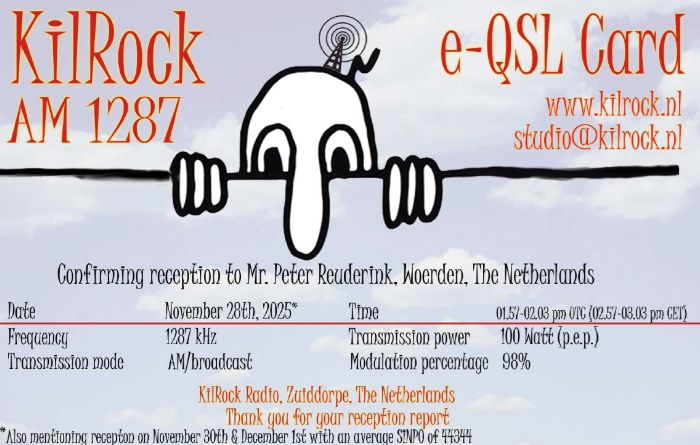
Kilrock Radio, a beloved Dutch low-power AM (LPAM) station known for its free-form mix of pop, rock, and soul music, has completed a significant relocation from its original home in ‘s-Gravendeel to Zuiddorpe in Zeeuws-Vlaanderen.
The move was prompted by station owner Willem Klomps relocating his residence in July 2024. As a result, broadcasts on 1287 kHz medium wave ceased on June 1, 2024, after over a year of on-air presence in the Dordtsche Kil area — the inspiration for the station’s name.
Kilrock AM 1287 retained their name, but also the nice eQSL card
After an intensive relocation process and home renovations, Klomps began rebuilding the studio and antenna mast in late July 2025. The station retained its “Kilrock” branding, fittingly, as the new region also features local “kil” waterways. On September 20, 2025, Kilrock Radio resumed test transmissions on the same frequency, 1287 kHz, marking its return after more than a year off the AM band.
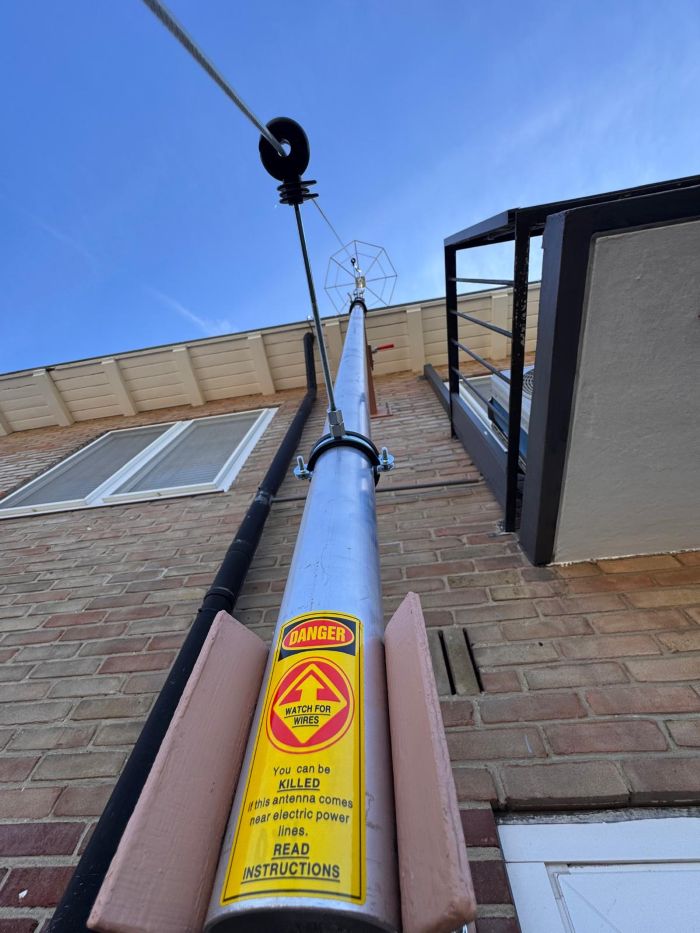
Despite the distance (with 116 kilometers the distance from my QTH in Woerden to Zuiddorpe is three times bigger than that to their previous location in ‘s Gravendeel), reception quality was pretty good in the afternoon. I did have to turn the 6x6x6 m delta loop N/S to receive them. At night SER Galicia is dominant.
Enaire (informacion@enaire.es) was so kind to confirm another couple of beacons from Spain that I received. This time I heard NDB VT from Vitoria on 308 kHz. As usual they sent their nice information sheet:
NDB 308-VT is one of the two NDBs for Vitoria Airport. The other beacon is is 345-VTA. Below you can see how they nicely align with both sides of the runway. Both antennas have a set-up which is a bit different from most Enair beacons: a “Sistema radiante de tipo margarita” as opposed to most Enaire beacons that have a dipole: “Sistema radiante de tipo T”.
BDXC : SWL 2262 PRe VERON : NL 14228 If you want to get in touch, just leave a message on one of my posts. Please note that I don't publish email addresses of verifiers which are not part of the public domain. So if you don't see the QSL address, just leave a message and I'll get back to you.
This is just a hobby site. Feel free to copy anything on my weblog. A link back to my site is appreciated when you do so. I try to provide accurate information, but if I'm wrong: don't blame me! I'm also not responsible for the use of sites I provide links to. I try to respect copyright rules, but should you think I made an infringement: just let me know via a message on the corresponding post and I will act accordingly.