"It's not true I had nothing on, I had the radio on" - Marilyn Monroe

Category: Info (Page 1 of 8)

NDB hunting: my CLE327 results, and a nice suprise from Iran

The NBD io group organizes a Co-ordinated LIstening Event (CLE) every month. As a huge fan of something that is a bit of a contest, a bit of a personal challenge, I like these a lot. More importantly they help me to improve my set-up which is why I try to participate most months.

CLE’s always have a certain goal. In CLE299 for example, you had to pick an azimuth and try to receive as much beacons along that line. CLE311 required you had to “build a pyramid”. And CLE309 was all about logging up to 8 stations from each Maidenhead square. In this one, CLE327, the aim was to select 10 frequencies ahead of the event and then log as much beacons as possible.

So the making the right selection was critical. Obviously you do that by checking on which frequency you logged the largest number of different beacons in the past, ideally beacons that you have a fair change of logging again. But I just moved to a new QTH, and worse, I only have a loop pointing 90/270 degrees at my disposal, whereas in the past I switched antenna directions for an optimal result.

My Results

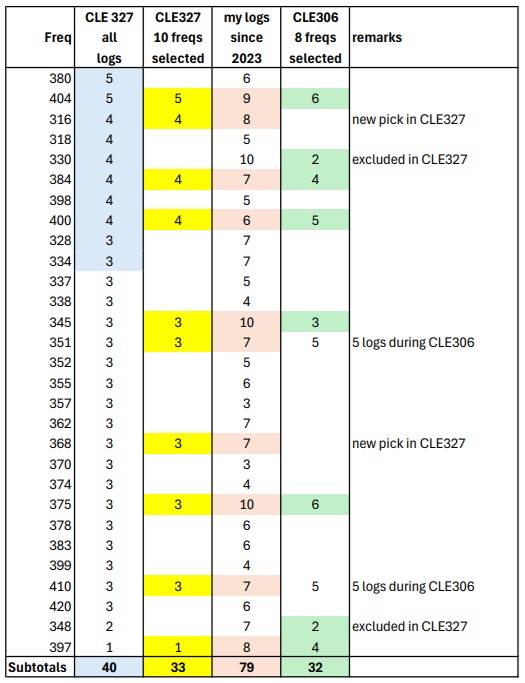
But hey… all for the fun of it. In the table below you can see my selection and my results. Now I can only receive these weak signals at my noisy QTH using Pskov, a software tool that basically tries to detect cyclic signals. If it recognizes one, it cuts an SDR recording (I used recordings of an hour) in pieces of exactly that cycle length and stacks them on top of one another to improve S/N ratio. To limit the amount of data processing I listened between 299 and 420 kHz only.

The previous event of a similar nature was CLE306 two years ago when the aim was to log as many NDBs on 8 preselected frequencies. Quite a few NDBs closed down since, so we were allowed to pick 10 frequencies this time. But obviously the CLE306 results provided a good starting point.

As you can see in the table above I managed to log 32 stations in CLE306. Based on my results I made the following selection for the new event:
– Two frequencies, 348 and 330 disappointed me in CLE306 big time. So I excluded them for CLE327.
– Two frequencies, 351 and 410 were not selected in CLE306, but during that event I logged 5 NDBs. So I included them in CLE327.
– And to bring the selection to 10 frequencies I added 316 and 368 as I logged quite a few NDBs on these frequencies in the past.

Again, note that the number of logs in the past are not the only number to go by. Some logs are really rare or once off UNIDs. Some NDBs are located at a larger distances to the north or south, which given high solar activity right now or my limitations with the antenna orientation might provide a difficult catch.

My result in CLE327 was 33 beacons in total. With 3.3 NDBs per frequency quite a bit lower than in CLE306 which resulted in 4 NDBs per frequency. Conditions in that one, which was held in July, were not much better, so I blame my fixed antenna direction for that.

In hindsight, if I had picked the right frequencies, I could have scored 40. So the selection was not too bad. My newly selected 397 let me down with only one log for unknown reasons. Conditions to the Balkan were not bad, as were conditions to the UK and south of France. Maybe I should replace it with 380 next time.

For reference: the average score for participants from Europe was 43, with the top dog scoring 65!

A nice suprise from Iran

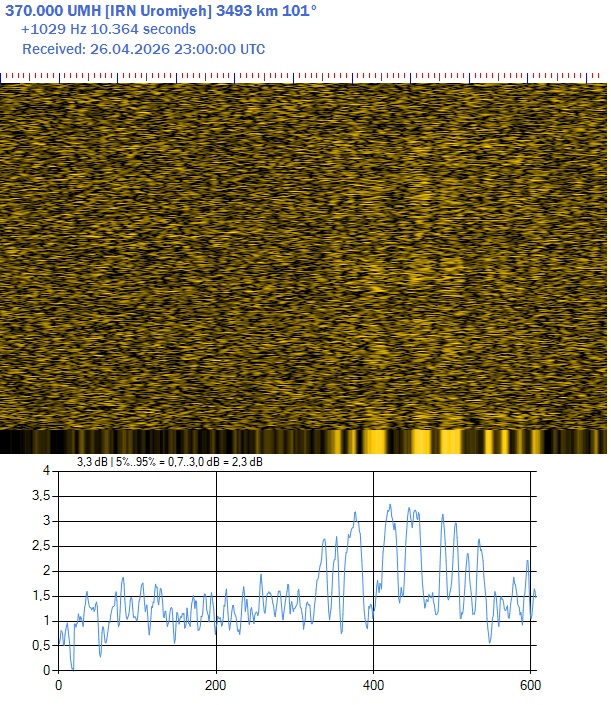
And to finish it off. During the event I received this nice signal from Iran. NDB Uromiyeh, almost 3500 km distance:

Pskov capture of NDB 370-UMH, Uromiyeh, Iran

My Top 10 DX 2025 result

Top 10 DX presents itself as the World’s largest SWL contest. I think they have organized it since 2017. So as posted earlier I decide to participate. Now I knew that I didn’t have a lot of time to spare as we were preparing our move to a new house. So I spent more time packing boxes than behind the radio. But in the true Olympic spirit: “Participation is more important than winning”.

The contest is about logging 10 stations from different countries between 2300 and 30000 kHz. Points are awarded using this formula: distance (in km) / power (in kW). WRTH data are used as reference.
In addition to the rule above there was multiplier of 3 to boost your score for stations from a different continent. Here I probably made my first mistake I tried to log stations from different continents and only missed Antartica. But in hindsight I think you get a multiplier bonus for each station from a different continent than your own…

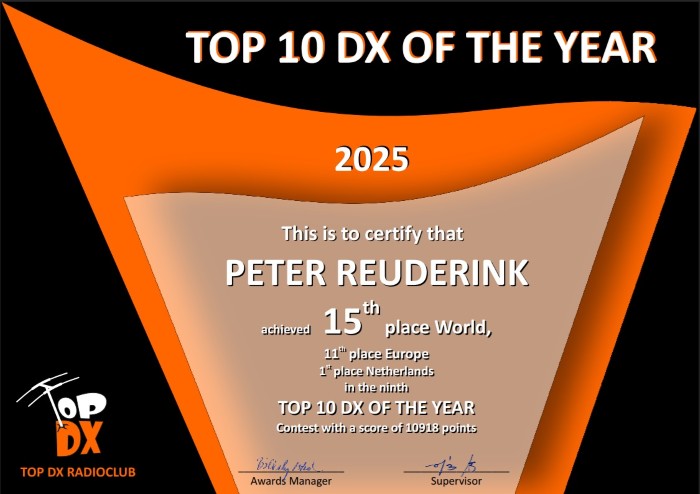
My TOp 10 DX of the Year Award

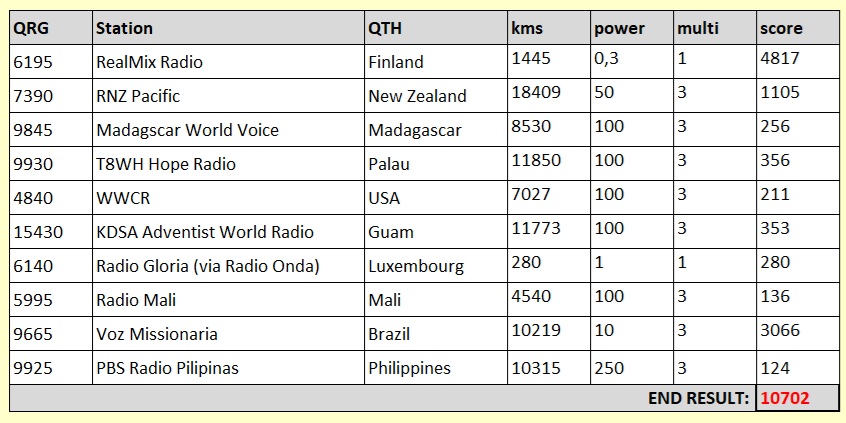
Below the 10 stations and points I collected (it differs somewhat from the 10918 points I was officially awarded, as my distance estimates might be slightly off).

This resulted in a 15th place among 36 participants Worldwide, 11th place in Europe and as I was the only Dutch participant: 1st place in The Netherlands. The winner was “ace DX-er” Christoph Ratzer from Austria with 545863 points, of which 318513 points were picked up for 1 catch! Congratulations! I was very pleased to see my DX friend Patrick Robic picking up 3rd place with 194204 points!

Now I have to say these scores made me aware of the real challenge of this contest. It is called Top 10 DX… but from the scoring I get the feeling that low power is more important than distance (DX). And so a relatively easy catch for me like RealMix Radio resulted in more points than stations from Palau and Guam which, subject to propagation, are not always easy if you also have to write down some proper details.

So that makes you wonder… Christoph knew how to log a station which yielded over 300000 points. Outside Europe that is a station at say 10000 kms with 100 Watt only (10000/0.1 x 3). Inside Europe you are looking for say 3000 kms with 10 Watt only (3000/0.01). DX-ers in the top 4 reported 10 catches with an average between 13000 and 23000 points. So that’s 10 stations with max 1-3 kW at a average distance of 10000 kms. The problem with Top 10 DX is that they don’t disclose which stations were received by any of the participants. Frankly, I’m not sure I like that as it doesn’t help me to get better as a DX-er by learning from others.

My conclusion: if you want to get a high score in the Top 10 DX contest you have to research which stations less than 3 kW outside your continent can be received (and less than 0.3 kW when on your continent). Those are the ones to target, anything else barely adds a significant number of points.

“Will I participate next year?” The answer is “maybe…”. If time permits I will invest in putting together a shortlist of stations that would result in at least 5000 points each. If that is a set I consider viable logging at my QTH I might give it another try. It might also be that I decide that this is just not my type of contest as noise levels block the reception of the few weak stations you need to have for a proper result and I can’t compensate for that by putting in more time and improve my score by adding some – slightly higher powered – stations. And again, the fact that the results of my “betters” are not made public plays a role as well: I do like competition, but more than that I do like helping fellow hobbyists to become better.

So we’ll see. That said, a big thank you to the organizers, it is always good to create challenges for the serious DX-er, and I do know that you also rather spend time behind the radio than processing spreadsheets of contest participants.

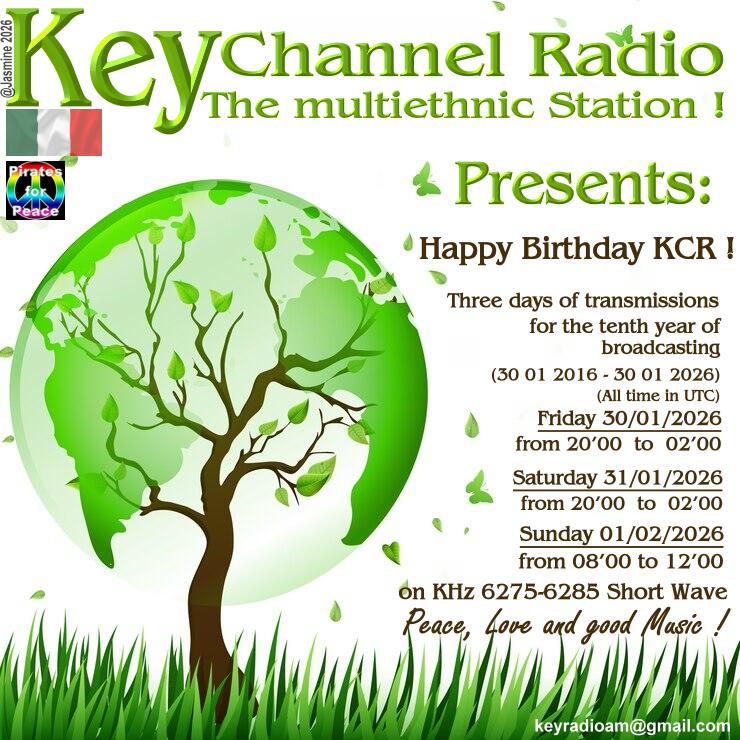
Key Channel Radio scheduled this weekend:

The Key Channel Team informed us that they will be on air this weekend. See below for details:

Dear friends, it’s been 10 years since our first broadcast. Many things in our lives have changed, but we’ve always been in your company. We thought we’d celebrate with a special broadcast featuring some exciting news. New prestigious collaborations. We are sure that you will celebrate with us by listening to us in large numbers as always. Good listening !!

Jasmine.

Christmas and New Year’s wishes from around the world

It is always nice to receive Christmas wishes from stations you sent a report to. But it was very nice to get quite a few wishes from friends that I enjoy this hobby with. Thank you all for following my blog, and once again, all the best for 2026!

Below a selection of some of the e-cards I received, plus a very special email to start with:

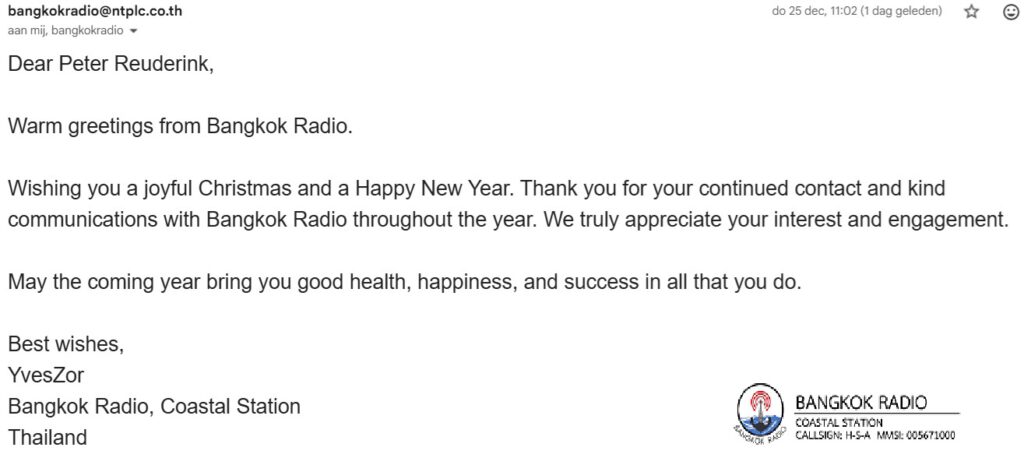
Christmas wish from YvesZor at Bangkok Maritime Radio. I have never received Chrismas wishes from a utility station, so that’s a first!
Nestor Fischetto… thanks for all your support with questions about radio stations from Argentina, Nestor!
Key Channel Radio, Thank you Massimo Rossi!
Ruqui Radio from Jordan Alcolea (Ruqui DX)
Radio Taiwan International… for my review of their test transmissions in German and French
And of course, the Benelux DX Club

Merry Xmas and a Happy New Year

To everyone who visits my blog… I wish you all a Merry Christmas and a Happy New Year. And of course a lot of good DX!

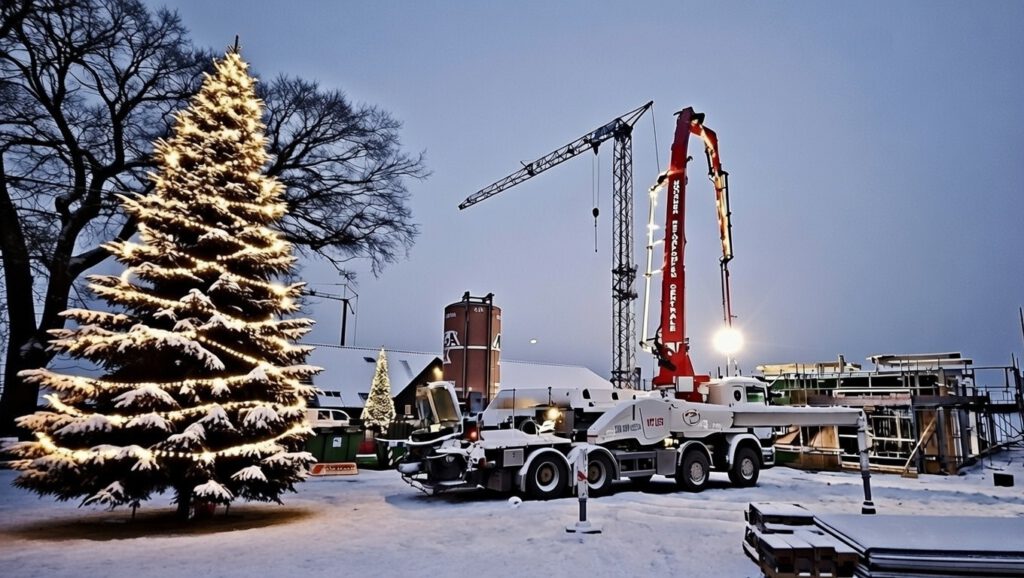
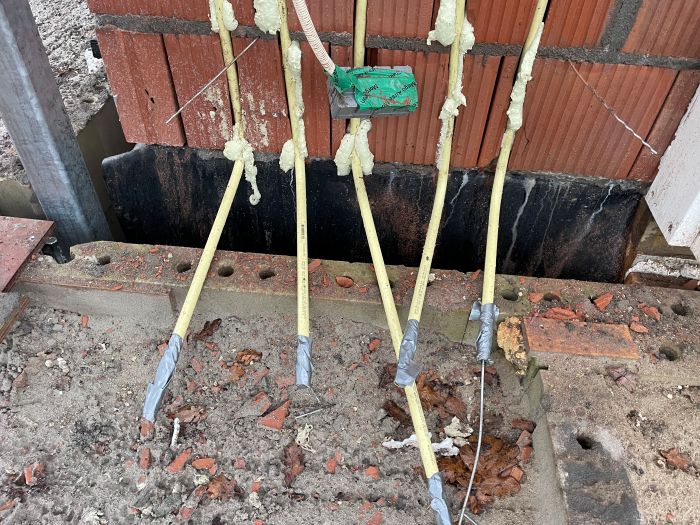
For me 2026 will be a year of change. We will be moving from the densely populated part of the Netherlands in the west, to one of the most rural parts of the country. And our house is under construction as you can see (I have to admit the big Christmas tree and the snow are AI).

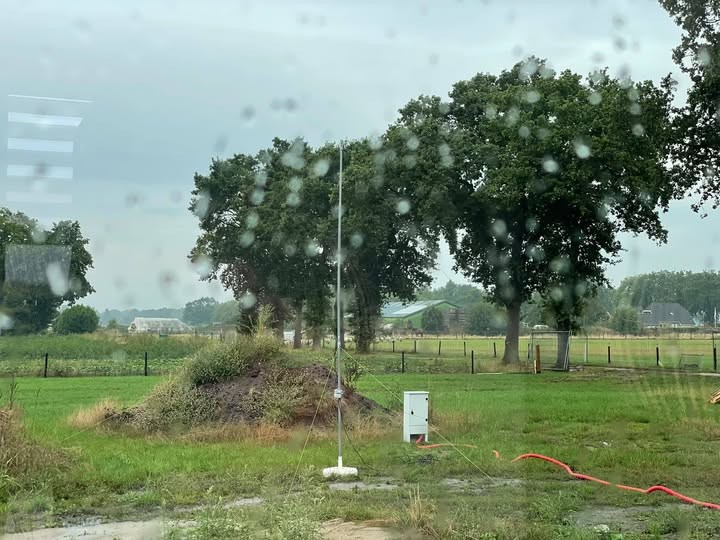
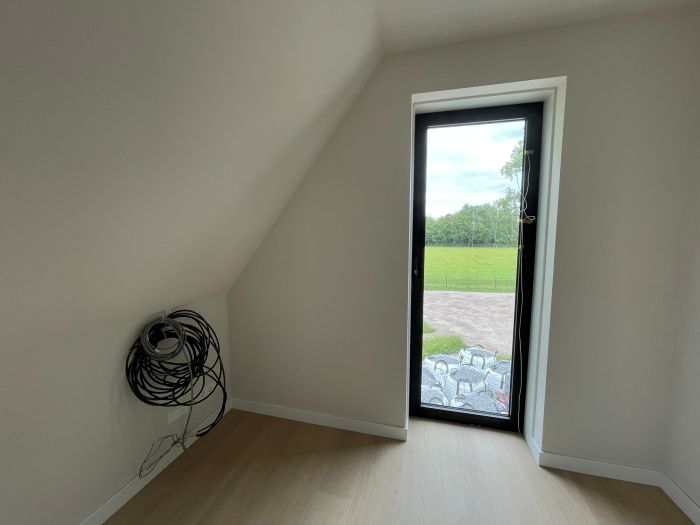
The lines for 3 antennas, a rotor and a clean grounding are already in place

Of course the new house will have a radio shack and facilities to connect to three antennas in the garden. On the picture above you can see the work in progress.

As we will move to a temporary house in the next few weeks I might have less time to spend behind the radio, resulting in fewer posts on this blog. It’s an investment in what hopefully will be a QTH with less QRM!

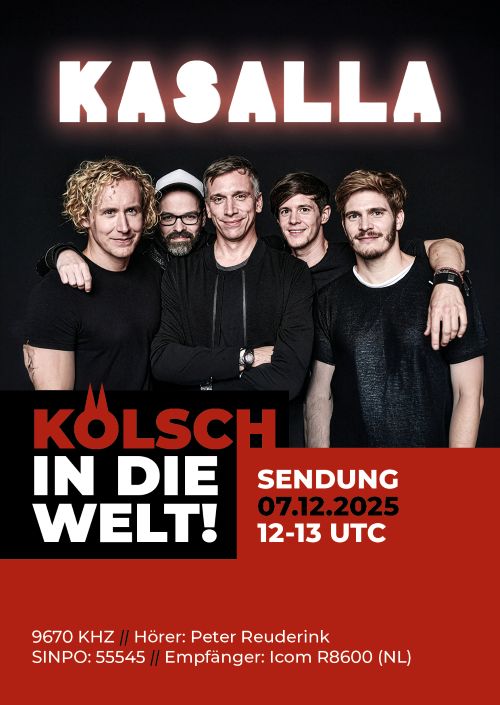
QSL Kölsch in die Welt 9670 kHz

I don’t know what it is… there is so much to listen to on the internet, but receiving a station with music that isn’t mainstream via the airwaves… it is always a bonus. Via Channel 292 I listened to Kölsch in de Welt with a program dedicated to Kasalla. Kasalla is a popular German Kölschrock band from Cologne, formed in 2011, known for energetic hits like “Pirate” and “Stadt met K” that dominate carnival sessions. Their music blends rock with Cologne dialect lyrics, celebrating local pride and creating euphoric live atmospheres across Germany and beyond.

It fits the mission of Kölsch in die Welt: to spread the Cologne way of life, music, and culture far beyond the cathedral city. With energetic Kölsch rock hits and tours throughout Germany and Europe, they carry pride in Cologne, its dialect, and its traditions to the world. Whether at concerts or planned international performances, Kasalla brings the spirit of Carnival, Kölsch, and Cologne to a global audience.

Their address is hobby-radio-bonn@web.de . Please do tune in, and send your reports!

Channel 292, Rohrbach, Germany

QSL Voice of Indonesia 4755 kHz

Since 2018 the Voice of Indonesia is back on shortwave. They are using frequencies in the 90 meter band (3325 kHz) from Palangkaraya on the island of Borneo and 60 meter band (4755 kHz) from Jakarta on this island of Java. A remarkable change of strategy as most broadcasters have left shortwave, and tropical band frequencies in particular.

According to Voice of Indonesia the reason is to promote Indonesian culture and government views, at relatively low costs and with the ability to reach areas where digital infrastructure is not as easily available as in other parts of the world.

eQSL from RRI Voice of Indonesia on 4755 kHz

Via voilisteners@gmail.com I received a personal email and a beaticul eQSL card for my reception of their program on 4755 kHz. I listened to their Spanish and German program which could be received in reasonable quality at 17:30 and 18:00 h UTC respectively. They even have a Dutch program which I will try to receive on 3325 kHz in the coming months.

My first QSL from the Voice of Indonesia is from February1989. See below.

1989 QSL from the Voice of Indonesia

In those days they were still broadcasting in the 25 and 19 meter band, and despite their 100 kW of power I don’t recall it being an easy catch. Funny thing is that in those days they didn’t have a broadcast in Dutch.

PA25NATO a special call sign in use during the NATO Summit The Hague

I noticed this special call sign PA25NATO a couple of time on SSTV 14230 kHz. Apparently it is in use to celebrate the upcoming NATO Summit in The Hague, The Netherlands.


It’s going to be quite the event security wise, right in one of the most densely populated areas of Europe, to the point that you think whether it wouldn’t have been wise to select a more convenient location. Good thing that I’m retired and don’t have to deal with all the road closures and resulting traffic jams in the coming weeks.

« Older posts

© 2026 Peter's DX Corner

Theme by Anders NorenUp ↑