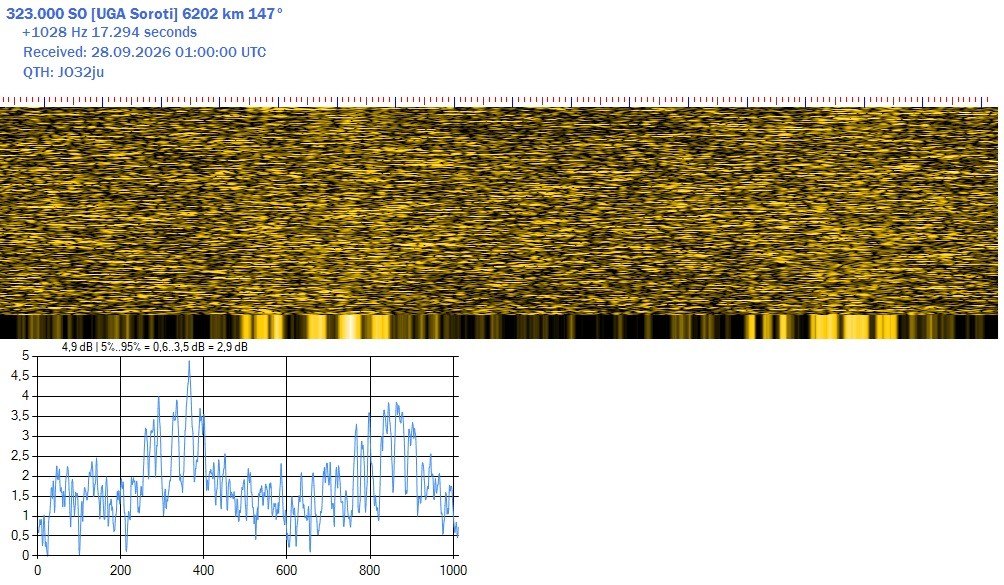
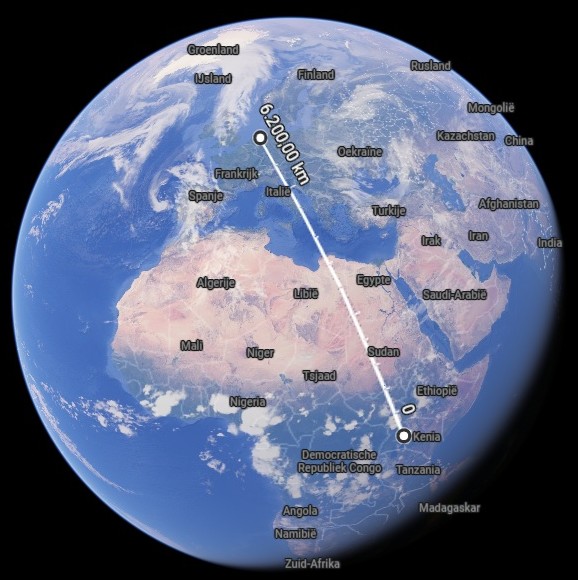
The Coordinated Listening Event of September was the first time I really could test how I would benefit from living in a low noise environment. I received more beacons that ever, including signals from Nunavut-Canada, Turkmenistan and Tajikistan. But NDB SO from Soroti Uganda on 323 kHz broke all my records. With 6202 kilometers it is the most distant beacon I ever received. It is the first log from Holland on the NDB list log, and only 5 other DX-ers from Europe have logged this NDB!
Of course I sent a report to the Uganda Civial Aviation Authority, but so far it remained unanswered.
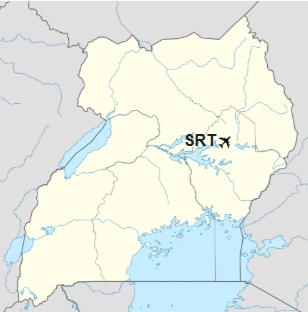
Location of Soroti Airport in Uganda
The airport was originally built as a school for the British Overseas Airways Corporation to train their pilots in tropical flying techniques. It was later used by the East African Civil Aviation Academy to train pilots from the East African Community.
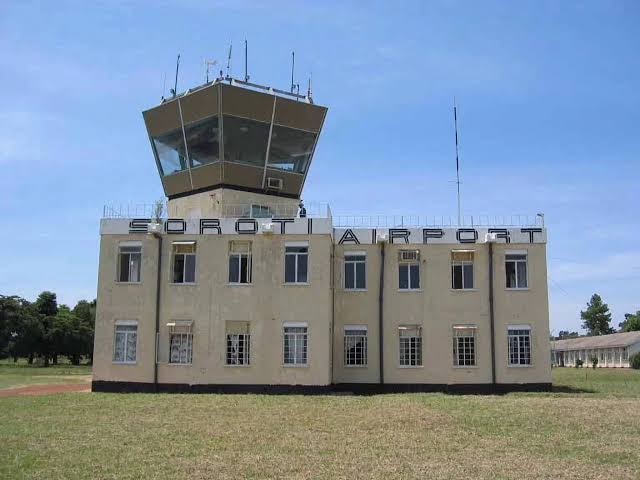
Soroti Airport
As of June 2018, the airport is home to the Soroti Flying School, which has various aircraft, including a Cessna 310. The flying school provides training through instrument and multi-engine ratings. There is no scheduled airline service at Soroti Airport, but it is possible to get non-scheduled flights through Eagle Air Uganda.
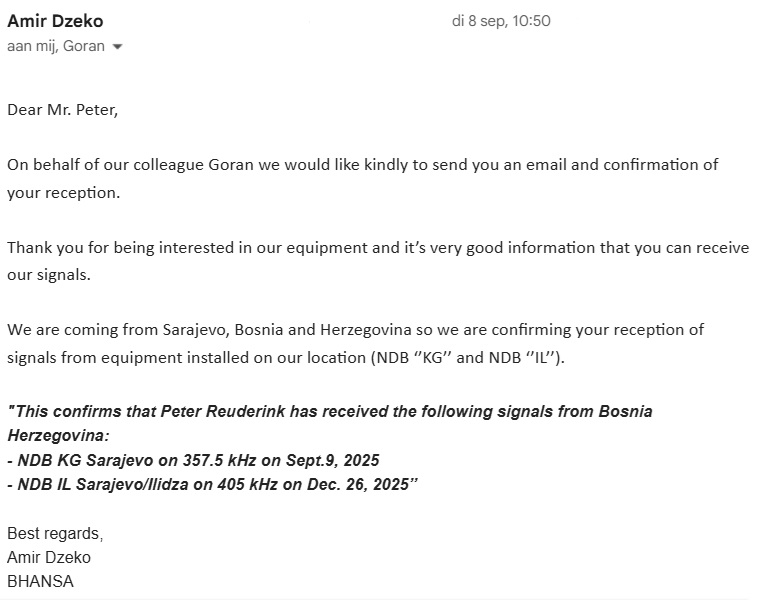
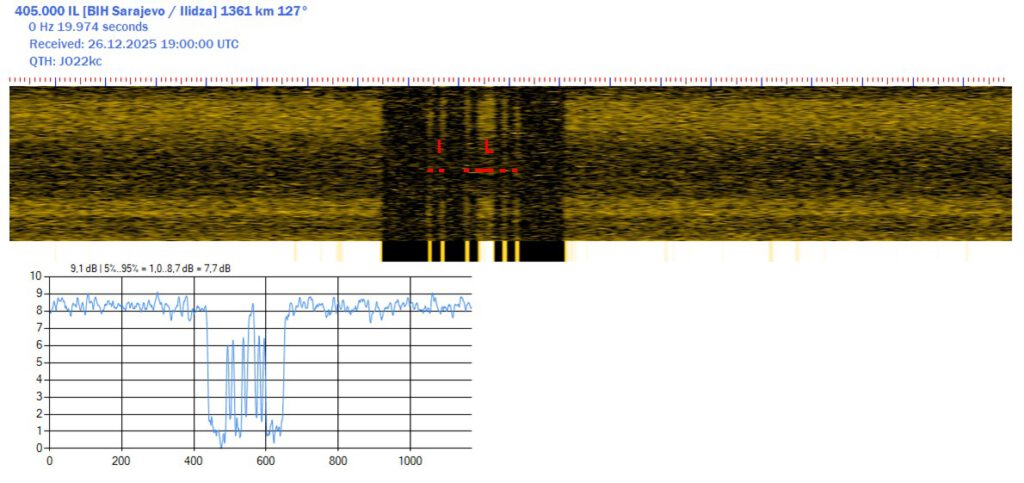
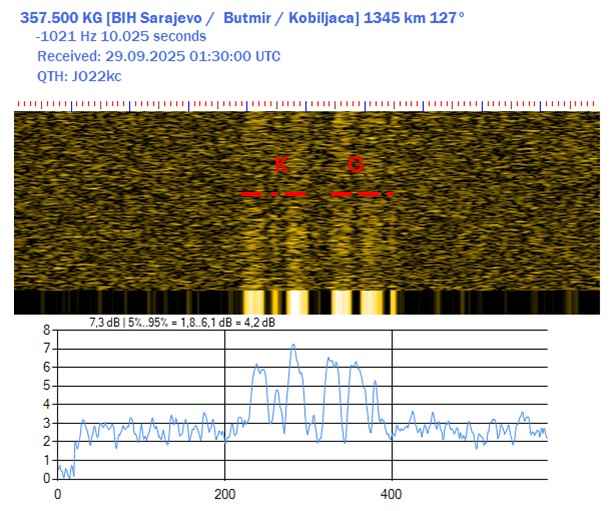
Mr Dzeko from BHANSA was so kind to QSL my reception of NDB IL Sarajevo/Ilidzaj on 405 kHz and NDB KG Sarajevo/Butmir/Kobiljaca on 357.5 kHz. Mr. Nikolic, system engineer at BHANSA was so kind to forward my report (see my post on Banja Luka NDB NA and NDB LU for a bit of background).
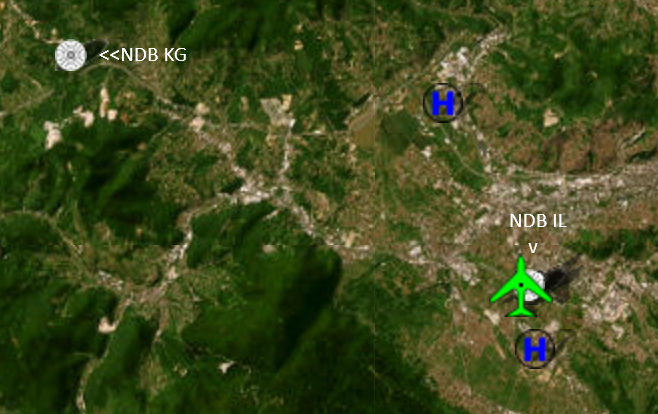
Unlike the Banja Luka pair, both beacons are still in operation. NDB KG is located 12.5 km NW in line with the runway. NDB IL is located next to the runway of Sarajevo
Sarajevo International Airport traces its roots to 1930, when Aeroput began regular flights linking Belgrade, Sarajevo, and Podgorica from a military field at Rajlovac and later the grass airfield at Butmir; after World War II interrupted service, civilian traffic resumed in 1947.
It was substantially expanded ahead of the 1984 Winter Olympics, including a longer runway and a new terminal that handled a record 14,000 passengers on the Games’ final day. During the Bosnian War the airport became the hub of a massive UN humanitarian airlift of some 13,000 flights and 160,000 tons of aid.
For Sarajevo International Airport expansion plans one of major restrictions is a mountain terrain that requires a high approach precision and a big inclination angle in a procedure of unsuccessful approach and landing.
A few weeks ago I received an email from Mr. Goran Nikolic, Systems Engineer at BHANSA. He asked me if he could use the information of my reception report of NDB „TU“ on 445 kHz near Tuzla in a technical book he was preparing on radio navigation aids. The idea was to explain that NDBs can be received over much longer distances if propagation conditions are favourable. As Mr. Nikolic wrote: “It is a very useful practical example for explaining a phenomenon that can otherwise remain rather abstract.”
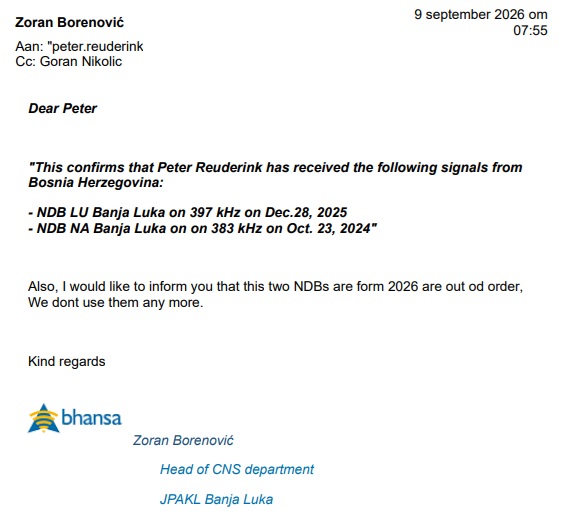
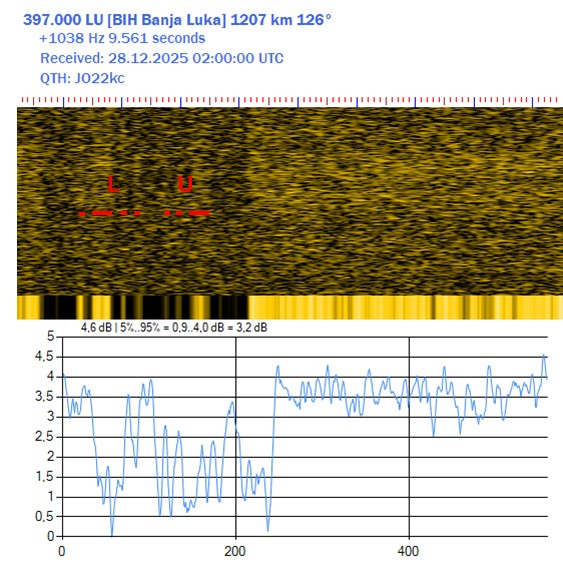
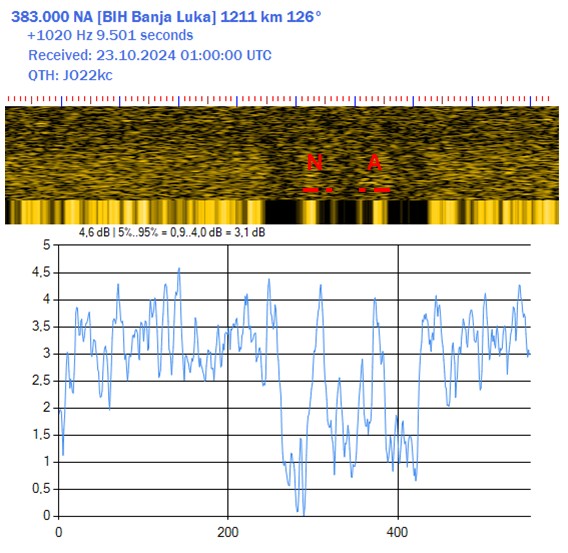
Of course I agreed, but I took the opportunity to ask Mr. Nikolic if he could confirm my reception of a number of beacons from Bosnia Herzegovina. My request was forwarded to Mr. Borenovic, Head of CNS department in Banja Luka. He confirmed my reception of beacons NDB LU on 397 kHz and NDB NA on 383 kHz. But also informed me that both beacons have been taken out of operation in 2026.
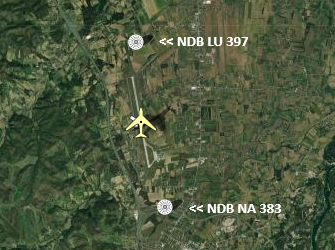
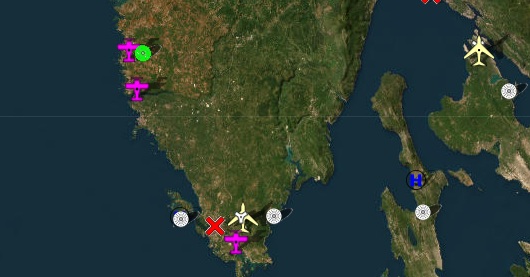
It is sad to see that this part of our radio hobby disappears as NDBs are replaced with more modern navigation systems. The picture below from OurAirports shows the position of these former beacons. Quite frankly I do think the exact location is a little bit more to the left, in line with the runway.
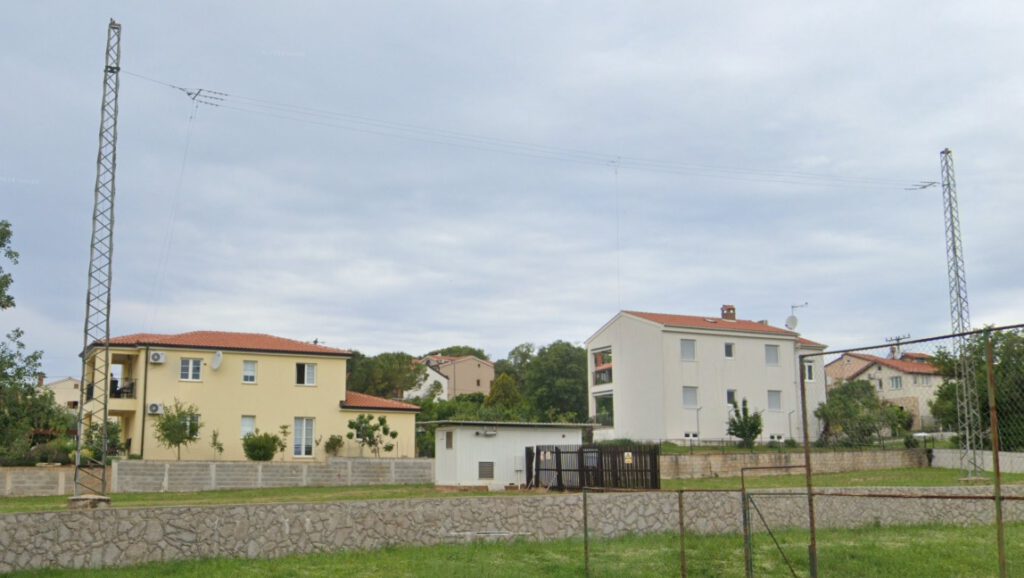
This is the equipment at the LU location as shown on Google Streetview:
Banja Luka International Airport (BNX), also known as Mahovljani Airport, began construction in 1976 as a secondary facility intended only for domestic flights within socialist Yugoslavia, and it saw little scheduled traffic even then. After the Bosnian War Banja Luka became the de facto capital of Republika Srpska, giving the airfield new political and practical weight; it opened to civilian traffic on 18 November 1997 and briefly served as the hub of the short-lived flag carrier Air Srpska (1999–2003).
Facilities were upgraded in 2002–2003 ahead of Pope John Paul II’s visit. For years passenger numbers remained modest, but the arrival of Ryanair in 2018 and Wizz Air in 2021 transformed it into a low-cost gateway. By 2025 it handled nearly 485,000 passengers, making it Republika Srpska’s only international airport and a vital link for Banja Luka—Bosnia and Herzegovina’s second-largest city—connecting the region to Belgrade and numerous European cities and supporting tourism, business, and the entity’s economic integration with the wider continent.
More info about the Republika Srpska can be found in my post on NDB BLK on 340 kHz.
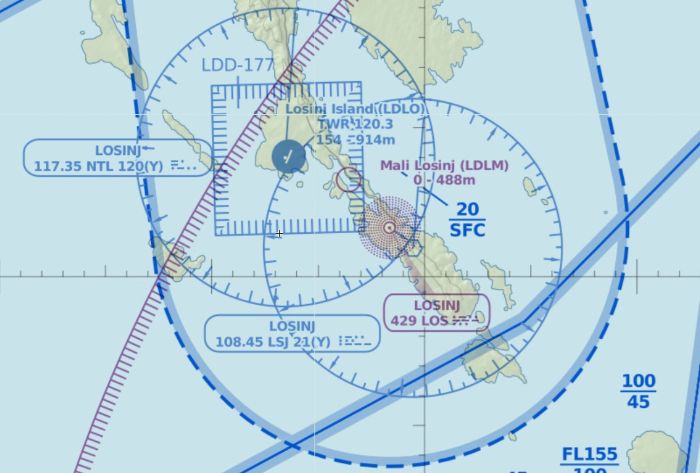
QSL for NDB LOS Losinj on 429 kHz. The beacon is associated with Losinj Airport in Croatia, a small airport, mainly in use for smaller private airplanes and taxi services. It is situated on Losinj Island, and definitely one of the easier to receive beacons here in the Netherlands.
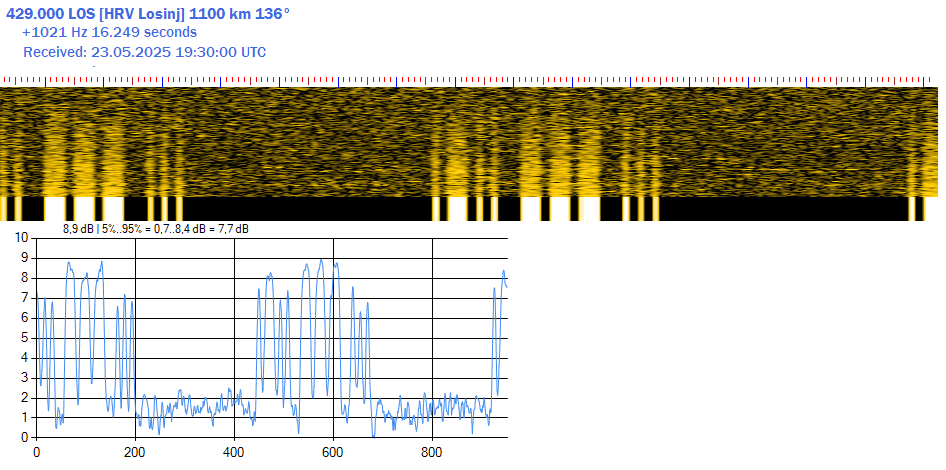
LOS Losinj is a pretty easy to catch NDB. Pskov recording.
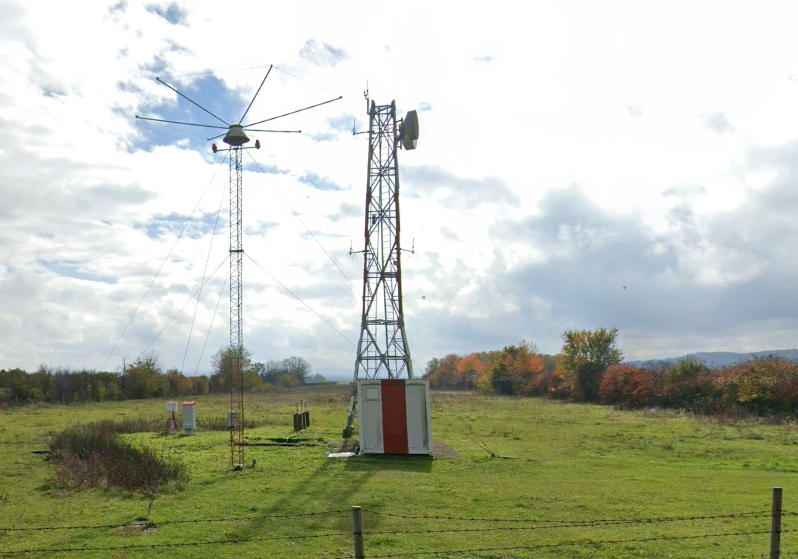
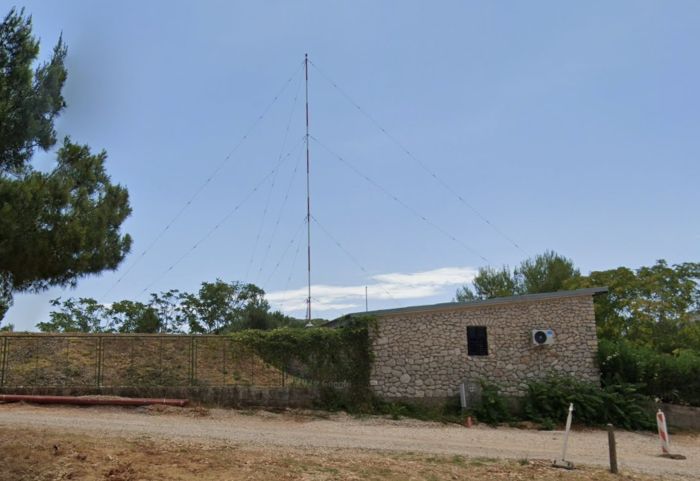
NDB LOS Losinj (c) Google Maps
NDB LOS Losinj (c) Skyvector
As with the other beacons from the Istria region my reception was confirmed by Mr. Birkić, head of Istria/Kvarner ATC at Croatia Control.
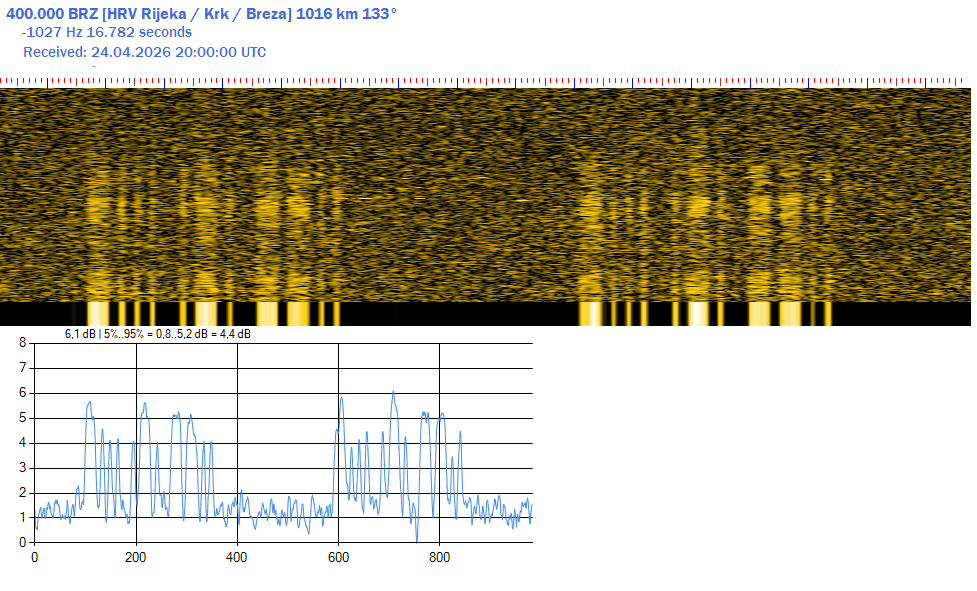
A QSL for NDB BRZ Breza, the “sister” beacon of NDB RI Rijeka. This approach and landing beacon is situated on the opposite end of the Rijeka Airport runway in Croatia. As with the other beacons in Istria such as NDB PLA and KAZ for Pula Airport, Mr. Birkić, head of Istria/Kvarner ATC was so kind to confirm my report.
Pskov recording of NDB BRZ Breza on 400 kHz
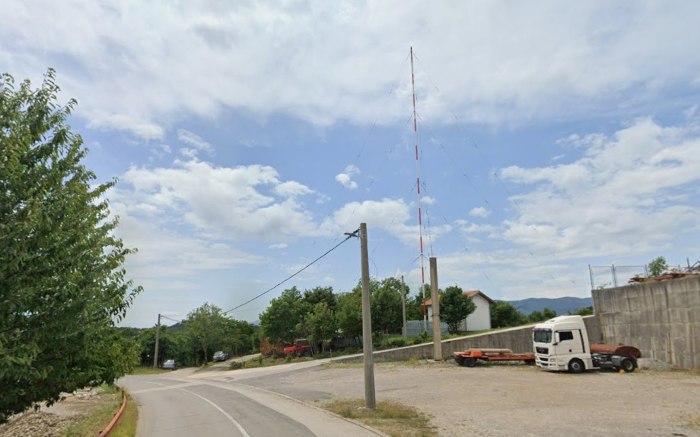
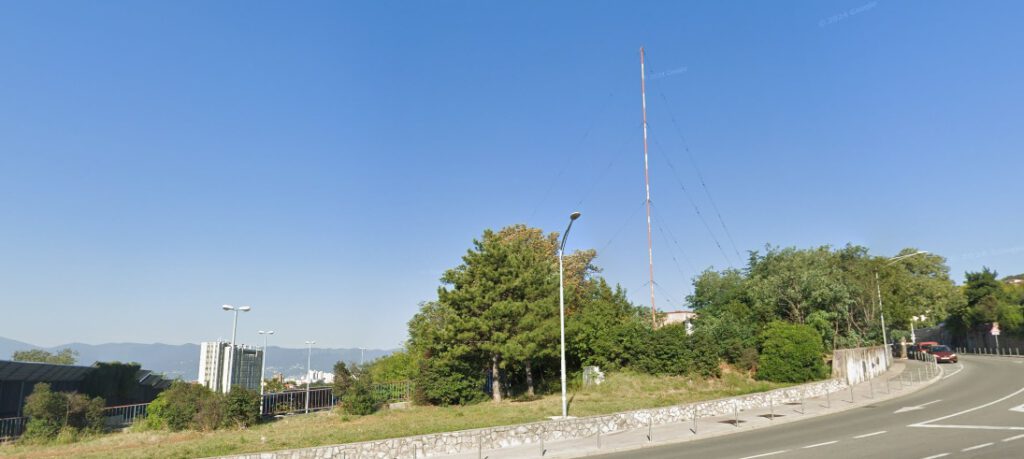
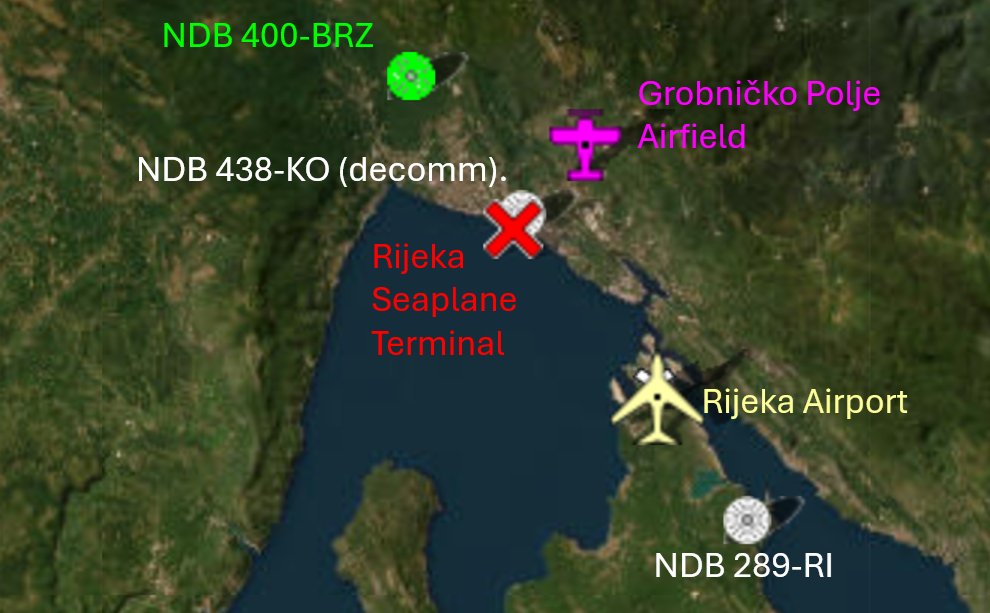
This beacon shows up nicely on Googlemaps, although somehow I initially made a mistake in identifying the proper location and posted the decommissioned NDB KO on 438 kHz. Thanks to Dominic for pointing this out in the comments!
NDB BRZ Breza for Rijeka, 400 kHz,
And this is the decommissioned NDB KO (was 438 kHz)
The various beacons and airports in the area (OurAirports).
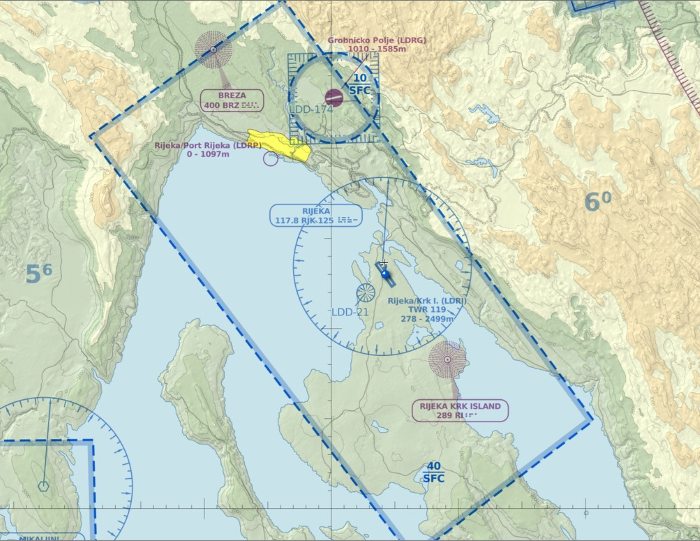
Rijeka Airport in Croatia has two approach and landing NDBs: NDB BRZ Breza to the north west and NDB RI Rijeka to the south east, as can been seen on the excellent Skyvector website.
As with the NDB PLA and KAZ for Pula Airport, Mr. Birkić, head of Istria/Kvarner ATC was so kind to confirm my report.
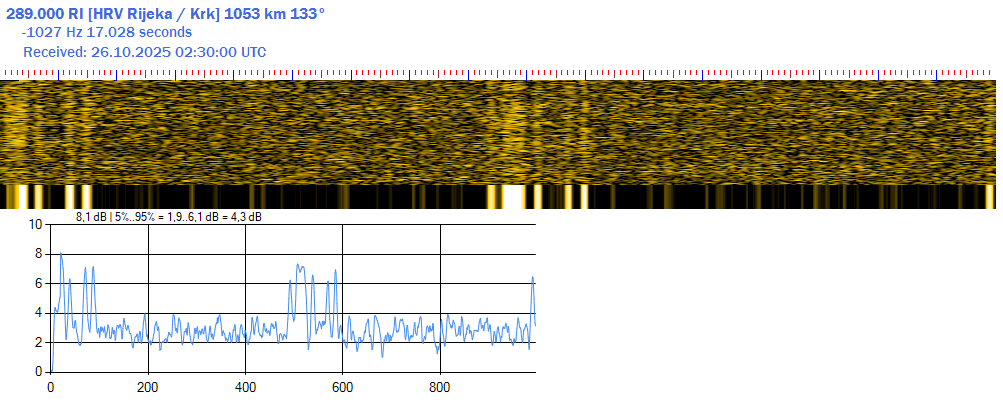
Pskov capture of NDB RI Rijeka 289 kHz
While the city of Rijeka is situated on the mainland of Croatia, the airport and NDB RI are located on the island Krk.
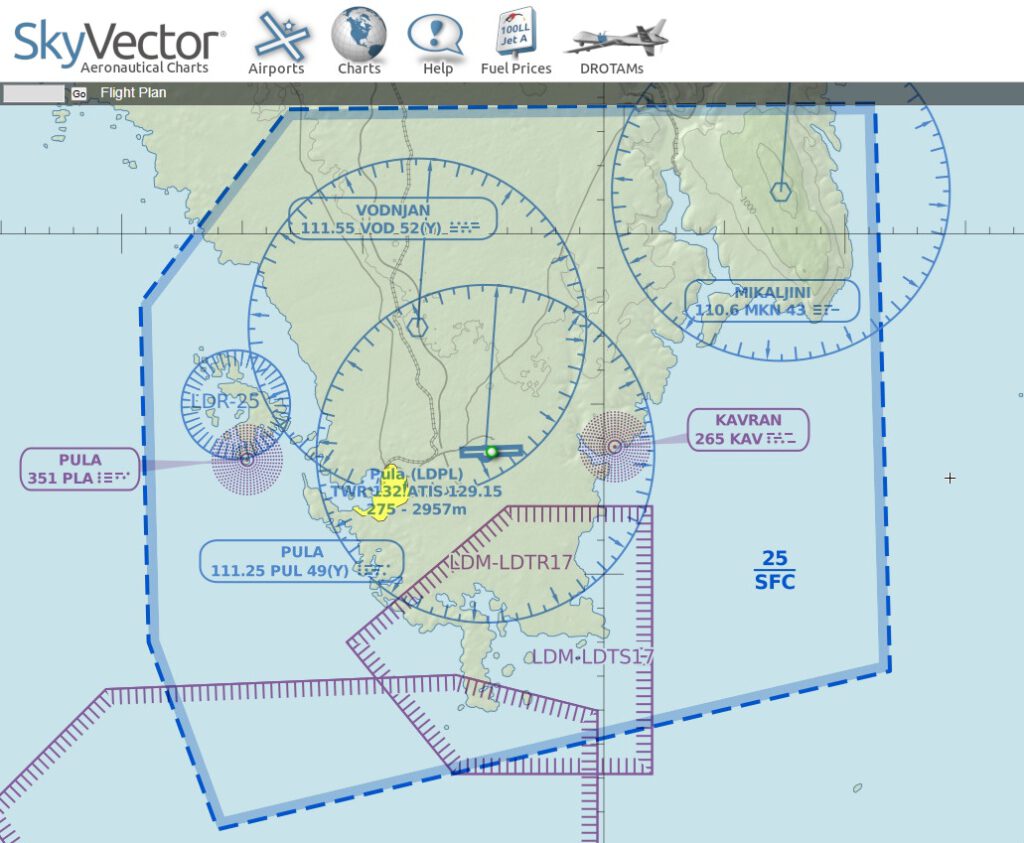
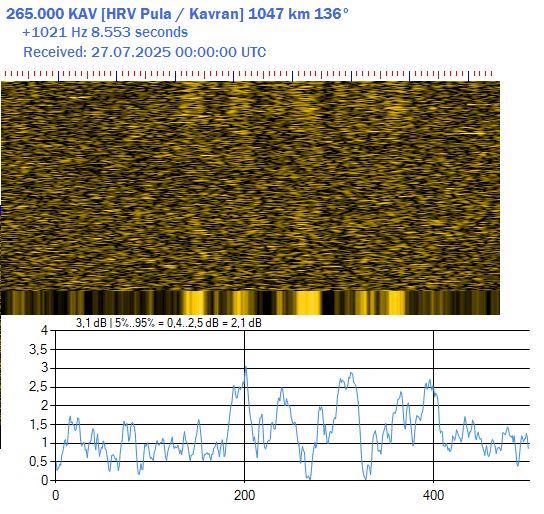
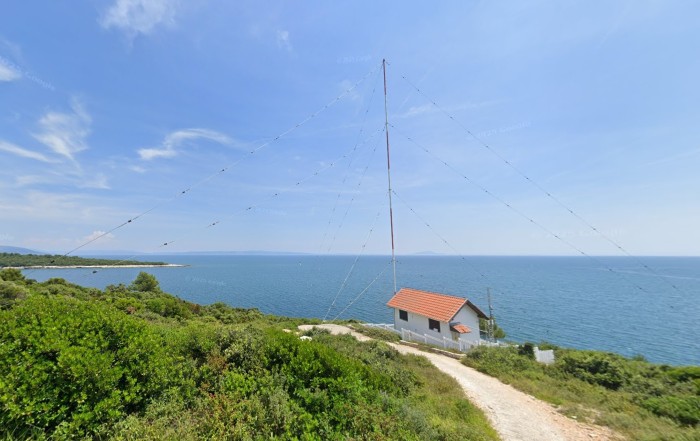
In addition to NDB PLA Pula I also received the NDB KAV on 265 kHz which is located east of the Pula runway as you can see on this Skyvector picture. Mr. Birkić, head of Istria/Kvarner ATC was so kind to confirm my report.
NDB 351-PLA west, and NDB 265-KAV east of the the Pula Airport runway.
The quality of my reception was not the best, but the picture below once again shows the power of the Pskov data analysis tool. For a few minutes the signal was OK, then it faded. But the aggregate was still quite strong (although the V was not as prominent as I would like to see).
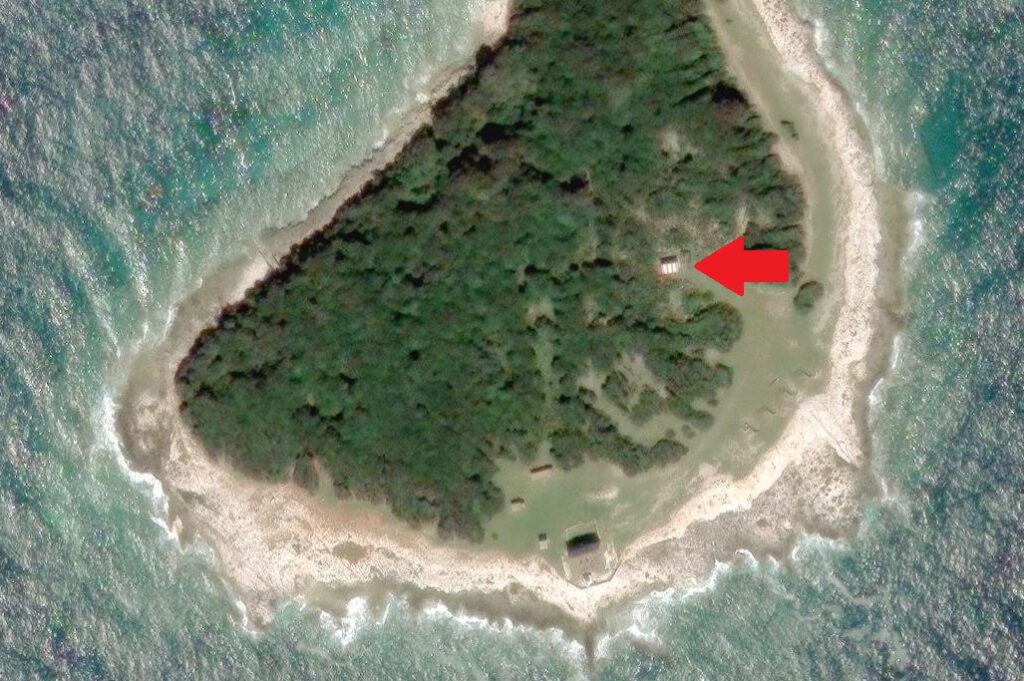
Receiving a beacon is one thing, I always like spot the location of the beacon using Googlemaps. Well this one is a beauty:
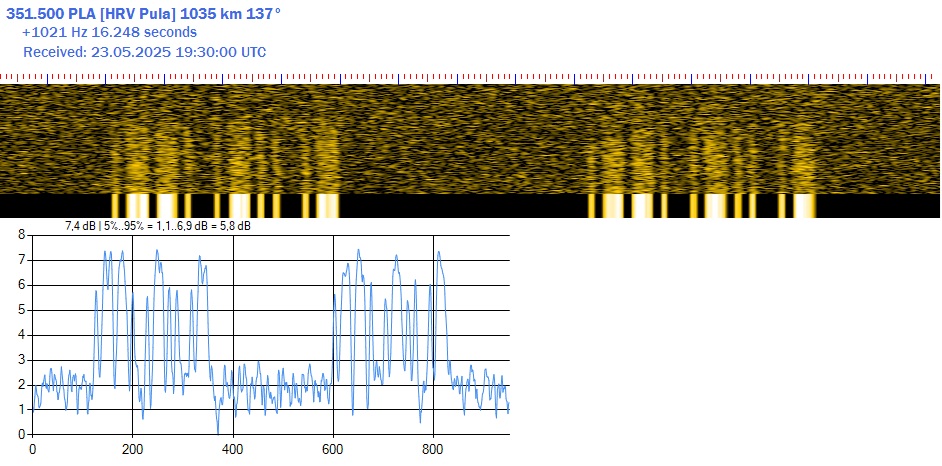
Quite a few people will know Pula as a favorite holiday destination. A 2500 year old city on the tip of the the Istria peninsula, Croatia. And as a holiday destination attracts traffic, Pula has it own airport. And as airports still have NDBs I was able to receive NDB PLA Pula on 351.5 kHz. Mr. Mario Birkić, head of Istria/Kvarner ATC was so kind to confirm my report.
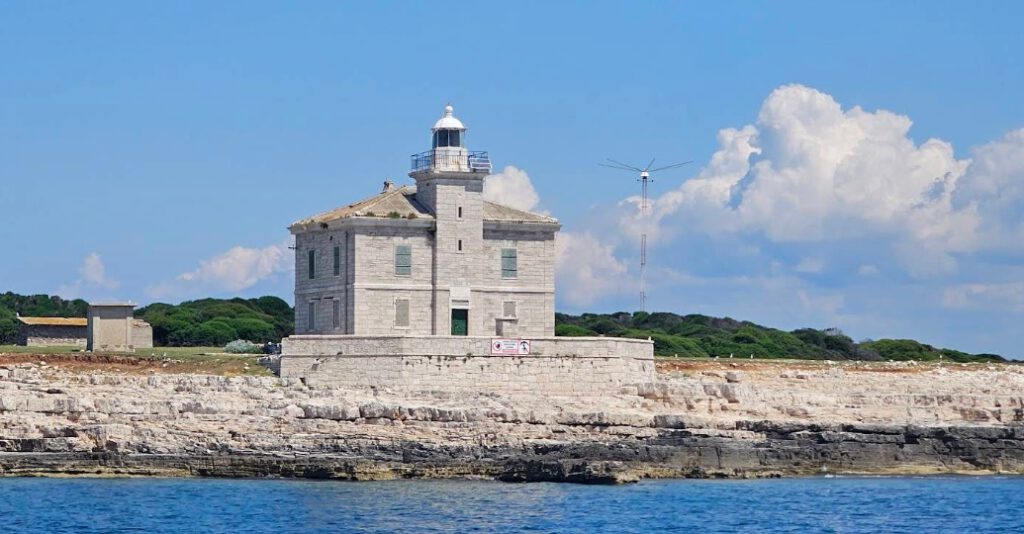
The PLA NDB is not located on the Istria Peninsula though, but on the largest of the Brioni Islands in the Adriatic.
Location of NDB PLA, Pula and Pula Airport (source: Skyvector).
Is the antenna behind the lighthouse the NDB PLA? Anyone?
Location of NDB PLA on Brioni Main Island (source: OurAirports)
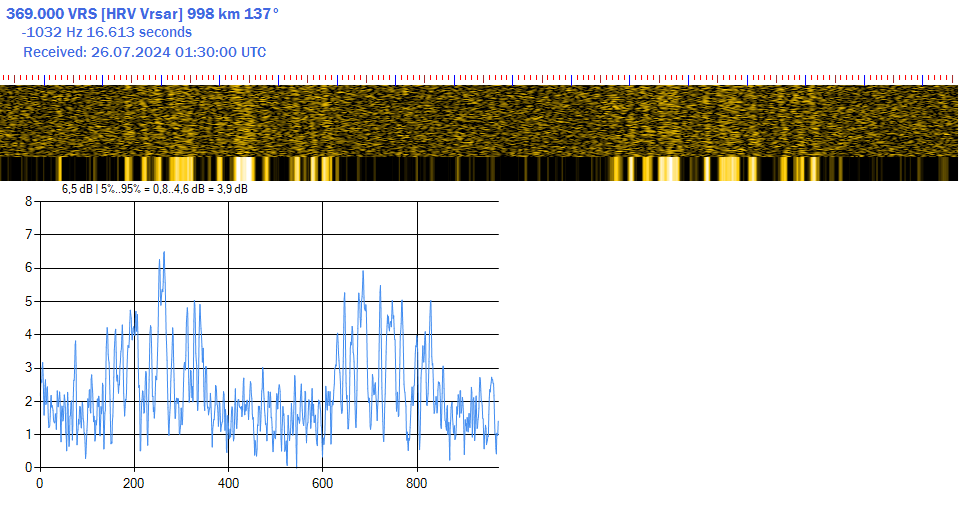
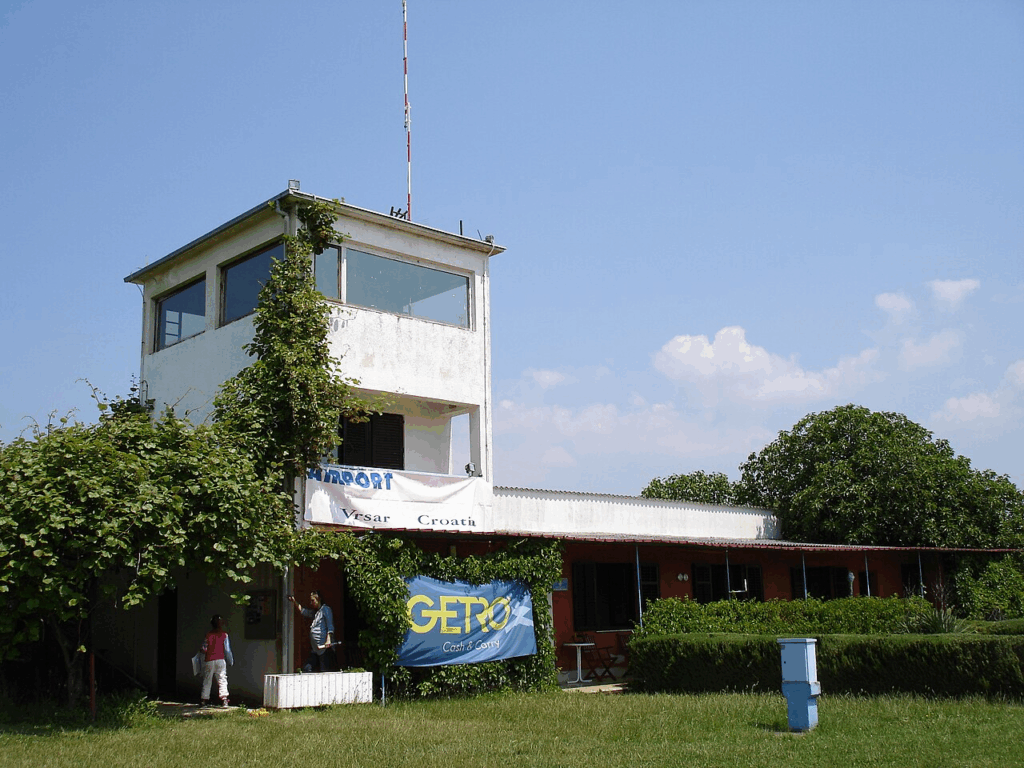
A QSL for NDB VRS Vrsar 369 kHz, Croatia. Unfortunately this beacon has been decommissioned. In 2023 I sent a reception report to Mr. Mario Birkić, head of Istria/Kvarner ATC for the reception of NDB CRE and NDB KO. In recent years I received 6 additional signals from beacons in the Istria region. One of the beacons I received in 2024 was VRS on 369 kHz:
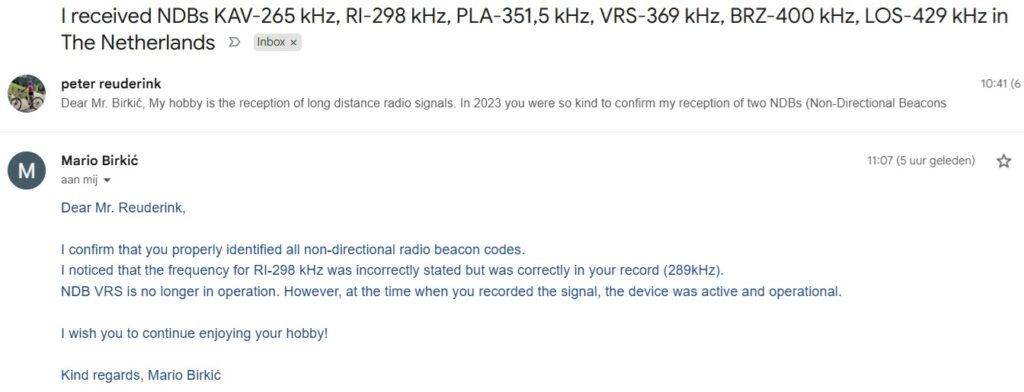
Mr. Mario Birkić was so kind to confirm my reception of these six beacons. He also mentioned that NDB VRS is decommissioned:
So this is another one that bites the dust. NDB KO on 438 kHz from my QSL request in 2023 isn’t active anymore as well.
The NBD io group organizes a Co-ordinated LIstening Event (CLE) every month. As a huge fan of something that is a bit of a contest, a bit of a personal challenge, I like these a lot. More importantly they help me to improve my set-up which is why I try to participate most months.
CLE’s always have a certain goal. In CLE299 for example, you had to pick an azimuth and try to receive as much beacons along that line. CLE311 required you had to “build a pyramid”. And CLE309 was all about logging up to 8 stations from each Maidenhead square. In this one, CLE327, the aim was to select 10 frequencies ahead of the event and then log as much beacons as possible.
So the making the right selection was critical. Obviously you do that by checking on which frequency you logged the largest number of different beacons in the past, ideally beacons that you have a fair change of logging again. But I just moved to a new QTH, and worse, I only have a loop pointing 90/270 degrees at my disposal, whereas in the past I switched antenna directions for an optimal result.
My Results
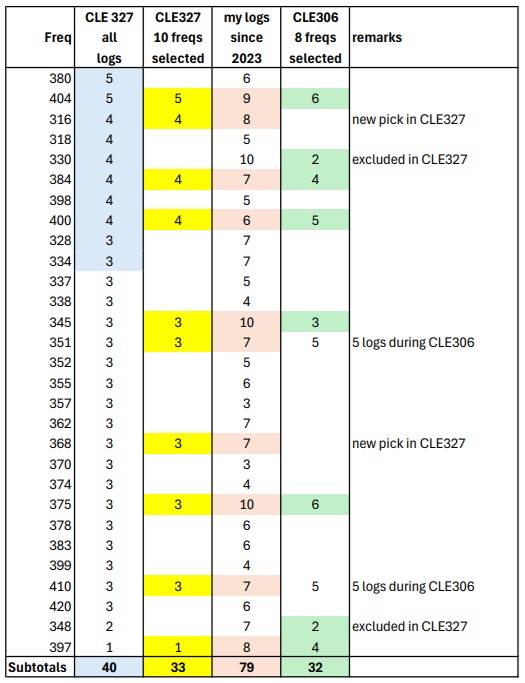
But hey… all for the fun of it. In the table below you can see my selection and my results. Now I can only receive these weak signals at my noisy QTH using Pskov, a software tool that basically tries to detect cyclic signals. If it recognizes one, it cuts an SDR recording (I used recordings of an hour) in pieces of exactly that cycle length and stacks them on top of one another to improve S/N ratio. To limit the amount of data processing I listened between 299 and 420 kHz only.
The previous event of a similar nature was CLE306 two years ago when the aim was to log as many NDBs on 8 preselected frequencies. Quite a few NDBs closed down since, so we were allowed to pick 10 frequencies this time. But obviously the CLE306 results provided a good starting point.
As you can see in the table above I managed to log 32 stations in CLE306. Based on my results I made the following selection for the new event: – Two frequencies, 348 and 330 disappointed me in CLE306 big time. So I excluded them for CLE327. – Two frequencies, 351 and 410 were not selected in CLE306, but during that event I logged 5 NDBs. So I included them in CLE327. – And to bring the selection to 10 frequencies I added 316 and 368 as I logged quite a few NDBs on these frequencies in the past.
Again, note that the number of logs in the past are not the only number to go by. Some logs are really rare or once off UNIDs. Some NDBs are located at a larger distances to the north or south, which given high solar activity right now or my limitations with the antenna orientation might provide a difficult catch.
My result in CLE327 was 33 beacons in total. With 3.3 NDBs per frequency quite a bit lower than in CLE306 which resulted in 4 NDBs per frequency. Conditions in that one, which was held in July, were not much better, so I blame my fixed antenna direction for that.
In hindsight, if I had picked the right frequencies, I could have scored 40. So the selection was not too bad. My newly selected 397 let me down with only one log for unknown reasons. Conditions to the Balkan were not bad, as were conditions to the UK and south of France. Maybe I should replace it with 380 next time.
For reference: the average score for participants from Europe was 43, with the top dog scoring 65!
A nice suprise from Iran
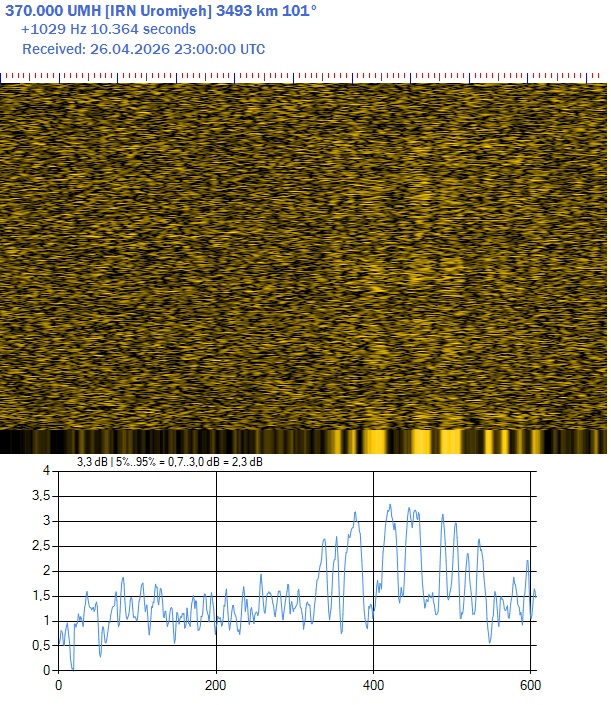
And to finish it off. During the event I received this nice signal from Iran. NDB Uromiyeh, almost 3500 km distance:
BDXC : SWL 2262 PRe VERON : NL 14228 If you want to get in touch, just leave a message on one of my posts. Please note that I don't publish email addresses of verifiers which are not part of the public domain. So if you don't see the QSL address, just leave a message and I'll get back to you.
This is just a hobby site. Feel free to copy anything on my weblog. A link back to my site is appreciated when you do so. I try to provide accurate information, but if I'm wrong: don't blame me! I'm also not responsible for the use of sites I provide links to. I try to respect copyright rules, but should you think I made an infringement: just let me know via a message on the corresponding post and I will act accordingly.