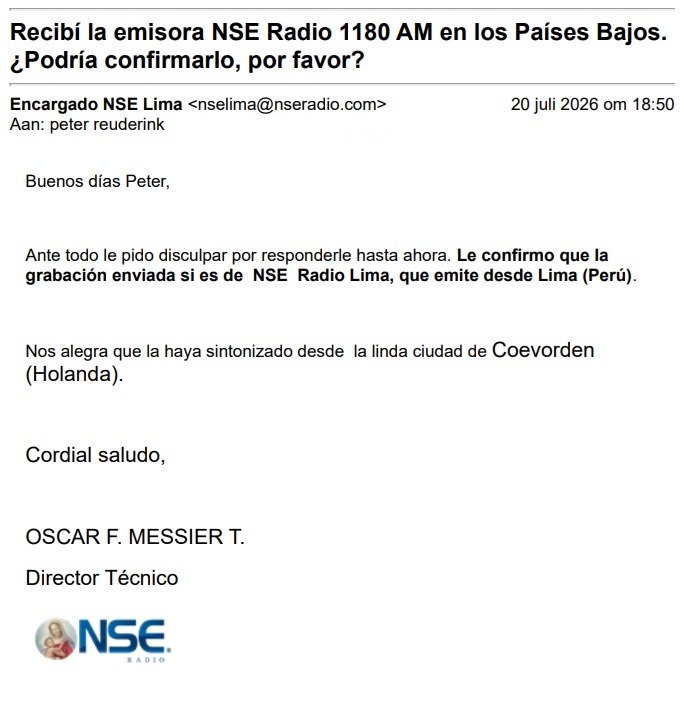
A QSL for my reception of NSE Radio from Lima, Peru, broadcasting on 1180 kHz mediumwave.
Reception quality was poor. With good DX ears the ID is recognizable in the first clip at 4 seconds: “NSE Radio…”.
The second clip features a female voice with messages and a typical tune in the background. It sounds very familiar, I think it was in one of my childhood piano lessons, but can’t find the tune anymore. Anyone?
NSE is an abbreviation of Nuestra Señora del Encuentro con Dios. Broadcasting on 1180 AM from Lima, Peru, this Catholic station is part of the broader NSE Radio and TV network dedicated to evangelization. The underlying Marian devotion and apostolic works trace their inspiration to Father Rodrigo Molina, with the title “Nuestra Señora del Encuentro con Dios” emerging around 1994 in Spain; the media ministry itself has more than 20–30 years of experience and has expanded across Peru (including stations in Arequipa and Cusco) as well as to other Spanish-speaking countries such as Chile, Argentina, Colombia, and beyond, while also producing content shared with partners like EWTN, Radio Católica Mundial, and Vatican Radio.
The Lima AM outlet (historically noted at around 10 kW) serves as a key production and live-broadcast hub, airing 24-hour programming that emphasizes religious teaching, spiritual formation, evangelization, sacred and other music, news, cultural and educational content, and special live coverage of papal events, all aimed at drawing listeners closer to God through Mary in accordance with Catholic Scripture and Tradition, largely sustained by volunteer efforts.
On June 19th I received COPE Lugo broadcasting a message inviting listeners to switch to 90.0 FM if they wanted to continue to listen to COPE. So another one bites the dust…
Below my recording of their announcement which is somewhat compromised due to heavy thunderstorms as well as the fact that my loop is in a fixed 90/270 degrees position.
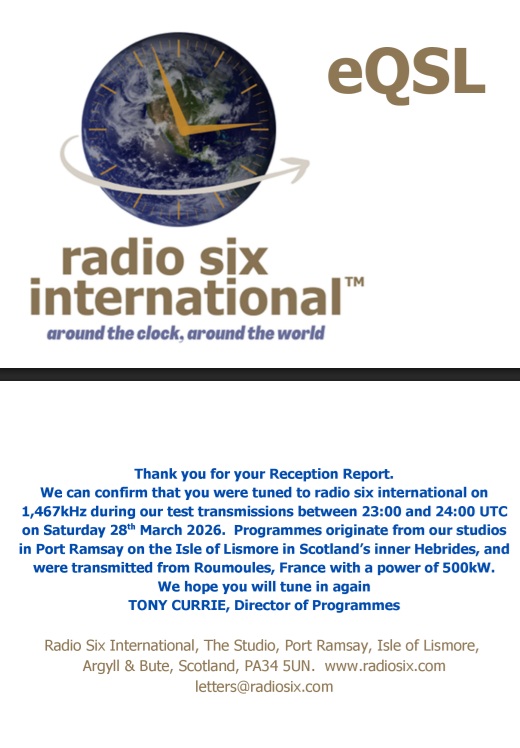
With 1000 kW the Roumoules transmitter is one of the most powerful mediumwave transmitters in the world. Built in 1987 it served Radio Monte Carlo broadcasts until March, 2020. The antennas are located in France, but the frequency is assigned to Monaco.
The religious broadcaster TWR has always used Radio Monte Carlo facilities, and since 1987 they also used Roumoules. And they continued doing so even when RMC seized their operations.
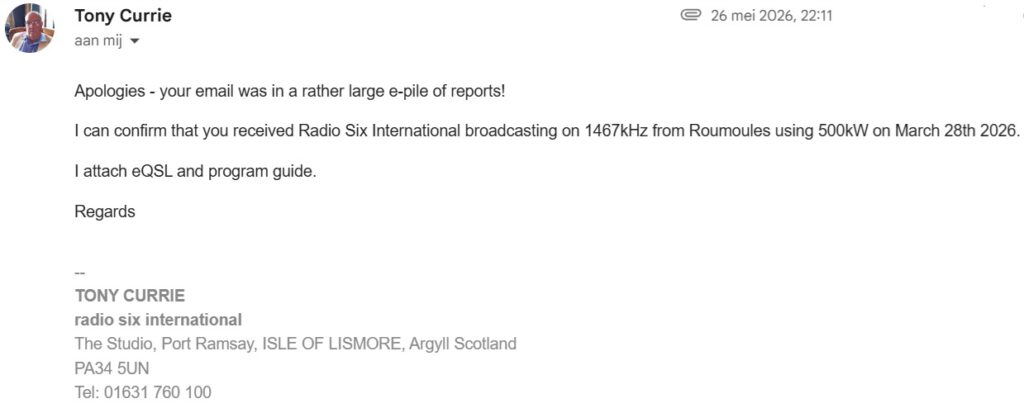
Since March 2026 the Roumoules facility has been made available to other parties. Radio Six was one of the first to launch a program “Midnight Rendezvous” and they were so friendly to QSL my reception report.
Below the recording I made of the program opening. Quality might be a bit compromised as my MW loop antenna had a fixed direction 90/270 degrees which I couldn’t change.
Radio De Vliegende Hollander (“The Flying Dutchman”) from Meppel, The Netherlands, can be heard quite well here in Coevorden on 1467 kHz. No surprise as the distance is only 37 kilometers. This LPAM station is broadcasting with 50 Watts, slightly lower than most Dutch LPAMs. At my previous QTH in Woerden I was never able to receive this station, as Radio Paradijs from nearby Utrecht was dominant. The first time I heard this station was on a clip my friend Arild Skalmeraas sent me to help with the station identification. Which means that Radio Vliegende Hollander already made it to Norway!
In the audioclip below you can hear the Radio Paradijs ID at 14 seconds, and much louder, the Radio De Vliegende Hollander ID at 22 seconds: “Dit is Radio de Vliegende Hollander, AM 1467 kHz, vanuit Nederland. Wil je meer informatie over ons, surf dan naar www.radiodevliegendehollander.nl . Radio de Vliegende Hollander te horen op AM, 1467 kHz, vanuit Meppel brengen we je het laatste nieuws”
Radio De Vliegende Hollander ID
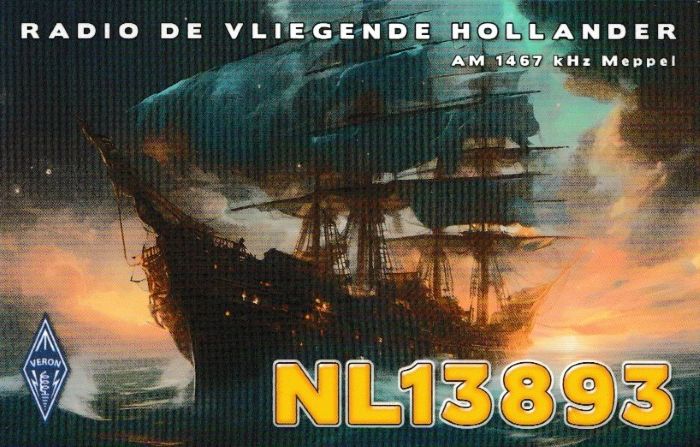
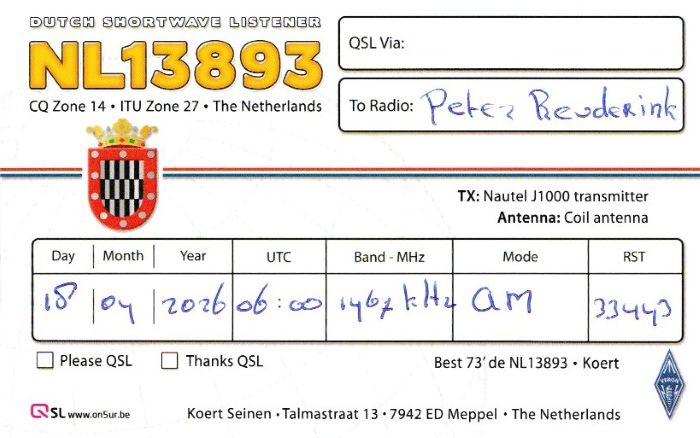
My reception report sent to 1467am(at)radiodevliegendehollander.nl was answered by Koert who is the station owner. Koert happens to be a member of the VERON as well as the Benelux DX Club, just as I am. And therefore maybe no surprise that reception reports are awarded with a beautiful old school QSL card. Big thanks to Koert!
Old school QSL card from Radio De Vliegende Hollander (which is Dutch for Flying Dutchman)
Fully detailed QSL card for Radio De Vliegende Hollander
DX-ing mediumwave pirates is nice because sometimes you have email correspondence with fellow radio enthusiasts. I received Radio Turftrekker on 1638 kHz. Operator Jeroen wrote that he was ‘spoon-fed’ with mediumwave pirate radio as his father is also a mediumwave pirate. As a small child, he was listened in. Occasionally he was allowed to say something on the radio.
But it is also nice because some of the station names used remind you of the heritage of the Netherlands. Radio Markies is an example. And so is Radio Turftrekker. While the next paragraphs are not really about radio or DX, I just enjoyed writing them. Skip it if you want, but if you like it, please leave a comment!
About the name of Radio Turftrekker
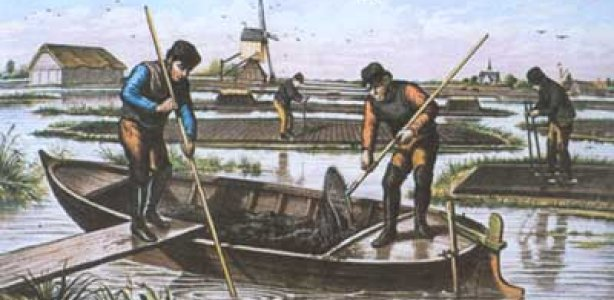
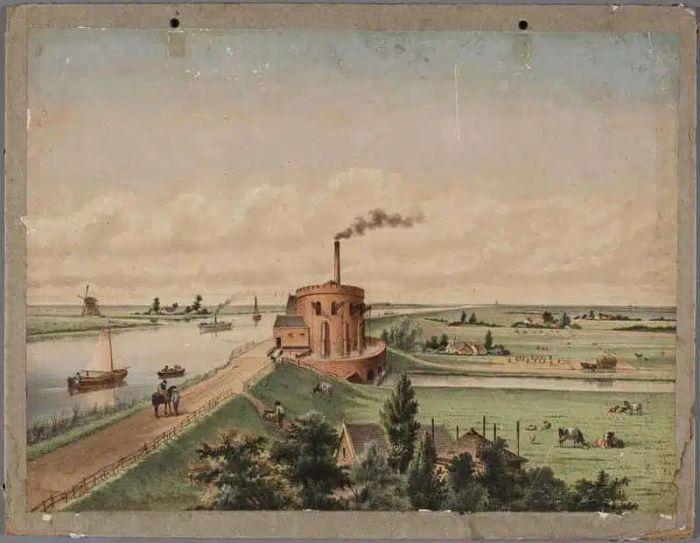
A “Turftrekker” or “Peat Puller” was a worker that extracted peat using a scoop with a net attached. Peat was used as a fuel to heat houses before we switched to coal (and Holland what late in doing so). However, with the peat being extracted, deep pools of water formed in Holland.
“God created the earth, except for the Netherlands, for the Dutch did that themselves” is a well-known Dutch saying referring to the polders and reclaimed lands. But what is often forgotten is that the same Dutch first lost almost half their country due to peat extraction.
“Turftrekkers” extracting peat. A picture from 1895 used in schools.
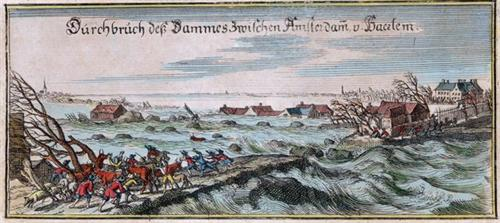
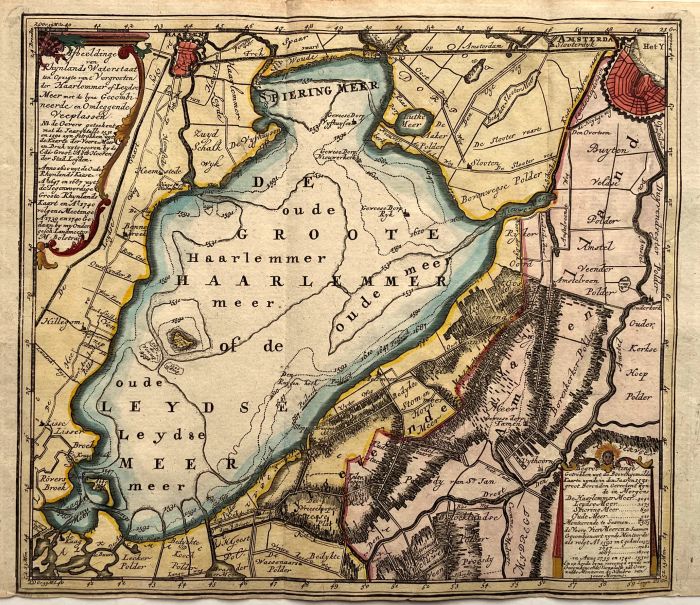
The prime example is the Haarlemmermeer (Haarlem Lake), the polder in which Schiphol (Amsterdam International) Airport is situated today. In the Middle Ages four lakes were formed as a result of peat reclaiming. Additional illegal reclaiming and storms resulted in the collapse of dikes, allowing the lakes to merge into what became the Haarlemmermeer. That lake was so large that it became an inland sea, and with southwesterly storms, it expanded ever further in the direction of Amsterdam.
The collapse of the dike between Amsterdam and Haarlem
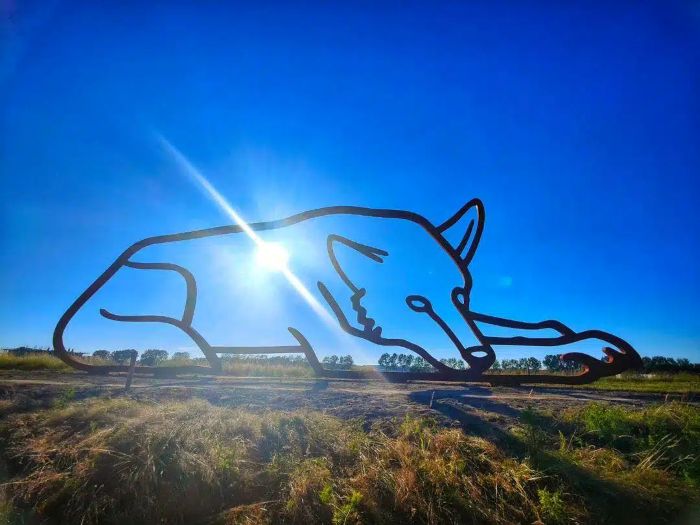
The Haarlemmermeer acquired the nickname “Waterwolf” as the water consumed more and more land. A beautiful artwork created in 2024 visualizes this. The Waterwolf seems to be at rest in this statue, as is the Haarlemmermeer.
The “Water Wolf” statue in the Haarlemmermeer. Finally at rest after 4 centuries.
Plans were made to reclaim the Haarlemmermeer as early as the 18th century. However, by then the lake was too large to be drained with windmill technology applied in the Beemster, Wormer, and Schermer polders. And so nothing could be done and devastating storms in 1836 caused parts of Leiden and Amsterdam to flood.
The Haarlmemermeer in 1740, top left the city of Haarlem, top right Amsterdam
But fortunately there was the introduction of the steam engine. In May 1840, thousands of laborers began digging a 60-kilometer-long ring canal and constructing a ring dike with shovels and spades. Three steam pumping stations were built: De Leeghwater, De Cruquius, and De Lynden. On July 1, 1852, the Haarlemmermeer was completely drained, and the development and parcelling of the more than 18,500 hectares of new land could begin.
One of the steam engines draining the Haarlemmermeer
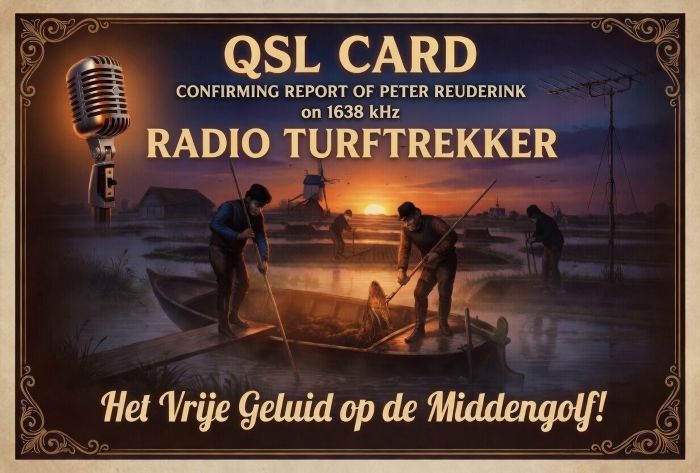
Back to Radio “Turftrekker”. Jeroen mentioned he didn’t have a QSL card. I proposed this design based on the school picture shown above. What do you think?
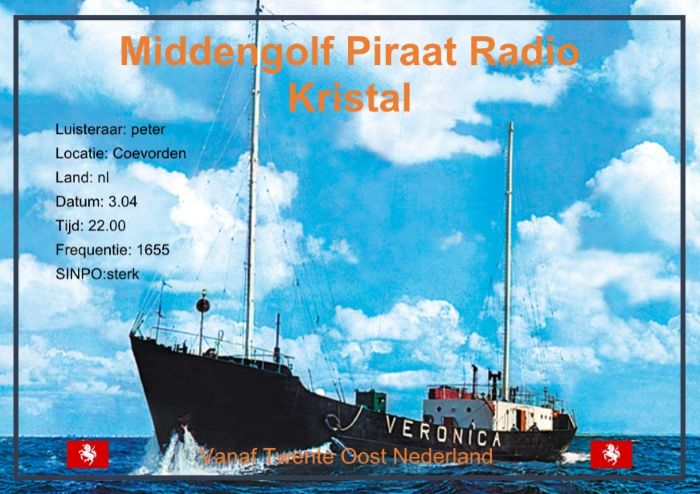
During the Pirate Hunt 2026 event I was able to log Radio Kristal, broadcasting from Twente, East Netherlands on 1655 kHz.
Operator Jan confirmed my reception with a nice eQSL featuring the offshore radiostation Veronica. The station I grew up with as a child.
Radio Kristal works with a tube transmitter and inverted V antenna. Jan mentioned that he is active for 47 years on AM and his station has been raided by the “Radiocontroledienst” (the authorities) twice.
ZoomRock FM is a new station broadcasting with 730 Watts only on 1242 kHz from Turku, Finland. Despite the fact that the provisional loop antenna that I use at our temporary house is directed east/west, which is not optimal, I was able to receive this station in the first two weeks of April, identify a couple of songs and record an ID. Harri was so kind to reward my reception with a nice QSL. The station shares the frequency with the 200 kW strong Radio Sultanate of Oman. But after 2h UTC that station (listed 24h) is either off air or fades out (I don’t know). Between 2h and 2:30 h UTC ZoomRock FM is audible.
Below a MP3 clip with the “bassy” ZoomRock FM station ID. Poor reception quality. If you want to hear a better recording, you can find one at Hugo Matten’s site.
I had a nice email conversation with Harri, the man behind ZoomRock FM. He told me that he received 130 reports, my report was the 2nd from The Netherlands. On the Facebook page Harri shows his equipment. A neat transmitter, but also an impressive antenna set up as he is apparently allowed to hook up his 2×58 m dipole to a commercial antenna tower.
ZoomRock FM transmitter
ZoomRock FM dipole antenna
It also turns out that Harri is an avid DX-er. Using two virtual SDRs he is trying to receive Transatlantic FM signals. Two YouTube videos show the locations and the stunning scenery:
Another catch during the Pirate Hunt 2026 held in the Easter weekend was Radio Alabama on 1620 kHz. Manfred from Radio Alabama was so kind to confirm my request with a kind email. He mentioned that he is broadcasting from the Netherlands with a staggering 2000 Watt homemade mosfet transmitter. But I’m afraid his location is on my null of the loop, and his antenna set-up might imply I’m a little bit in the dead zone.
And no the logo above is not the one from Free Radio Alabama. But I liked it a lot.
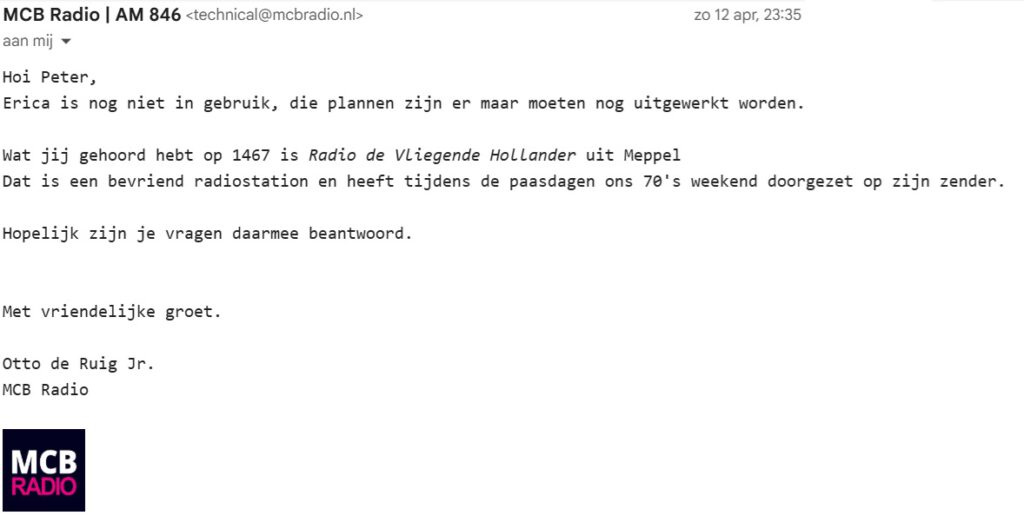
During the Easter weekend I received a program of MCB Radio on 1467 kHz. I was quite surprised about this, as I had MCB, and LPAM from the Netherlands, listed on 846 kHz only.
So I sent a report to MCB and Otto from their technical department was so kind to confirm my reception as well as the answer to my question: the MCB program was relayed by Radio Vliegende Hollander from Meppel, The Netherlands, which makes sense as this is only 37 kms from my current QTH in Coevorden.
Below the audioclip of the Easter program I received, with the clear ID “De grootste hits uit de jaren 70… dit is het 70ies weekend op MCB… 1974!”
Radio Caroline North was live from the Ross Revenge with an Easter special. I received them broadcasting via the 648 kHz 4 kW transmitter in Orfordness, United Kingdom. Despite the fact that I’m now living further away from the sea the reception quality was excellent, even during the day.
My report sent to north(at)radiocaroline.co.uk was confirmed by Alan:
Hello Peter,
Thank you for your report which has reached me. I can confirm that you have indeed received Radio Caroline North, live from the Ross Revenge, via 4G link, on 648Khz AM, April 4th 2026, at 14.31 hours. I’m often in Harlingen in Friesland so am familiar with how strong the signal is on the east coast of the North Netherlands, so good to know you get a good signal in the East towards the border. Hope you have enjoyed this weekends special programmes.
Regards, Alan
Their next program from the Ross Revenge is scheduled for 9-10th May. More info on their website.
BDXC : SWL 2262 PRe VERON : NL 14228 If you want to get in touch, just leave a message on one of my posts. Please note that I don't publish email addresses of verifiers which are not part of the public domain. So if you don't see the QSL address, just leave a message and I'll get back to you.
This is just a hobby site. Feel free to copy anything on my weblog. A link back to my site is appreciated when you do so. I try to provide accurate information, but if I'm wrong: don't blame me! I'm also not responsible for the use of sites I provide links to. I try to respect copyright rules, but should you think I made an infringement: just let me know via a message on the corresponding post and I will act accordingly.