The Woofferton shortwave station will celebrate its 80th birthday on October 17, 2023. The Mayor of Leominster and the Deputy Mayor of Ludlow will join other dignitaries at a special event in Woofferton to mark the occasion. The transmitter facility was built by the BBC during the Second World War to accommodate additional shortwave transmitters. When the station officially began broadcasting on October 17, 1943, it had six 50 kW RCA transmitters, acquired through a loan-lease agreement. The station has been modernized several times over the years and is now DRM (Digital Radio Mondiale) capable and offers daily digital radio programs. There will be a special program on shortwave (and other platforms) for the birthday on October 17, 2023: 1:30 p.m. – 2:30 p.m. UTC:
Transmitter 95 Marconi BD272 from 1963: 15245 kHz (250 kW, 294°) towards North America
Transmitter 96 RIZ: 17785 kHz (250 kW kW, 114°) towards Europe
Transmitter 92 RIZ: 11725 kHz-DRM (110 kW DRM, 114°) towards Europe
The program details the history of the broadcasting facility, which was used not only for the BBC and then the Voice of America, but for numerous other foreign services. Station employees will have their say about the history and present of the broadcasting system. QSL hunters can apply for an E-QSL by submitting meaningful reception reports to radio @ encompass.tv. There is even a raffle. (Dave Porter via Alan Pennington/Wolfgang Büschel)
I was not very active blogging I have to admit. Following the developments in Israel my mind is elsewhere, and I still find it difficult to focus my mind on pulling “difficult to read” radio signals out of my SDR IQ recordings…
I’m still monitoring the waves, and the computer picked up some signals from two countries under attack…
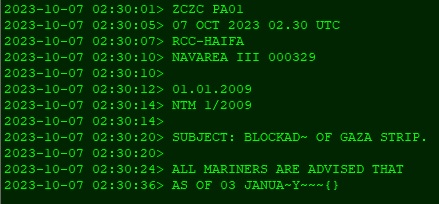
On October 7th I picked up this NAVTEX signal on 518 kHz from Haifa Radio, Israel, mentioning the blockade of the Gaza strip. As the message states “as of 03 January” I do believe that this is not related to the current war, but to a blockade that has been established earlier.
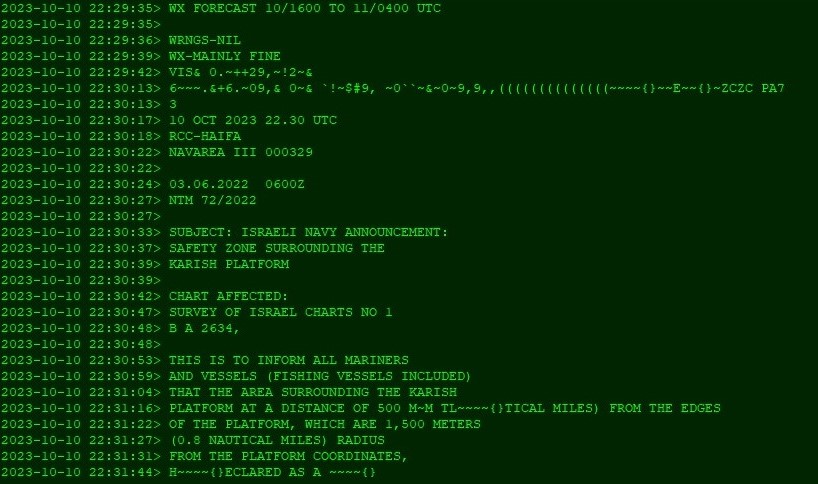
On October 10th I picked up another message. This one contains an Israeli Navy annoucnement about a safety zone around the Karish platform.
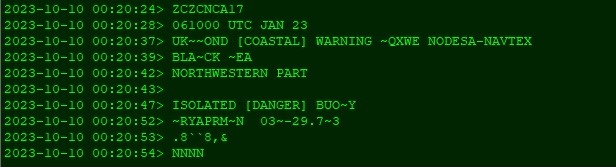
Another station that I didn’t receive for a while is Odesa Radio, Ukraine. I see a couple of warnings about drifting buoys in the Black Sea… probably nothing out of the ordinary, while buoys are there for safety they often break loose and appear in messages like this.
Forty years ago I received a QSL for the non-directional beacon LJS on Bjørnøya or Bear Island. Administratively Bjørnøya is part of Svalbard or Spitsbergen, a territory of Norway. Given its remote location Spitsbergen (including Bear Island) is a separate radio country according to the EDXC list. I somehow assumed that there was no NDB active anymore on the island. But last week I received a beacon BJO on 316 kHz and learned that its location is Bjørnøya.
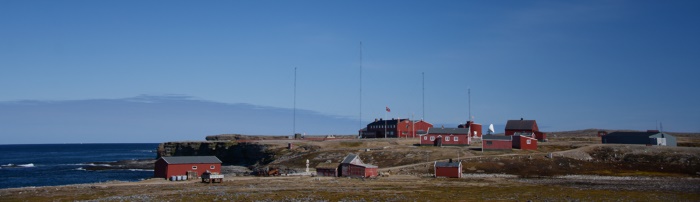
The maritime radio station Bjørnøya Radio closed in 1996 when – like so many other stations – the station was converted to remote operation from the Kystradio Nord center. But the Bjørnøya Meteorological Station is still staffed, one of the reasons being that a couple of times per day weather balloons have to be launched.
Bjørnøya Meteorological Station (photo: https://bjornoya.org/)
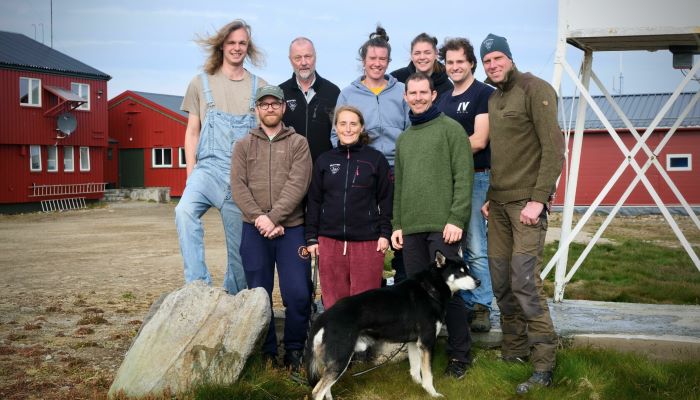
I decided to give it a try, and emailed the Meteo station to find out if they knew about the beacon and could confirm my reception report. Within hours I got a reply from Lisanne… in Dutch! Lisanne is one of two Dutch people in a team of 9 persons that run the Meteo station. They are on duty from June to December when they will be relieved by the next team. Lisanne is trained as meteorologist and it is her 2nd stint on the island.
The team of 9 people on Bjørnøya Meteorological Station. Lisanne in the center, wearing a light blue jacket.
Lisanne wrote that although Bjørnøya Radio is closed, they still transmit a weather bulletin twice a day (10:05 h UTC and 22:05 h UTC) on 1757 kHz. It is preceded by an announcement on 2182 kHz. Lisanne shared this nice Facebook movie about it. But she told me also that they did not send a signal with call sign BJO. There is an amateur radio at the station for visiting amateurs, but that one hadn’t been used either in the past year.
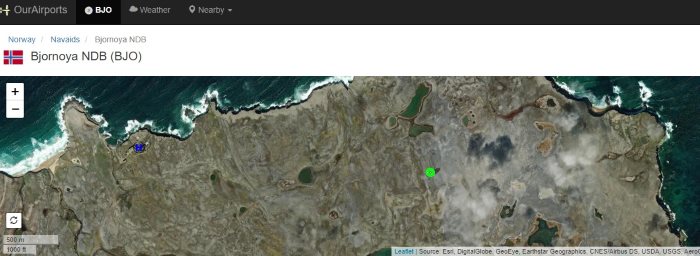
Bjørnøya Meteorological Station (blue H marks their Heliport) and the location of NDB BJO (green dot)
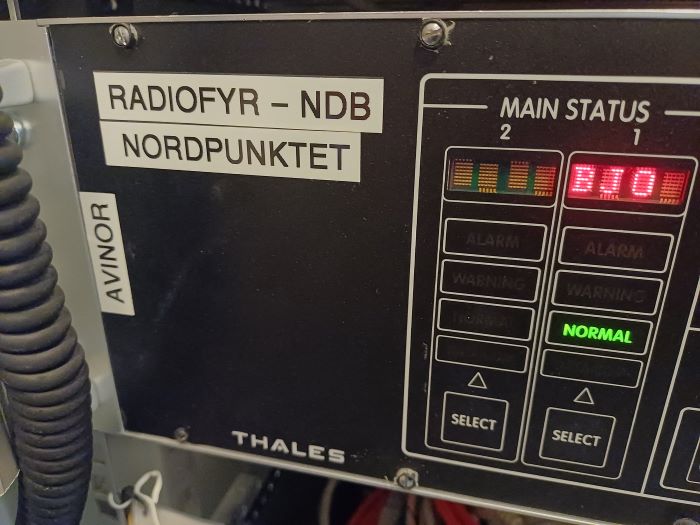
I thanked Lisanne for the nice picture and the reply. And explained to her that the transmitter/antenna I was looking for was probably close to the station and the nearby heliport. A day later another email came in. Over coffee she had raised my question again and with the help of the airports.com site learned that a few kilometers to the east, on the so-called Nordpunktet (North Point) there was an antenna and a little cabin which housed the NDB transmitter. I got a couple of nice photo’s as well.
The fuse cabinet of the Thales NDB transmitter is located in the Meteo Station itself
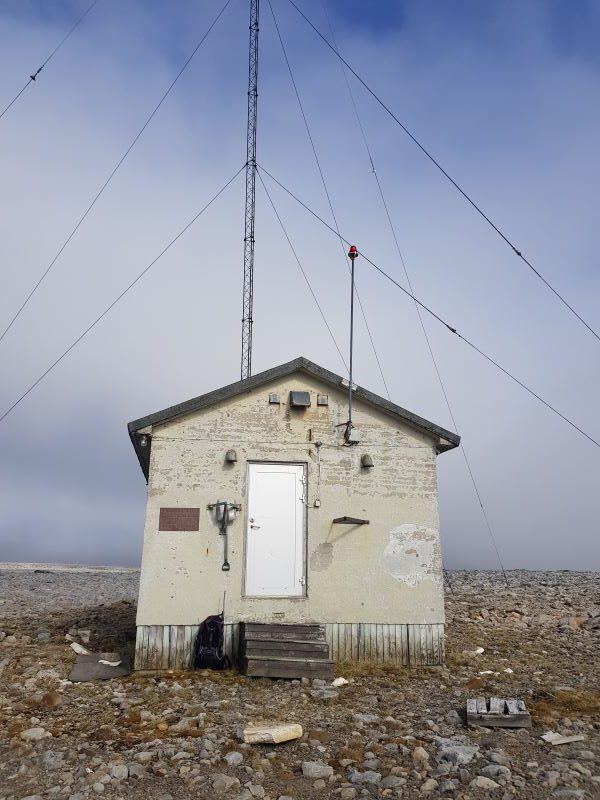
The little cabin housing NDB transmitter BJO and the antenna
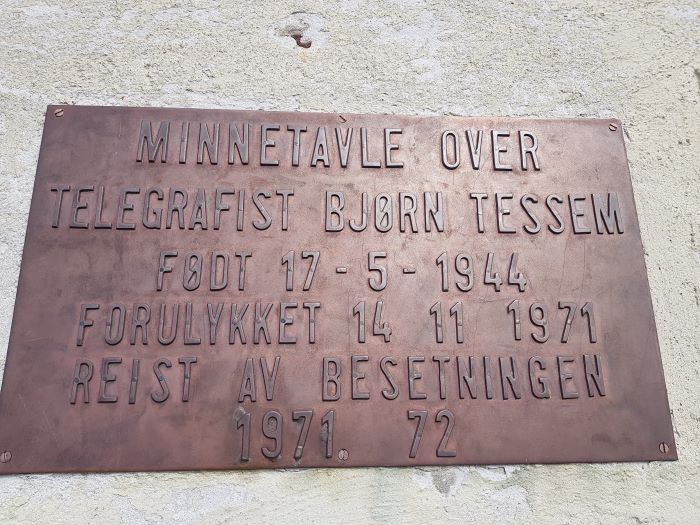
There is a story connected with the little cabin. In 1971 an operator of the Meteo Station named Bjørn Tessem was attacked by a polar bear. He was found near the door of the cabin, with the bear over him. Most likely he attempted to enter the cabin to save himself but the door was locked. There is a small memorial plaque about this event on the wall of the cabin.
Memomarial Plaque for operator Bjørn Tessem who died following a polar bear attack
So you can see how the reception of just three letters BJO in morse code, received over 2500 kms, lead to a surprising conversation, a few nice pictures and a tragic story.
My sincere thanks to Lisanne and the team members at Bjørnøya Meteorological Station, who also gave me permission to publish their photo’s. They have their own website at https://bjornoya.org/ .
The Voice of America broadcasts under the name Studio 7 to Zimbabwe. The programs in Shona, Ndebele and English are aired from Selebi-Phikwe, Botswana. I sent a reception report to the usual qsl@usagm.gov address, but also wrote to studio7@voanews.com .
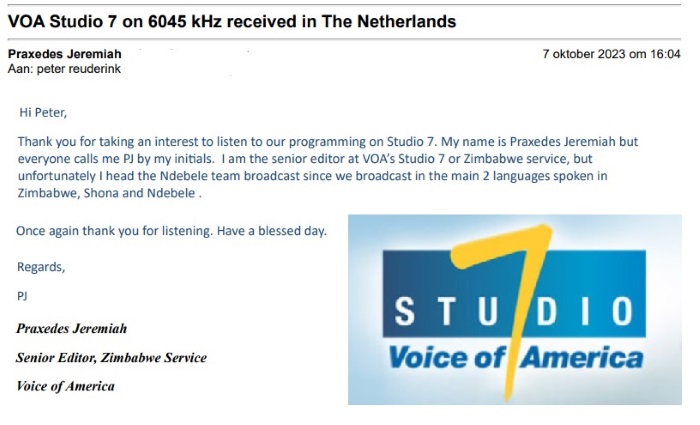
Praxedes Jeremiah, senior editor at Studio 7 sent an email reply. The program on 6045 kHz I listened to was in Shona language, but so many English words were used that I could understand which topics were discussed.
QSL for VoA Studio 7 program from Selebi-Phikwe, Botswana
I got a polite email as a QSL for my reception of the NDB LX-402 for Eskilstuna Airport, Sweden. The radio beacon is located 1086 km from my QTH in Woerden.
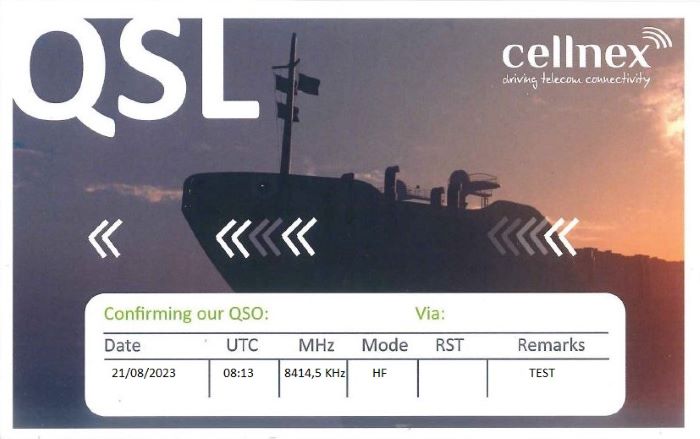
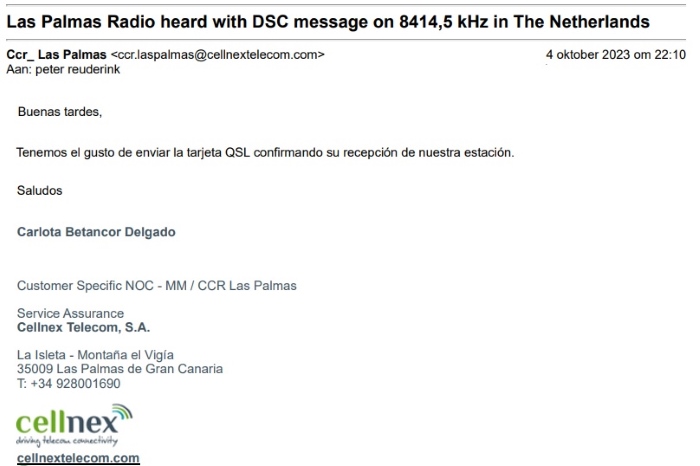
Coast Guard Radio in Spain is remotely operated from three centers: Coruna, Valencia and Las Palmas. This e-QSL CCR Las Palmas confirms my reception of the latter, operating from the Canary Islands on 8414.5 kHz. It was my 2nd attempt to get a QSL from this station via ccr.laspalmas@cellnextelecom.com , so maybe they reply a little bit irregular.
Unfortunately the e QSL doesn’t show the station name, so I have to save the email that went with it in my files as well:
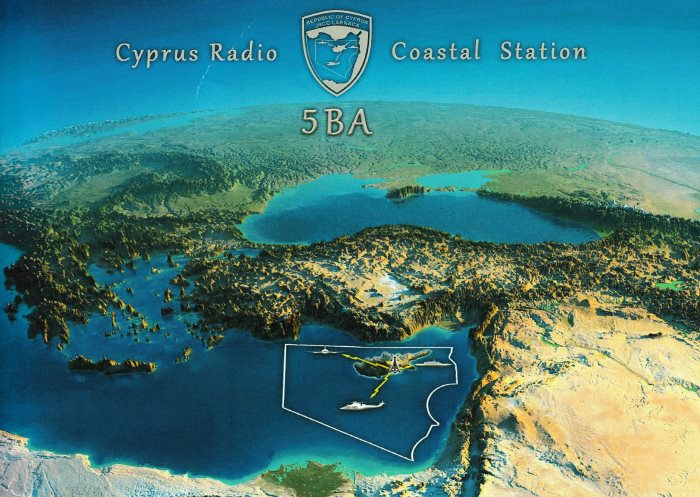
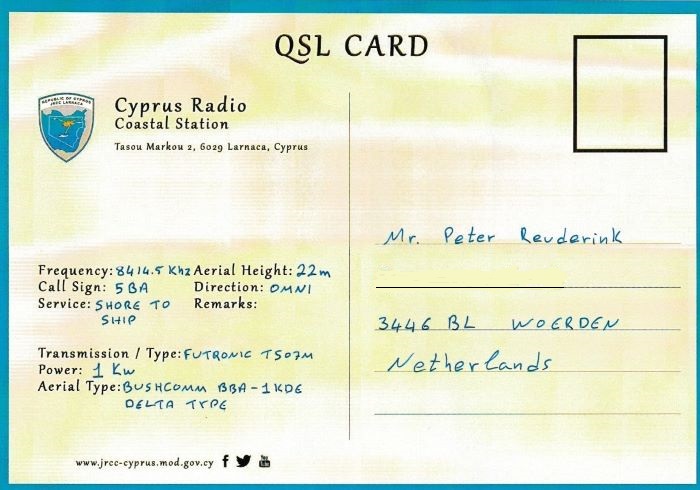
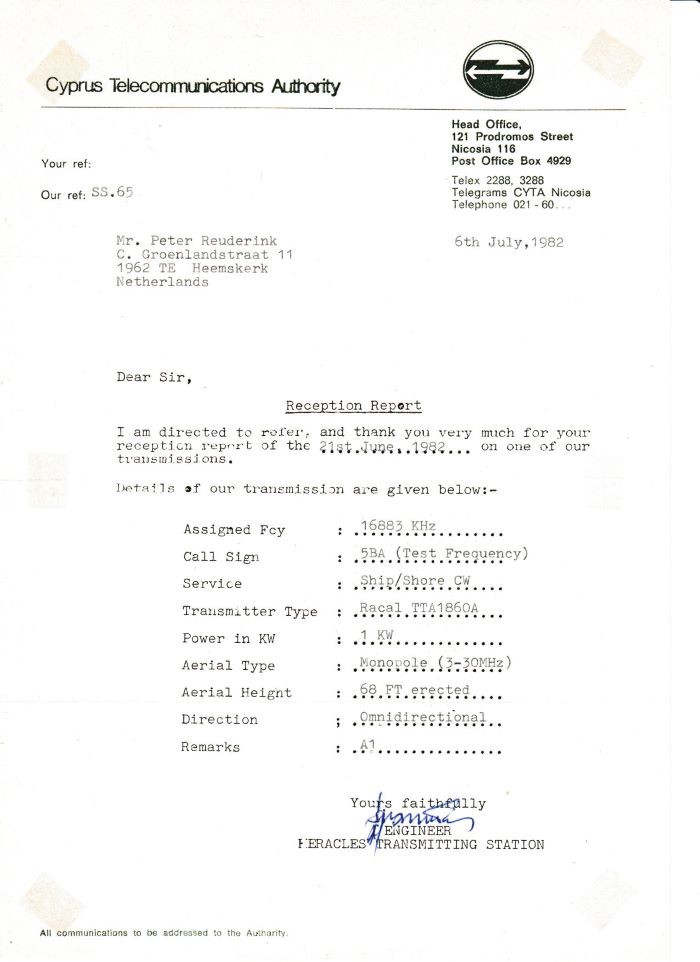
A real QSL card for Cyprus Radio 5BA on 8414.5 kHz. I heard this coastal station with a DSC message. It is nice that they still award QSL cards by mail. Forty years ago they were also reliable verifiers. I attached an old QSL letter from 1982 for a reception of a broadcast in A1 (Morse code).
Nice QSL card from Cyprus Radio 5BA, Nicosia, Cyprus
There is always something special about receiving a station from an island. I was a huge fan of Dutch writer Boudewijn Buch who had a TV program in which he visited islands, met the people living there, and told stories about these islands. You might compare him with the likes of Paul Theroux. Unfortunately Boudewijn died much too young.
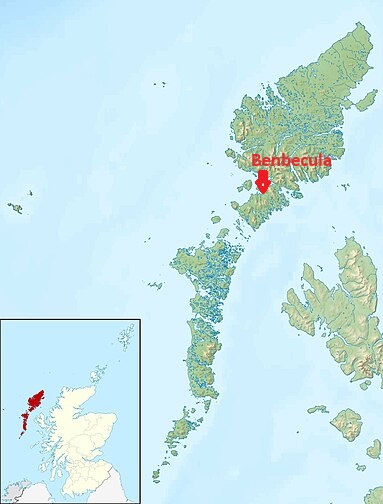
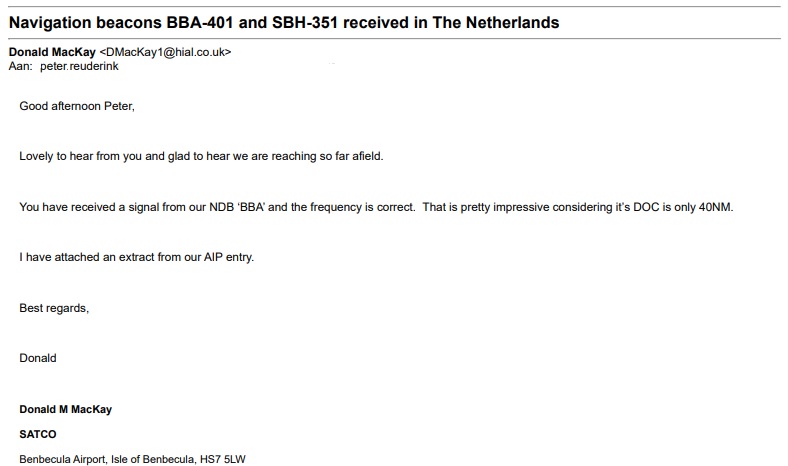
As posted earlier I received a QSL for the Kirkwall NDB on the Orkney Islands. I learned that Kirkwall is one of 11 airports operated by HIAL, Highlands and Islands Airports Ltd. So I asked the kind lady at info@hial.co.uk if she would also consider forwarding my reception report of BBA (Benbecula) and SBH (Sumburgh) to the responsible operators.
David from Benbecula Airport was the first to reply. Thank you David! Another island I can add to my list… but also an island that I want to visit now I have reached the happy age of retirement. It’s high on my bucket list. David also added an overview of the radio navigation aids at Benbecula Airport (see below). Benbecula Airport started in 1936. It was a Royal Airforce Airport during WWII. From here it was home to aircraft carrying out patrols to protect shipping convoys on the Atlantic from German U-boats. After the war it became a civilian airport again, and today their are scheduled flights to Inverness, Glasgow and Stornoway.
Mr. Mattias Nilsson, flight safety coordinator, was so kind to QSL NDB VX-329 and JX-349 at Växjö Småland Airport, Sweden. The airport is located 830 km from my QTH in Woerden.
BDXC : SWL 2262 PRe VERON : NL 14228 If you want to get in touch, just leave a message on one of my posts. Please note that I don't publish email addresses of verifiers which are not part of the public domain. So if you don't see the QSL address, just leave a message and I'll get back to you.
Feel free to copy anything on this weblog. I try to provide accurate information, but if I'm wrong: don't blame me! A link back to my site is appreciated when you copy info.