"It's not true I had nothing on, I had the radio on" - Marilyn Monroe

Tag: Belarus

QSL Radius FM Minsk 72.11 MHz

My first OIRT Band QSL for Radius FM, broadcasting from Minsk, Belarus on 72.11 MHz with 9 kW. Via office(at)radiusfm.by I received a fully detailed email in Dutch:
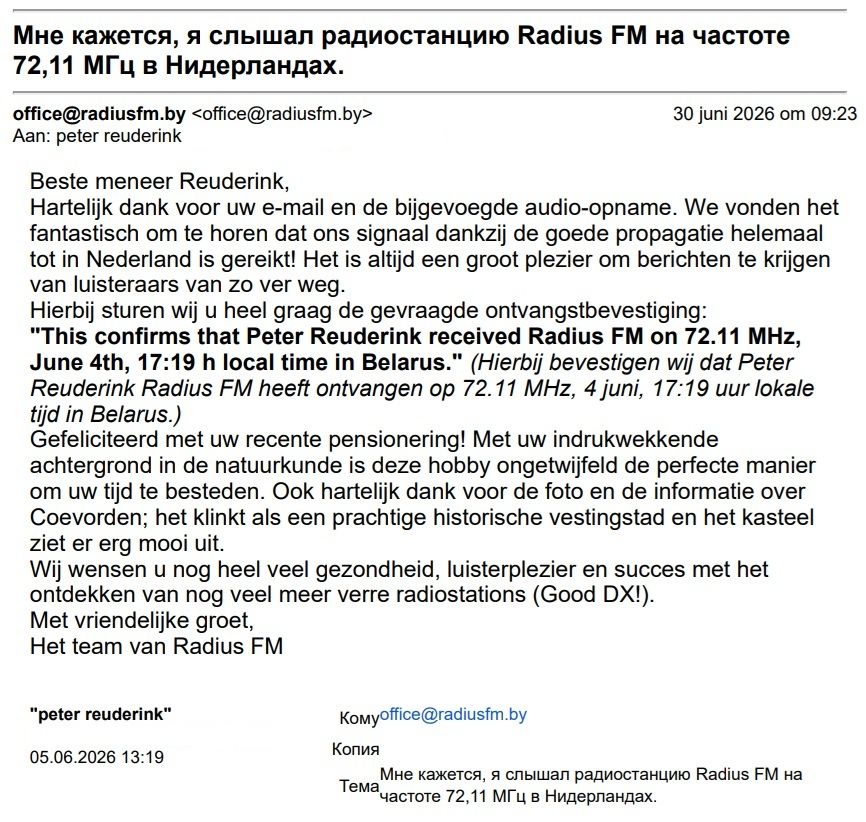
QSL email, in Dutch (!) for my reception of Radius FM, Belarus on 72.1 MHz

Radius FM was launched on July 12, 2003, in Minsk, Belarus. Despite it’s commercial contemporary youthful style it is is part of the Belarusian National State Television and Radio Company. As such it falls under the umbrella of the state media structure, which is directly overseen by the Office of the President of Belarus. This explains its extensive nationwide coverage and status as a major network. The Minsk transmitter on 72.1 MHz is the only outlet in the OIRT band, all other frequencies are in the regular FM band.

Today, more than two decades after its debut, Radius FM continues as a leading hit radio brand, blending current international and local pop music with digital streaming, a mobile app, and strong social media presence. It has evolved while staying true to its core identity as “the wave of top music.”
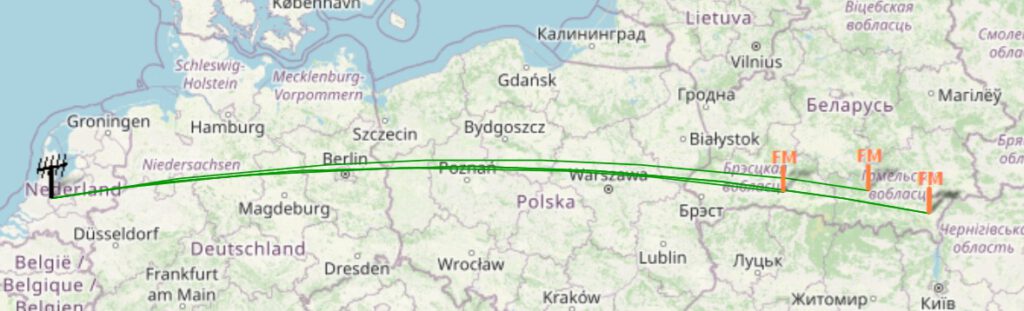

Radius FM station ID

My first OIRT signals. From Belarus.

Last week I received my first OIRT signals. Until 2 years ago I never had a receiver that was able to pick up 70 MHz signals. Today I do, but the only antenna I have is a 87-108 MHz antenna… apparently that’s all it takes to pick up these signals over a distance of 1600 km when sporadic E conditions are favourable.

What is OIRT?

The OIRT radio band is a range of radio frequencies used for FM broadcasting, primarily in Eastern Europe and the former Soviet Union, spanning from 65.8 to 74.0 MHz (sometimes cited as 65.9 to 74.0 MHz). Named after the Organisation Internationale de Radiodiffusion et de Télévision (OIRT), a Prague-based organization that served as the Eastern Bloc’s counterpart to the Western European Broadcasting Union (EBU), it was established to standardize broadcasting in socialist countries during the Cold War.

The OIRT band was a product of Cold War-era technological and political divisions, designed to isolate Eastern Bloc broadcasts from Western signals. Its lower frequencies allowed better coverage in expansive regions but made cross-border reception difficult. Today, its use is declining, but it remains a niche interest for radio enthusiasts (DXers) who tune in during Sporadic E propagation events to catch distant signals.

Below a little recording of a conversation on BR Pershy Kanal (Channel Nr. 1) on 66.32 MHz. The spacing between stations is only 30 kHz, rather than the 100 kHz used for the 87-108 MHz band.

I tried to send a reception report to Belarus Radio, but since the war between Russia and the Ukraine all email correspondence is blocked “for security reasons” (which might be the EU or Belarus, I just don’t know). That’s a pity. If someone knows a workaround, please let me know!

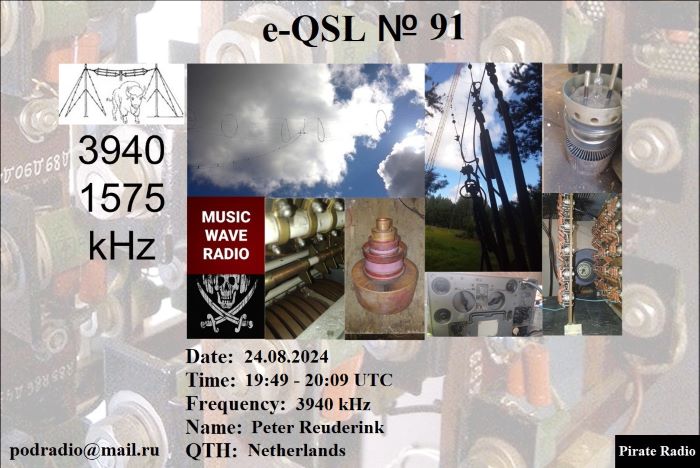
QSL Music Wave Radio 3940 kHz

A QSL from Music Wave Radio, a pirate station on 3940 kHz. The transmitter location is a bit unclear. Some sources state that it is Belarus, with programs produced in Russia. Anyway, it is definitely not the eastern part of The Netherlands, the UK where most of my pirate QSLs come from.

e QSL Music Wave Radio on 3940 kHz

When I listened Music Wave Radio was broadcasting Russian pop and rock music. Shazam helped me out to identify some titles and artists, but I still had to decipher them from cyrillic script. Apparently I passed the test because operator Evgeniy confirmed my reception report with in a day. I sent my report to podradio@mail.ru.

© 2026 Peter's DX Corner

Theme by Anders NorenUp ↑