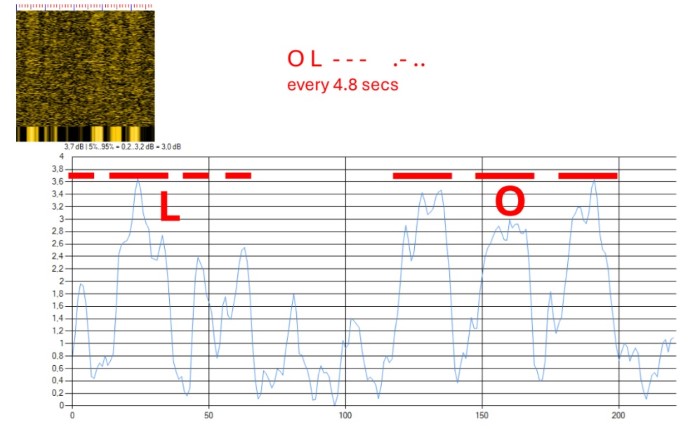
Chris from Aviseq, who also QSL-ed my reception of the beacons WU and VNA for Umea Airport, was so kind to confirm my reception of the beacon OL for Lycksele, Sweden on 320 kHz by email as well.
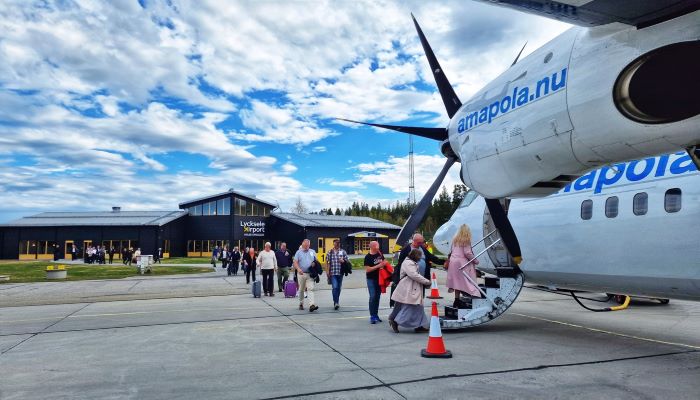
Lycksele Airport is located in South Lapland, a sparsely populated area in the north of Sweden. The distance to my QTH is 1590 km. Amapola operates daily flights to Stockholm from Lycksele Airport.
To give you an impression what it means to dig such a signal out of the noise with Pskov software I added the above picture. In the yellow/black panel you see how OL is received… Every line from left to right is a capture of the cyclic signal. As you can see the first minutes/cycles offered a better signal… The aggregate is a clear OL identification in morse code.
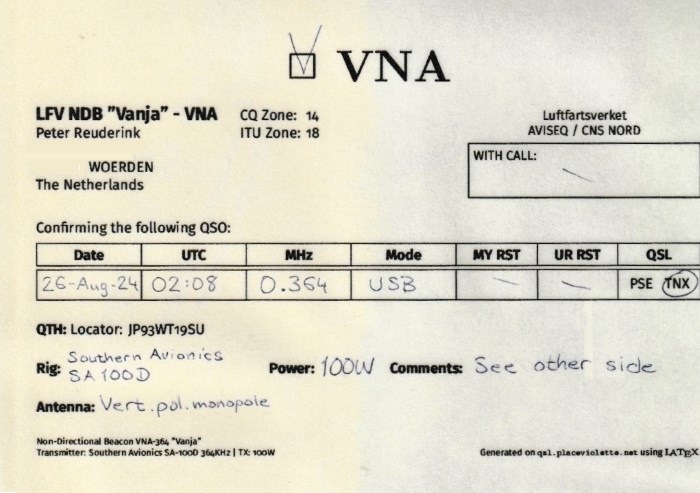
A QSL from NDB VNA-364 Vanja, a navigation aid for Umea Airport in Sweden.
QSL NDB VNA-364 Vanja for Umea Aiport
Earlier I received a e-QSL for my reception of the other NDB for Umea Airport WU-329. The engineering team that reached out to me promised to send a QSL card by mail for the other beacon VNA-364 once they had completed their maintenance visit and were able to take a few pictures. Last week I received it!
QSL for NDB Vanja-354 for Umea Airport
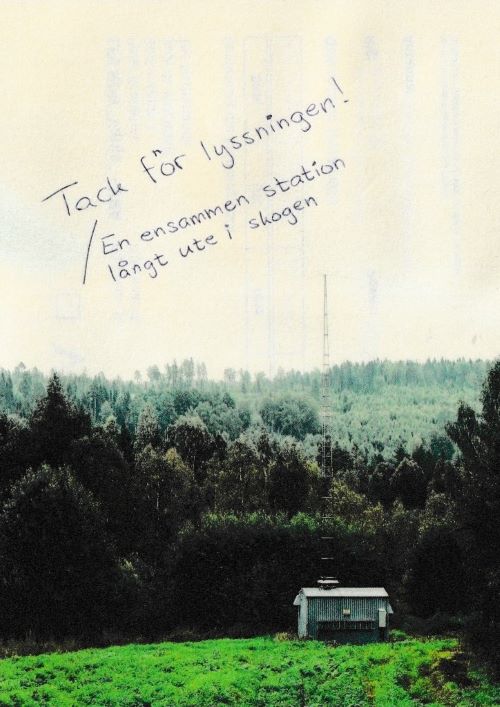
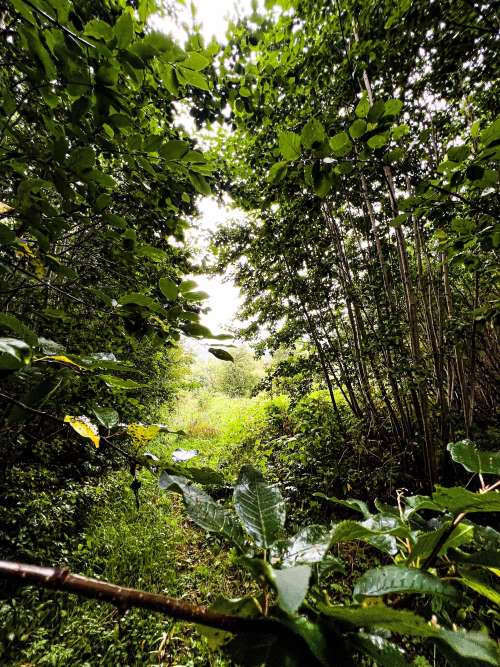
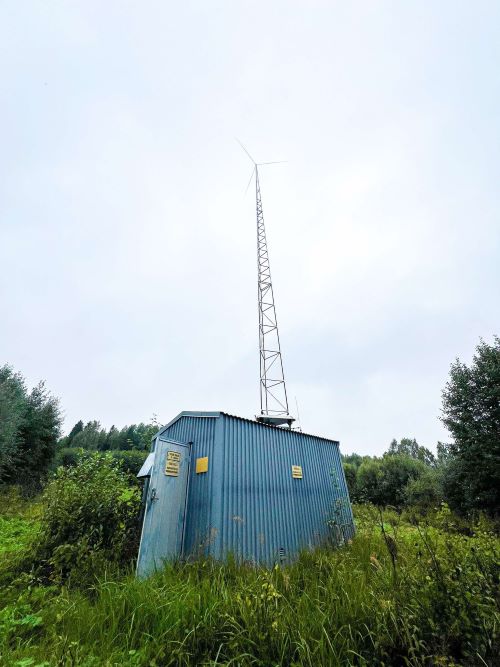
It is always nice to get a picture of an NDB. Sometimes I’m able to trace them on Streetview in Google Maps. But as Christoffer from the Engineering team explained: no chance for VNA which is pretty much off the beaten track. The picture below shows the access path to the beacon.
Access “road” to NDB VNA-354 Vanja
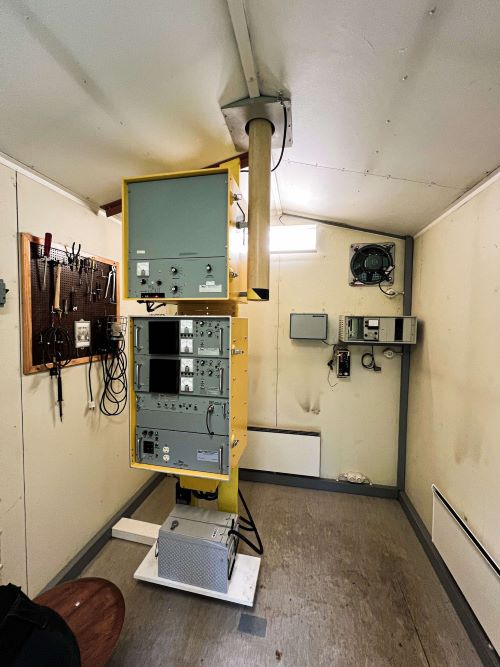
The transmitter is SA-100D transmitter with 100 Watt. Christoffer told me it’s the same as WU uses and the stations are near identical in terms of looks.
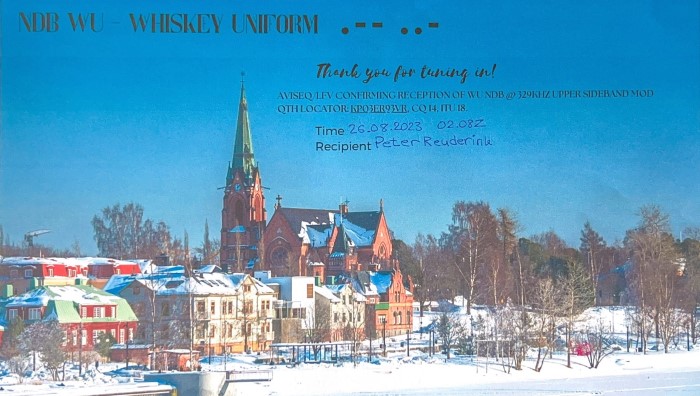
Almost exactly a year ago I wrote a post on my reception of two beacons for Umea Airport: WU-329 and VNA-364. At the time I received a polite “thank you email” from Swedavia, the operator of Umea Airport. But hardly a QSL.
Two weeks ago I was contacted by engineers working at AVISEQ, the company responsible for the maintenance of the navigation aids and ATC communication/systems in Sweden. They had read my post and prepared the above eQSL for NDB WU-329 me and there should be a QSL for VNA-364 on its way. Of the latter beacon I also received some nice pictures, as the team was doing some maintenance on VNA. I will post them together with the QSL.
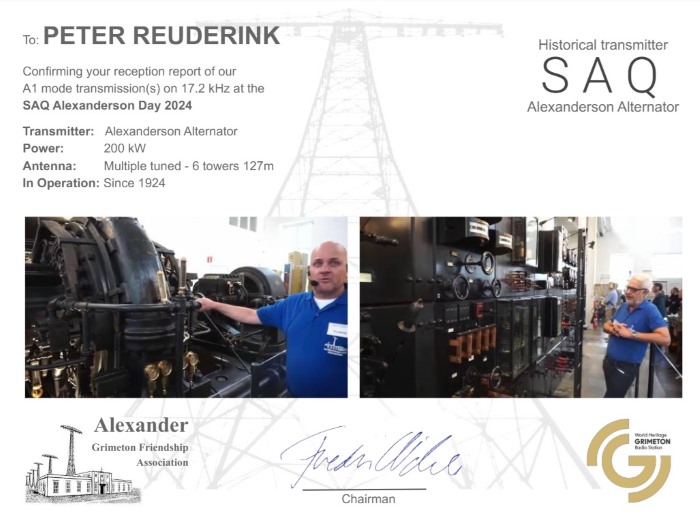
June 30th was the celebration of Alexanderson Day (the day named after the inventor of the Alexanderson Alternator) at SAQ. Despite mid summer conditions reception was quite good as was also the case last year. This resulted in another SAQ Grimeton QSL.
A nice feature of these SAQ broadcast is that they broadcast the event via YouTube with a live chat channel where DXers from around the world compare how well they receive the station.
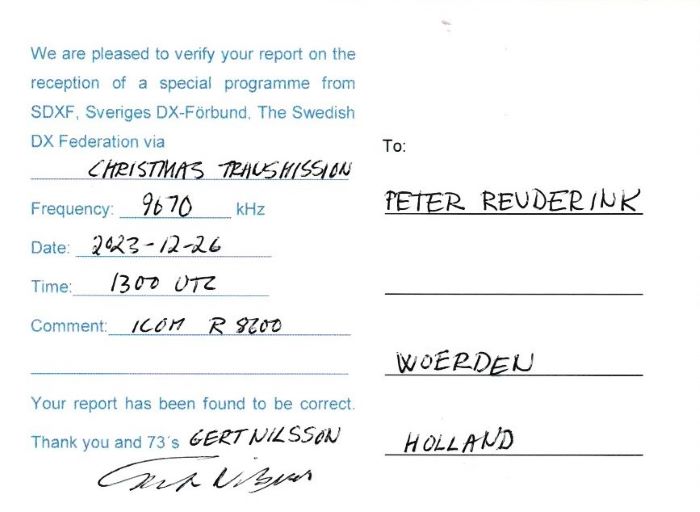
The Sveriges DX Förbund, SDXF (or Swedish DX Assocation) can be heard with a program via Channel 292. December 26th I heard them on 9670 kHz with a special Christmas edition. Unfortunately the program was mainly in Swedish, with a few minutes in German language only. Reception report should be sent to qsl@sdxf.se. QSL manager Gert Nilsson sent me an email confirming that my report was received, and a few weeks later I received their nice QSL card by mail.
QSL SDXF via Channel 292
Not sure when they are on the air again (they had a show on World Radio Day yesterday), so please check the websites of SDXF or Channel 292 for more information.
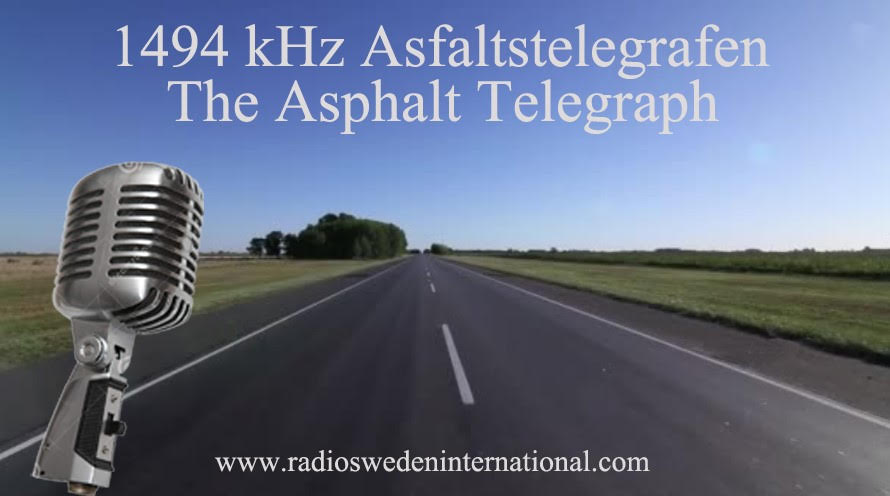
Asfalttelegrafen was on air from December 23rd until January 5th. I tried a couple of times around Christmas, but I couldn’t get a decent signal here in Woerden. Tracking some KiwiSDRs I learned that the signal reached the German coast, but then it quickly deteriorated.
On January 4th however I was lucky however. And although a strong noise source on 1495.25 kHz forced me to notch everything between 1000 and 1500 Hz I could recognize the various titles played and picked up a clear ID (at 24 secs in the clip).
A day later I received a lengthy and detailed email QSL from Torleif Roos, who is DXer and HAM operator as well. Asfalttelegrafen is located in Ludvika, Sweden, 1097 km from my QTH. I noticed the name is sometimes also spelled as Asfaltstelegrafen.
eQSL from Asfaltstelegrafen, Ludvika, Sweden
The station got its name from “Asfalttelegrafen”, a program on the Swedish National Radio 3rd program on FM around 1975. In the late Sunday nights before midnight it brought rock music. Unfortunately private individuals can’t obtain a permanent license in Sweden, so Torleif has to apply for a 14 day license every time he want’s to broadcast. More information can be found on the radio sweden international website.
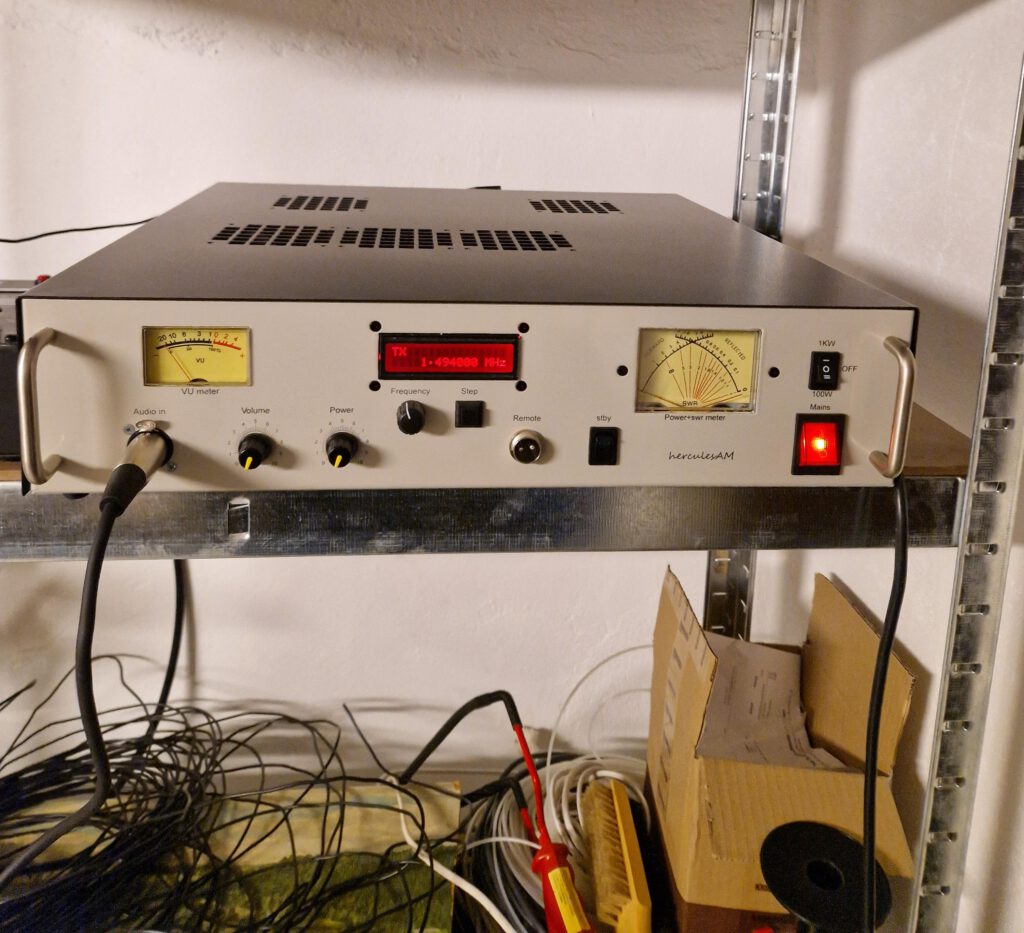
The transmitter is a 1 kW Hercules. It is connected to a “L” antenna, 48.5 meters long above an earthplane created by 16 cables of 50 meters each. Broadcast times were 20:00 – 03:55 h UTC, which is the window created when Radio Moldova is not in the air. During those hours the frequency is empty in Europe, with the next station being in Iran.
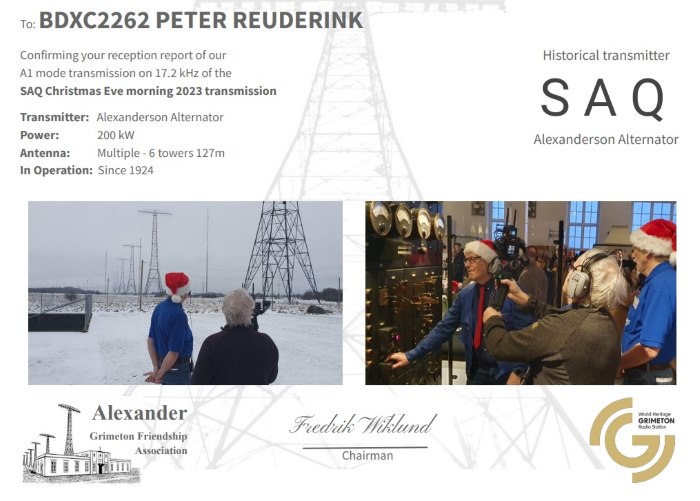
Of the 4 SAQ Grimeton broadcasts I was able to listen to in 2023 this was by far the best reception with a clear CW signal, S4. A week later I received their e-QSL!
e-QSL for the SAQ Grimeton Christmas Eve morning transmission 2023
SAQ Grimeton is a former wireless telegraph station in Sweden. It generates radio signals using an AC generator (called an alternator) designed by the Swedish engineer Alexanderson. This technology was used prior to the development of vacuum tube oscillators. You can learn more about the history of this station and its planned transmissions on the website of the Alexander assocation.
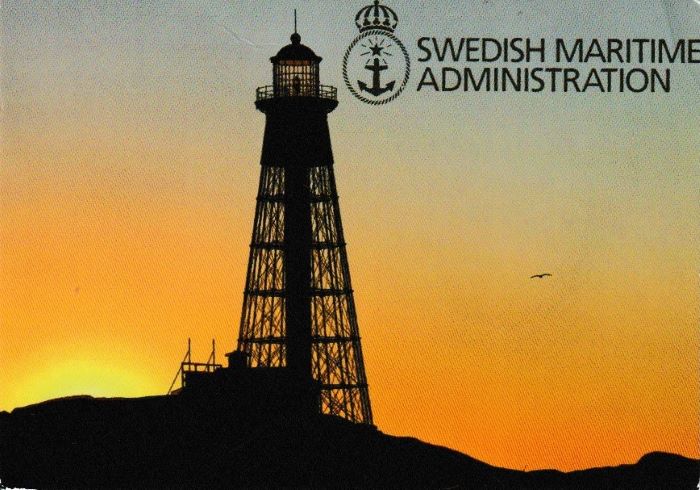
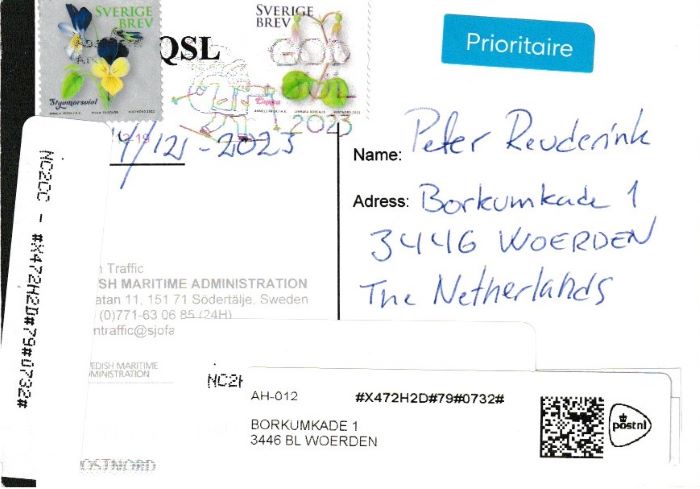
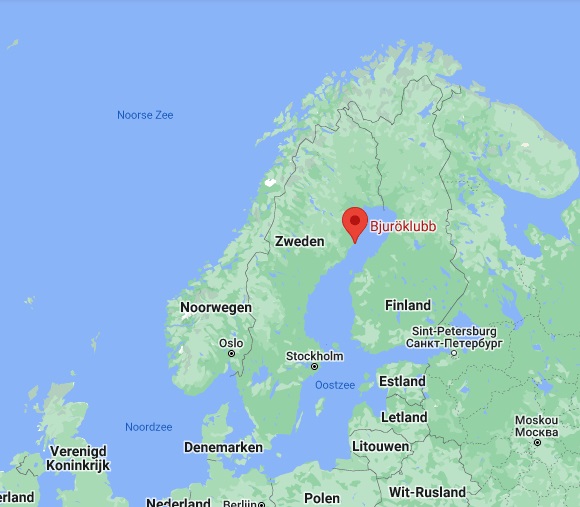
A nice surprise at the end of this year was this traditional QSL card for my reception of SAH Bjuröklubb with a NAVTEX message on 518 kHz. With 1656 km this is the most distant station from the three NAVTEX stations in Sweden. The other two SAA Gislovhammer and SAS Varberg are just over 700 km away.
a traditional QSL card for my reception of Bjuröklubb NAVTEX on 518 kHz
Unfortunately, the location Bjuröklubb was not indicated on my QSL. And I don’t think it is hidden below the stickers that Post NL apparently needed to put all over the card ☹️. I sent my report to swedentraffic@sjofartsverket.se . Please note that JRCC Göteborg is responsible for DSC safety watch.
A quick update on my previous post on DSC and NAVTEX in Sweden. Following my QSL from JRCC Sweden I wrote an email to Stockholm Radio with a little query (and a reception report of Stockholm Radio on 2187.5 kHz).
Bjorne from Stockholm Radio was so kind to explain the current situation:
All transmission of weather and MSI (maritime safety information or navigational warnings) on MF are done by “Sweden Traffic” which is part of the Swedish Maritime Administration: Sjöfartsverket
All Emergency monitoring (GMDSS/DSC) is done by JRCC Sweden, located in Gothenburg. JRCC Sweden is also part of Swedish Maritime Administration: Sjöfartsverket. For this purpose JRCC Sweden has access to all Stockholm Radio facilities. I received my QSL for JRCC Sweden via jrcc@sjofartsverket.se
In addition to providing VHF telephone services Stockholm Radio (www.stockholmradio.se ) is only responsible for coastal weather transmissions on VHF during summertime (June 15th – September 15th according to their website).
Göteborg and Stockholm Radio can be received regularly on 2187.5 kHz with DSC messages. As I already had QSLs from the 80-ies for I didn’t bother to send a reception report and QSL request for these two stations. But then I saw a QSL from Artur at MaresmeDX for JRCC Sweden. And I wondered how they are actually organized these days.
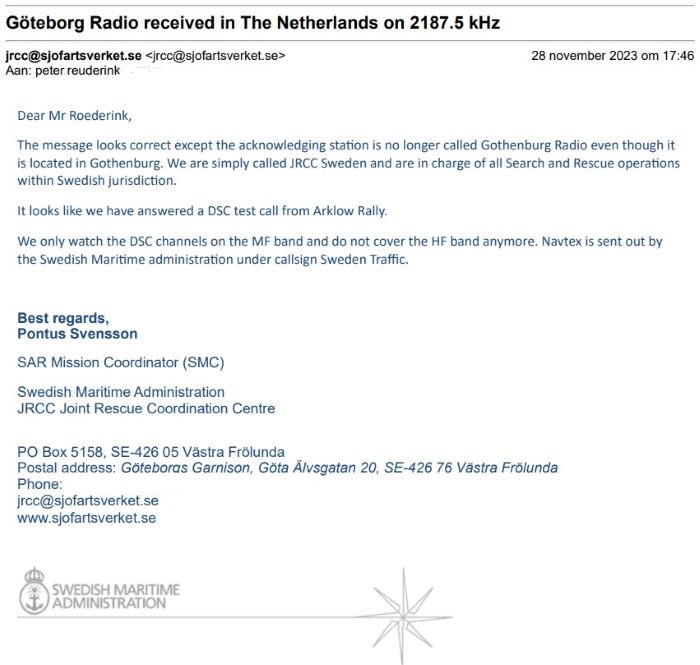
Within an hour of sending my reception report for a reception of MMSI 002653000, Göteborg Radio on 2187.5 kHz to jrcc@sjofartsverket.se I got an answer:
So it seems that everything on MF is now under the jurisdiction of JRCC Sweden. The HF band isn’t covered anymore. And I guess that the name Stockholm Radio is used for VHF DSC watch and weather broadcasts: https://stockholmradio.se/ .
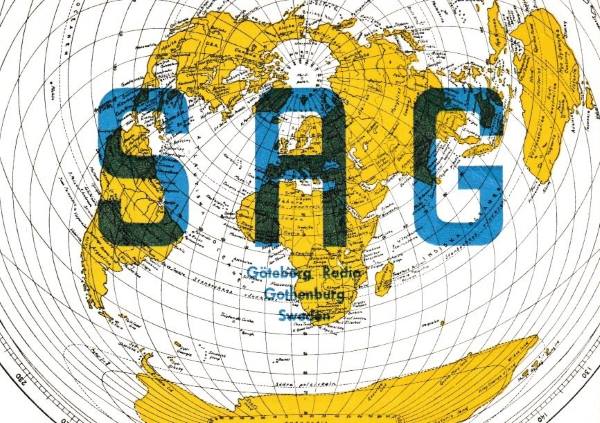
In the 80-ies you could listen to a couple of stations on MF. In addition to Göteborg (SAG) and Stockholm Radio (SDJ) I remember Karlskrona (SAA), Härnosand (SAH) and Tingstaede (Visby, SAE). The nice thing was that they had matching set of QSL cards. But although I heard all stations, I managed to get the QSLs for Göteborg and Stockholm Radio only…
1982 QSL Göteborg Radio SAG (1785 kHz)
1980s (I’ve two, both no details) QSL Stockholm Radio SDJ
BDXC : SWL 2262 PRe VERON : NL 14228 If you want to get in touch, just leave a message on one of my posts. Please note that I don't publish email addresses of verifiers which are not part of the public domain. So if you don't see the QSL address, just leave a message and I'll get back to you.
Feel free to copy anything on this weblog. I try to provide accurate information, but if I'm wrong: don't blame me! A link back to my site is appreciated when you copy info.