There are two opportunities to hear the Bahamas on medium wave. On 1540 AM the National Voice broadcasts with 50 kW from Nassau. On 810 AM there is The Light with 10 kW from Freeport.
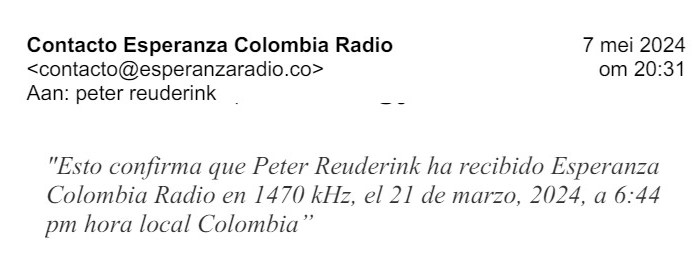
I have seen a few reports of 1540 AM from Europe. I’ve not been so lucky yet: all I heard on 1540 was CHIN from Toronto, and KXEL from Cedar Rapids, Iowa. During my stay on Curaçao it was easier to receive this station. The only competition came from Radio Cóndor from Colombia.
Email QSL from ZNS The National Voice, Bahamas
My report to digitalmedia@znsbahamas.com was answered with a fully detailed email in a day.
Among the DSC stations Faversham Radio, call sign MNC, is something special. You have the major Coastal Radio Stations and Rescue Coordination Centres (JRCC or MRCC) and then there are a few maritime colleges and training institutes like MarTec in Skagen, NuTec in Bergen and Trondheim, and the Constanta Maritime University. Faversham Radio/MNC MMSI 002320204 however is a voluntary run station specifically set up to allow DSC test call Acknowledgements in NavArea 1 following the closure of LyngbyRadio HF provision quite some time ago. It is not part of the GMDSS system but runs automatically H24 and while very active pre the Pandemic is now rarely used with the expansion of HF provision elsewhere. It is situated in Faversham along the Swale, a tidal channel in the Thames estuary.
Roger Taylor was so kind to confirm my reception of Faversham Radio. After serving as a radio officer at sea and then teaching Decca radar systems all over the world, he joined the Merchant Navy College at Greenhithe in Kent. After a stint at the National Sea School in Gravesend he and a few colleagues decided to become independent and start Snargate Radio as a training facility for GMDSS. They gave it call sign MNC, referring to the old college at Greenhithe. But also the first coastal radio station in the UK using an M (as in the old days of the Marconi Stations) rather than G in their call sign.
Later MNC was relocated to Faversham, and the name was changed accordingly. The station is entirely voluntary run by ex seafarers. The transmitter is a Sailor 5000 SSB kit because, as Roger explains, this is the only kit that allowed them to program an MMSI number starting with “00” indicating that it is a coastal radiostation. This is indeed something that is odd with stations like MarTec, NuTec, CMU or ANFR Donges: their MMSI is like that of a ship.
Faversham Radio is allowed to acknowledge DSC test calls. Making it the only HF maritime provision in the United Kingdom. In the beginning (2013-2015) the station was heavily used. But then a drop in requests was noted. Apparently due to the fact that the UK MCA had asked the entry in the ALRS (Admiralty List of Radio Signals) to be deleted. This has no been decided otherwise, but the use of Faversham Radio is still very low. Making it a rare catch.
A QSL CBEF 1550 “La Première” from Windsor, Ontario, Canada. Thanks to Hugo Matten! I sent a report to cbef@radio-canada.ca twice. But twice all I got back was an acknowledgement by a CBEF employee that my email was received, and my request forwarded to the responsible team…. and that was all.
Hugo however got a direct reply from Mihai Bulgaru, Supervisor Transmission. So my third email went directly to Mihai. And yes he was so kind to reply to me as well, even referring to Hugo’s report:
Mihai included two nice photo’s of the station and transmitter site as well:
CBEF 1550 “La Première”, Windsor, Ontario
A big thanks to Mihai for the confirmation, and thanks to Hugo for sharing his QSL!
I got “Great!” as an answer on my reception report for Direct 107, a station broadcasting on 107.1 FM. Is it enough to count as a QSL or not? Probably not. But for me it is another nice souvenir from a holiday on Curaçao!
Nevertheless I’m still grateful to the people at the station for acknowledging my reception report. Nice logos on the email make up for the lack of detail! And I learned a new word in Papiamento: “Atministrashon”.
Direct 107 broadcasts in Papiamento, the language of the people on Aruba, Curaçao and Bonaire. On Curaçao it was recognized as an official language in 2007 (which is a bit late if you ask me). If you know a bit of Spanish and English you might be able to understand a bit of it. But the origin is Portuguese rather than Spanish. Which is a reminder of dark times when the Dutch “imported” slaves from the Portuguese colonies Cabo Verde, Senegal and Guinea Bissau to the islands.
Modern Papiamento is more a mixture of Spanish, English and Dutch though. There are 180.000 people on the islands that speak Papiamento. Together with the people from the islands that live in The Netherlands there are about 250.000 Papiamento speaking people in the world. I would have loved to send my report in Papiamento language, but there is no Google Translate for it…
Direct 107 is one out of two stations of Direct Media on FM. They also run a television program TV Direct13.
Maarten Schakel, station manager, was so kind to QSL Hitradio 915 Curacao. I submitted around 10 reception reports to various FM stations on Curacao. This was only the second report that got confirmed. Together with the email from Paradise FM it is the only detailed response I received so far.
I sent my report to info@hitradio915.com . Do visit the Hitradio 915 website. It is really very flashy and gives you that special Curacao holiday feeling: Bon Bini!
Since 2010 Curacao, a former Dutch colony, is an independent country. And thus the EDXC lists it as a separate radio country as well. Unfortunately, by the time I resumed my hobby about a year ago, the only medium wave station Z86 went bankrupt and is off air. The Dutch Coastguard in Willemstad, which I received often between 1980-1990, doesn’t have a significant HF presence anymore as ship traffic goes by satellite. All that is left is basically FM. So when I visited the island in March this year I decided to send QSL requests to the stations I heard, in an attempt to add Curacao to my collection.
Email to QSL Paradise FM.
Joris Reer from Paradise FM was the first to reply with an email confirmation of my reception. Joris, who is host of the afternoon show, also asked my phone number. Next day I was on the air in the “Reer in het Verkeer” show explaining what our beautiful hobby is all about. Unfortunately for English speaking readers the show, like the QSL, is in Dutch which is still the official language on Curacao, next to Papiamento and English.
If I did my homework correctly, Curacao is the 197th radio country in my collection. And yeah, Joris was correct that it is a bit of a “cheat” as it is obviously not really DX. The only other “cheat” in my collection is Liechtenstein. I received “Radio L” while traveling with my wife on a 1500 km bicycle tour through the Alps years ago. I drafted my reception report during a stop for lunch in the capital Vaduz. But if anything, the Paradise FM QSL is a nice memory of a beautiful holiday on Curacao!
Staying on the island Curaçao for two weeks I couldn’t resist to bring my small Grundig G6 aviator with me. And send some reception reports of course. The e- QSL TWR Bonaire 800 kHz is for the strongest station in the Caribbean.
QSL TWR Bonaire 800 kHz
In 2021 the transmitter power was increased to 440 kW. The decision to boost power was made when it was recognized that “a large regional station in Latin America was needed to supplement the small FM operations on air in that region”, according to Lauren Libby, president and CEO TWR. The station went on air in 1963 with 500 kW. But the costs of running a high power tube type rig forced them to cut back power to 100 kW in 1998.
The station can be heard in Europe, although it is not as easy as the power might suggest given that the frequency is only 1 kHz away from European 801 kHz with some Spanish stations. Worse at my QTH is LPAM station Radio Jong Europa from Alphen aan de Rijn. Only 100 Watt, but also only 20 kilometers away they spoil reception with broad band non stop music. In Curaçao, at only 80 kilometers away from Bonaire, it is an easy catch obviously.
Nice detail is that you can write the station directly at 800am@twr.org and get a dedicated QSL, rather than the more generic QSL via the TWR webform. And, together with Saba and St. Eustatius, Bonaire is a separate radio country!
I received a friendly email to QSL NDB LAR-382 and EVR-425 Portugal. Rosa Roque, head of maintenance at FIR Lisboa Airport, answered the email I sent to geral@nav.pt . The same address that verified my reception of NDB FIL on the Azores.
Dear Peter,
We confirm that these are the frequencies and the call sign of these radio beacons.
It’s amazing how, under exceptional propagation conditions, a frequency can be heard at such a great distance.
This is to confirm that Peter Reuderink has received radio beacons LAR on 382 kHz, and EVR on 425 kHz.
Many thanks. Best Regards.
Atenciosamente,
Rosa Roque
DOPLIS/MANLIS – Head of Maintenance Services
Lisbon FIR Operations Directorate
As far as I know their are 4 NDBs left in Portugal. Two of them can be received most evenings at my QTH, LAR at Arruda (I guess the callsign is derived from Lisboa-ARruda) is situated north of Lisbon International Airport aligned with the runway. EVR is situated at Évora Municipal Airport. The Brazilian aircraft manufacturer Embraer owns two plants adjacent to the airport.
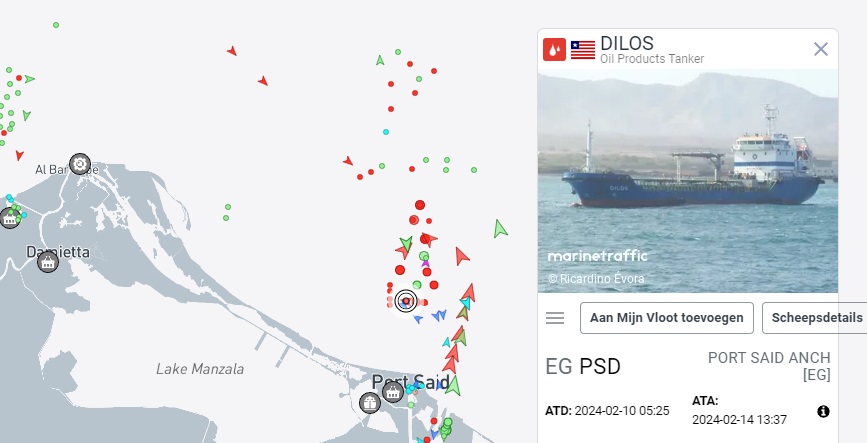
Recently I received Bangkok Radio on 2187.5 kHz. With 9225 kilometer this is by far my most distant maritime reception on MF. Unfortunately I couldn’t find an email address, until Néstor Damián Fischetto provided me with one. Within a few days I received a fully detailed email from YvesZor, radio operator at the station:
Dear Peter Reuderink,
Thank you for your email and for sharing your reception report of Bangkok Radio. We are delighted to hear that you were able to receive our station on 2 MHz, especially considering the distance of over 9225 kilometres. It’s always gratifying to know that our signals are reaching listeners around the world.
We confirm your reception of Bangkok Radio on 2187.5 kHz on February 27th, 2024, at 20:28 h UTC. Your dedication to the hobby of radio reception for over four decades is admirable, and we are honoured to be a part of your listening experience.
Should you have any further questions or if there’s anything else we can assist you with, please feel free to reach out to us.
Thank you once again for reaching out to Bangkok Radio. We value your support and interest in our broadcasts.
Warm regards,
YvesZor [YZ] Radio Operator Bangkok Radio
Big thanks to Nestor (and Rob IZ0CDM, who provided similar address info a few days later)!
I did not get my PPC signed, but I did get an email to QSL CFAJ 1220 St. Catherines ON, Canada. I sent my report to info@classic1220.ca.
1220 kHz is a good frequency for listening to Transatlantic MW stations, nicely in between European 1215 and 1224 kHz. That said, despite their 10 kW of power it is still not so easy to hear CFAJ. Their antenna pattern, using a nine (!) tower array, is tuned to a for Europe unfavorable NW/SE direction. This is done to reduce interference with neighboring US transmitter WHKW Cleveland. And exactly that station is the one that is heard more often Europe.
Praveen Amirtharaj, who answered my reception report, talks about “our new station”. And it is true, this station went on-air in 2020 with the call sign CFAJ. Since 1967 a station with callsign CHSC was active on this frequency, but their license was terminated in 2010 as the authorities (CRTC) concluded following format violations, physical deterioration and financial issues the station would not be able to comply in future.
In 2015 a new application to use the facilities of CHSC was granted to a new organization that runs CFAJ since 2020 with a Classic Hits format.
BDXC : SWL 2262 PRe VERON : NL 14228 If you want to get in touch, just leave a message on one of my posts. Please note that I don't publish email addresses of verifiers which are not part of the public domain. So if you don't see the QSL address, just leave a message and I'll get back to you.
Feel free to copy anything on this weblog. I try to provide accurate information, but if I'm wrong: don't blame me! A link back to my site is appreciated when you copy info.