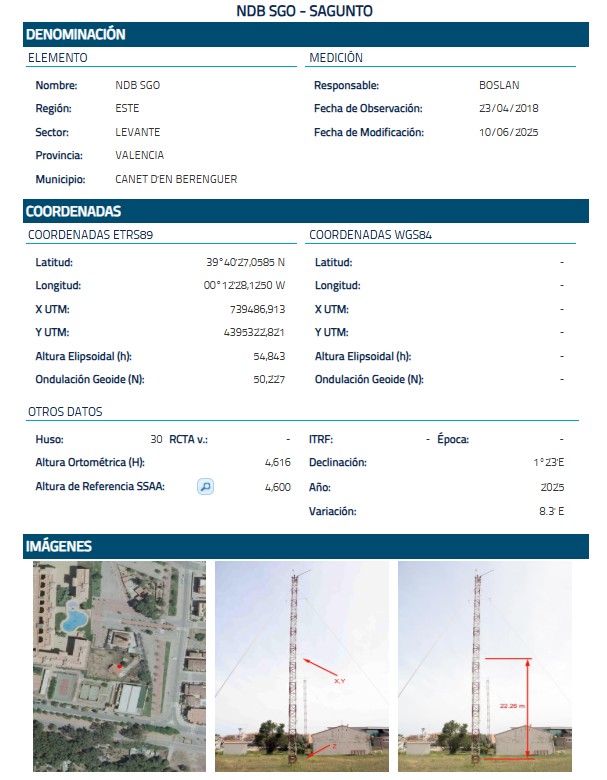
NDB SGO on 356 kHz is another typical ENAIRE beacon: 200 Watts in a “Sistema radiante de tipo T”: three horizontal wires between two towers. The navigational function is linked to Valencia Airport. The beacon is located in Canet d’en Berenguer, north of Valencia. I’m not an expert, but when I checked on flight radar I noticed that flights pass north of Valencia, making a U-turn to land in an easterly direction.
The info sheet for NDB SGO shared by Enaire
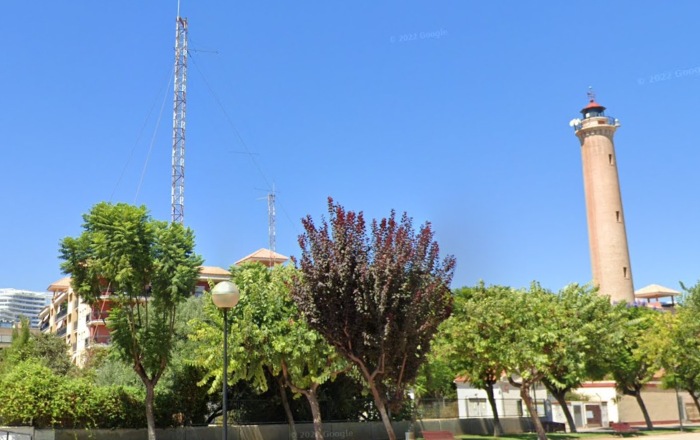
If search for the beacon on GoogleMaps you will see that it is a bit of a weird location, in front of a hotel and in right in the centre of a nice beach resort and yacht club. But I guess the beacon was already there when the development of the resort started around 2001.
NDB SGO Sagunto is located next to the lighthouse, in front of a hotel (GoogleMaps).
My report was confirmed via informacion@enaire.es .
ENAIRE confirmed my reception of the NDB ECV-319 at Colmenar-Viejo airbase in Spain. This is the home of the Fuerzas Aeromóviles del Ejército de Tierra (FAMET), the Spanish Army Airmobile Forces. There are 4 helicopter batallions that have Colmenar-Viejo as their base, including BHELTRA V who fly Chinook (which is cool as my nephew and godson flies a Chinook as well).
I like chasing DX stations. But I also like listening to producers that offer something special on shortwave. For that reason I regularly check the Channel 292 calendar. But Shortwaveradio.de also offers nice programs.
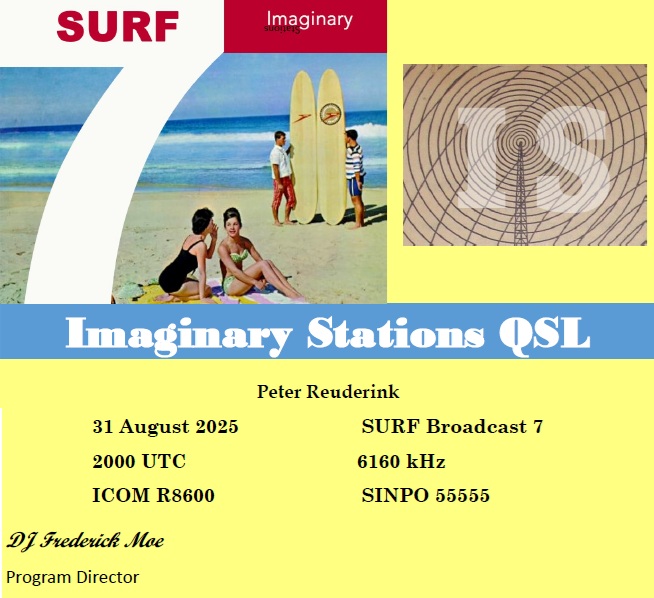
This weekend I listened to SURF, a program from Imaginary Stations via Shortwave Gold. My report was confirmed by DJ Frederic Moe with a nice eQSL:
Imaginary Stations is a shortwave radio program producing creative broadcasts with themed music and content. One of these is around surf classics (SURF series). Another theme is analog music archives (The Ancient Analogue Archive). They are on air via Shortwave Gold (Shortwaveradio.de) and WRMI. In the program I listened to they invited people to become member of their Pen Pal club, and the Japanese “Surf” music played was by recommendation of a member from Tokyo.
You can find more info about Imaginary Stations on this Factsheet:
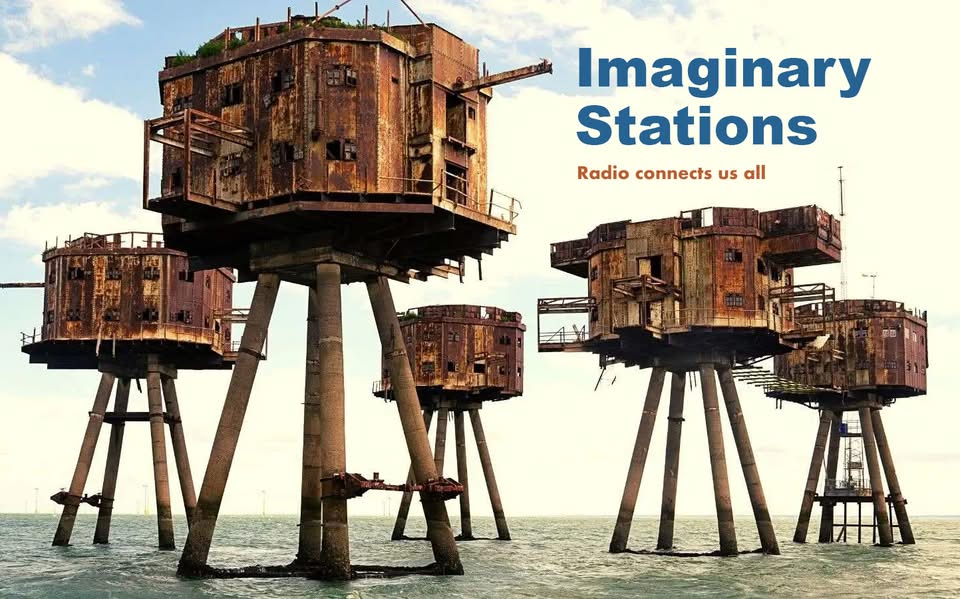
By the way, the Facebook page of Imaginary Stations and Radio Skybird features Shivering Sands Army Forts in the Thames, from which Radio City was broadcasting. A place full of radio history as I explained in an earlier post.
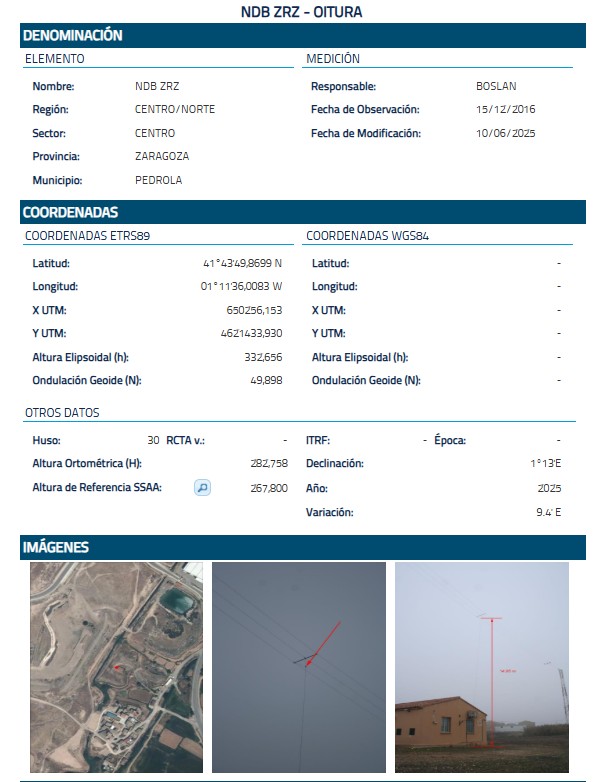
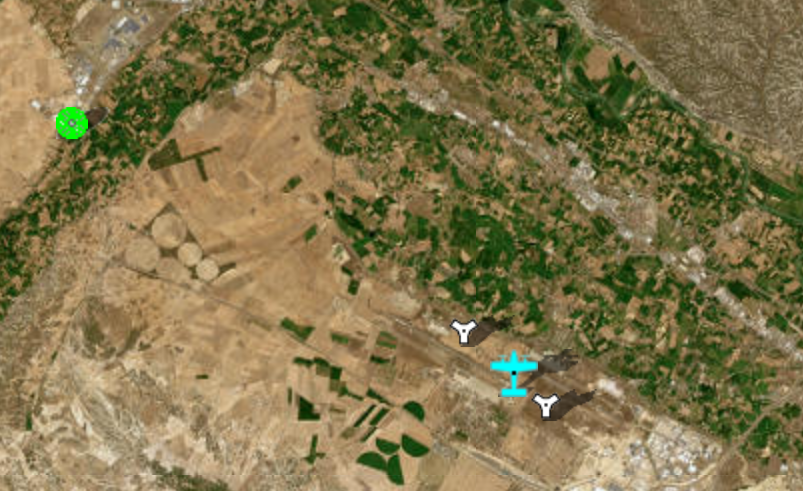
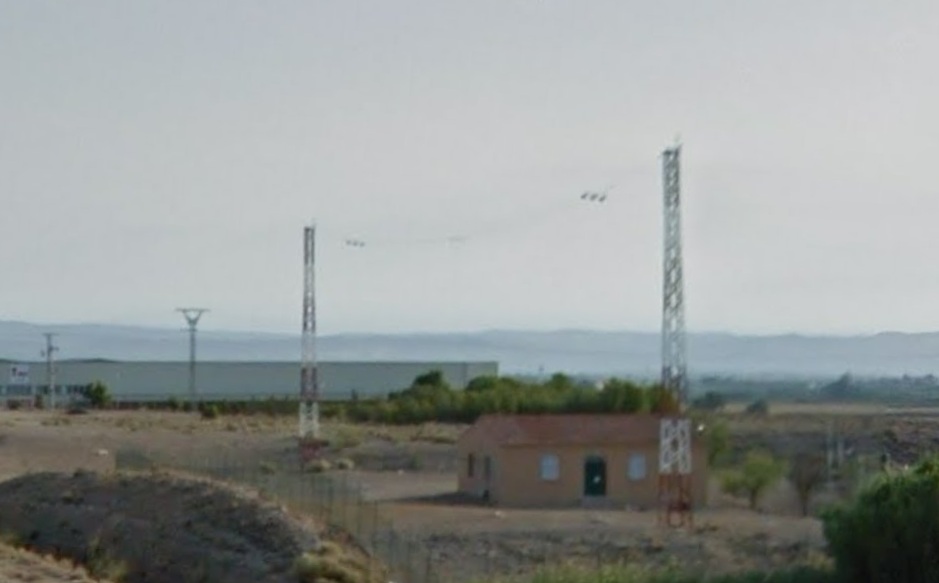
QSL for NDB ZRZ Zaragoza on 389 kHz. A beacon with a strong signal, but somehow often compromised by QRM at my location. The ZRZ beacon is located 15 kms NW of Zaragoza Airport.
My report was confirmed by informacion@enaire.es .
NDB ZRZ Zaragoza (green circle) is located 15 km NW of Zaragoza Airport
Google Maps view on NDB ZRZ Zaragoza
Zaragoza Airport history goes back to the Cold War. Constructed by the US it was one of three major USAF Cold War airbases in Spain. But what I didn’t know is that is was used as a Transoceanic Abort Landiing facility for Space Shuttle missions.
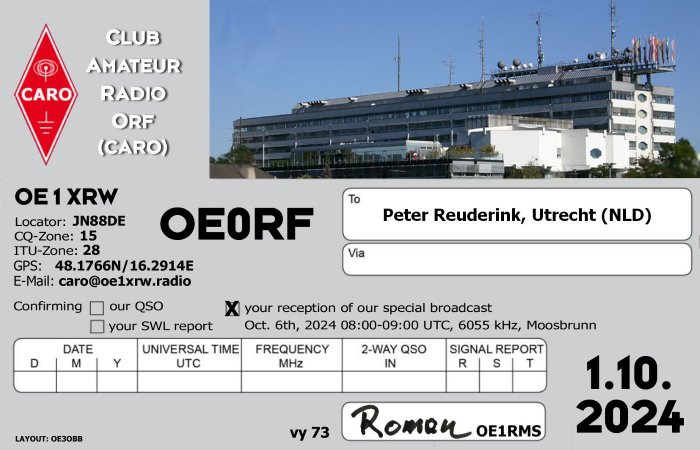
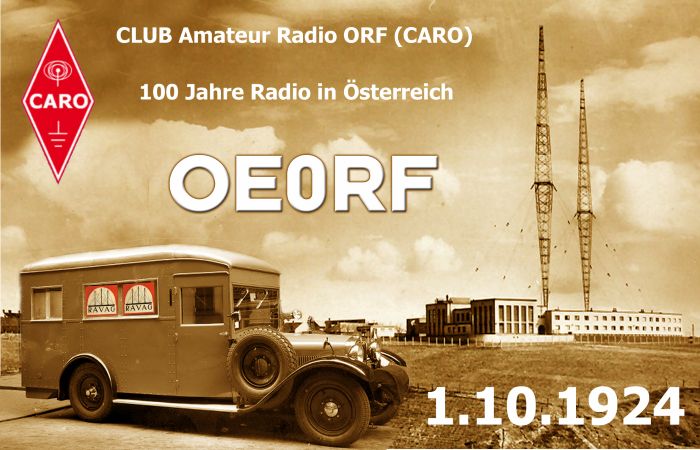
The Moosbrunn shortwave antenna is no more since January this year. Fortunately I was able to get a confirmation of my reception of ORF Radio Ö1 broadcasting via Moosbrunn. It is sad to see the destruction of the Moosbrunn facilities just after the celebration of 100 years radio in Austria. CARO, the Club Amateur Radio ORF, aired a special centennial broadcast on 6055 kHz in October 2024. It took a while (no problem, after all it is all volunteers work), but this week I received the beautiful eQSL.
QSL card CARO Moosbrunn transmission on 6055 kHz
I listened to a rebroadcast of an interview with Prof. Harranth who was the curator of the Dokumentationsarchiv „Funk“ (Radio) with 6 million items about Austrian radio history.
CARO sent the following accompanying message with the QSL:
The ORF Amateur Radio Club (a division of the ORF Sports Association, known as CARO) organized a series of broadcasts following the announcement of the demolition and decommissioning of the large shortwave transmitting station in Moosbrunn. These broadcasts paid tribute to the station’s decades-long successful operation. Some of these audio programs can be replayed via CARO’s website: https://www.oe1xrw.radio
Additionally, the website offers a comprehensive documentation of the former station’s history for those wishing to read or view more about it.
For many years, Moosbrunn stood as a symbol of Austria’s positive global image and the voice of its people. The station housed a dedicated shortwave editorial team — first under Radio Österreich International (ROI), later under a modified retransmission of standard ORF radio content.
Among the broadcasts were several historical retrospectives, including a program commemorating 100 years of radio in Austria. A particularly notable feature was an unpublished interview with the late Prof. Wolf Harranth, who passed away in 2021. In it, Harranth candidly explained the political, social, and technical background of the founding of ORF’s predecessor, Radioverkehrs AG (RAVAG).
Following the final transmission by Radio Dessau on 31 December 2024, deconstruction of the Moosbrunn site began in early 2025. First to be brought down was the globally unique, 70-meter-high and equally wide rotatable curtain array antenna, followed by other remaining structures like the log-periodic antenna and the “Reusenantenne”. The transmitter building was cleared. Discussions are underway regarding future use of the property, including possible 5G technology experiments.
In total, nearly 1,000 reception reports were received across the two final broadcasts (October and December 2024), including several hundred written and email confirmations. Because it was initially unclear whether the site might be preserved, the sending of QSL confirmations was delayed. Eventually, a dedicated CARO QSL team was formed, with Wolfgang OE3OBB managing electronic confirmations.
CARO sincerely thanks everyone for their confirmation reports and long-standing loyalty to the Moosbrunn transmitter — many of which spanned several decades.
We wish you good health and continued success. Club Amateur Radio ORF, Vienna
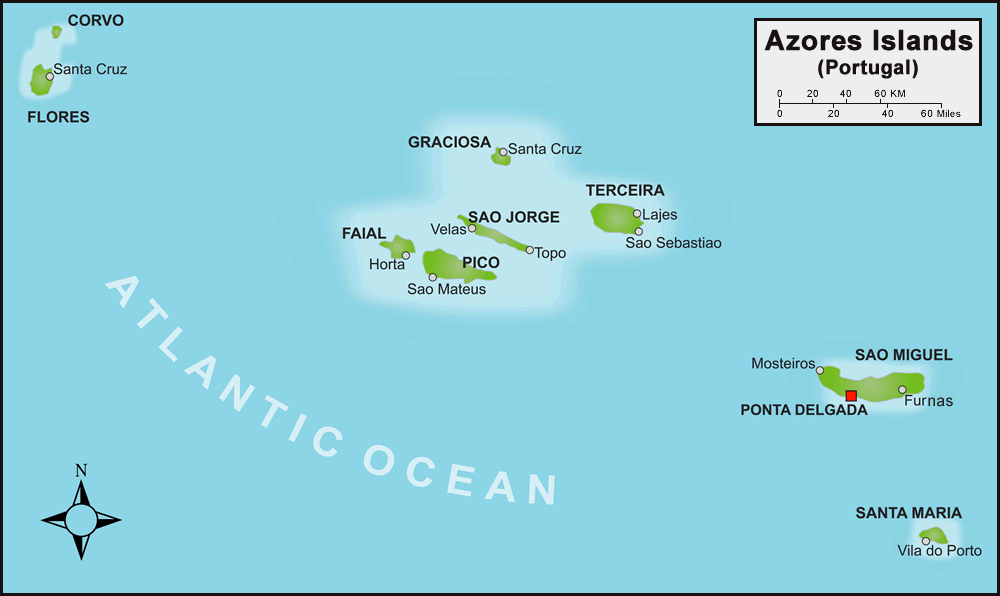
My 6th and final Azores beacon confirmed (there are only 6 active NDBs on the Azores) is PI on 420 kHz. This beacon is located on Pico Island. Pico Airport is also a smaller airport operated by Sata Aeródromos. But in addition to flights to the island of Terceira and Sao Miguel it also offers flights to Lisbon in mainland Portugal.
My report was confirmed by Marco Figueiredo from Nav Portugal.
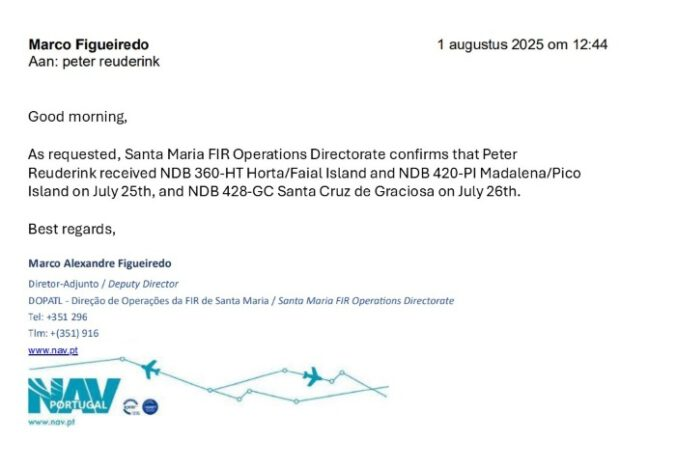
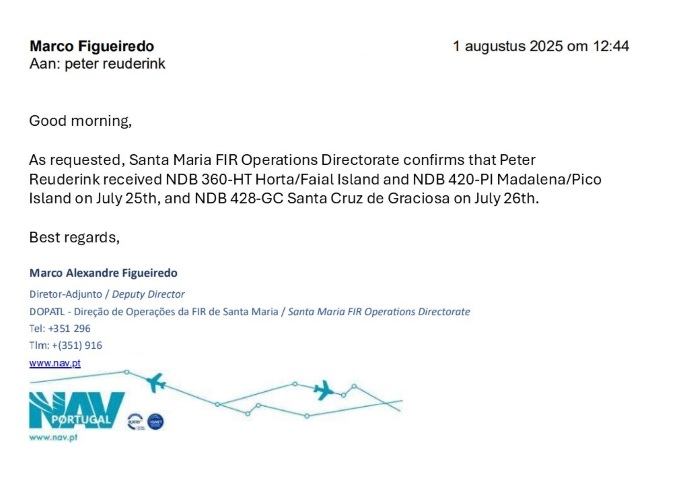
During the night of July 25th/26th I heard three new NDBs from the Azores. GC on 428 kHz on Graciosa Island was one of those and it was confirmed with the other two by Mr. Figueiredo from NAV Portugal:
The bigger airports of which I received other beacons (Horta, Ponta Delgada, Flores) are managed by ANA Aeroportos de Portugal. Smaller airports like Graciosa are managed by SATA Aeródromos. They also operate the airports on Islands Corvo, Pico and São Jorge. SATA is the abbreviation of Serviço Açoriano de Transportes Aéreos and they also operate the daily flights to Graciosa to Lajes and Ponta Delgada.
The night of July 25th/26th offered excellent reception conditions from the Azores. I heard all 6 NDBs including 3 new ones! Mr. Figueiredo from NAV Portugal was so kind to confirm my reception report. So my Azores collection is now complete
NDB HT Horta on 360 kHz is one of two NDBs on Faial Island. The other one, FIL on 380 kHz, is easier to receive in The Netherlands. Horta Airport is relatively small with flights to neighbouring islands in addition to a scheduled flight to Lisbon, Portugal.
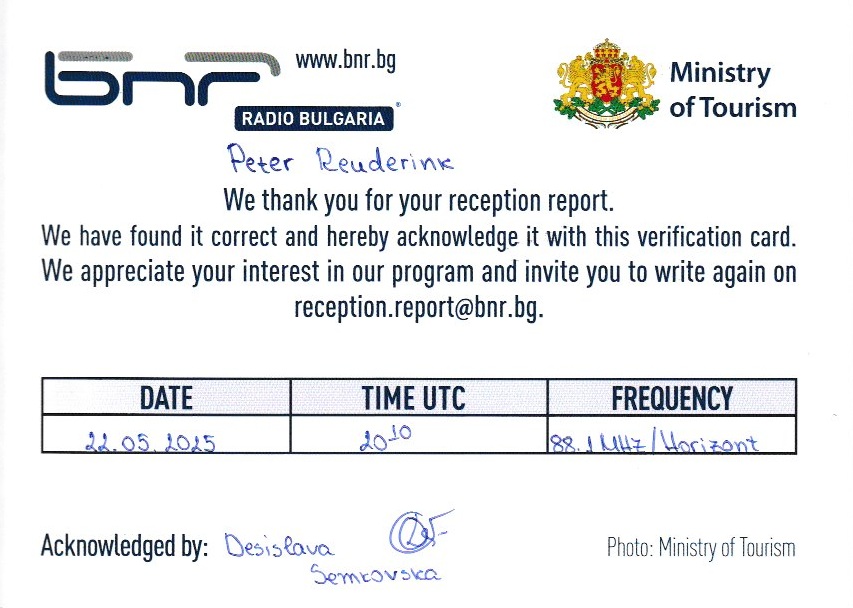
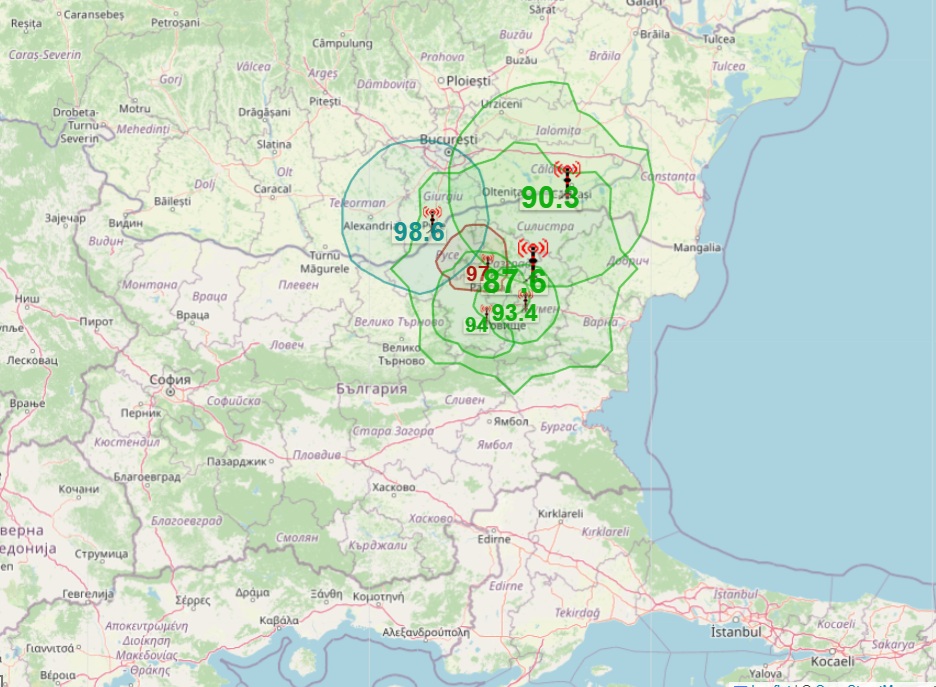
During the opening on 22 May I received several stations from Bulgaria: BNR Radio Varna, Radio Shumen, Radio Hristo Botev and the national program Radio Horizont. Via reception.report@bnr.bg I received a beautiful QSL card confirming my reception report:
QSL card BNR Horizont, 88.1 MHz
I received BNR Horizont via their 91 kW transmitter located in Kavarna, situated on the Black Sea coast.
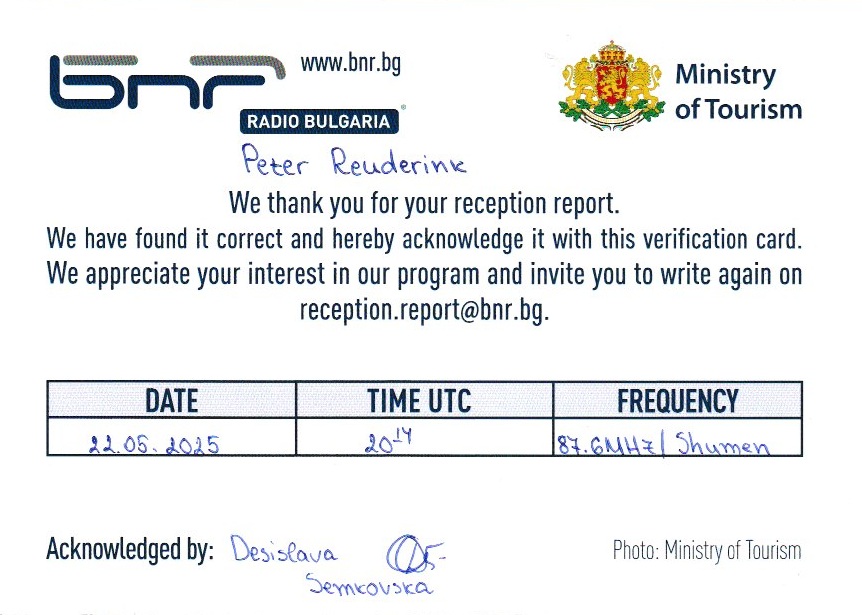
I like it when an organisation understands that they are representing a country. And send QSLs to people who are interested. If anything Bulgaria is on my “bucket list” now for visiting European countries. My report of a reception of Radio Shumen on 87.6 MHz was confirmed by BNR reception.report@bnr.bg . They sent this beautiful QSL card by mail!
I received Radio Shumen with a sports coverage on a local sports game. The ID is clearly heard on 7 seconds in this audio clip:
There are a few Radio Shumen transmitters, but the one from Venets is one of the stronger ones with 100 kW. Not that this necessarily matters much with Sporadic E receptions.
BDXC : SWL 2262 PRe VERON : NL 14228 If you want to get in touch, just leave a message on one of my posts. Please note that I don't publish email addresses of verifiers which are not part of the public domain. So if you don't see the QSL address, just leave a message and I'll get back to you.
Feel free to copy anything on this weblog. I try to provide accurate information, but if I'm wrong: don't blame me! A link back to my site is appreciated when you copy info.