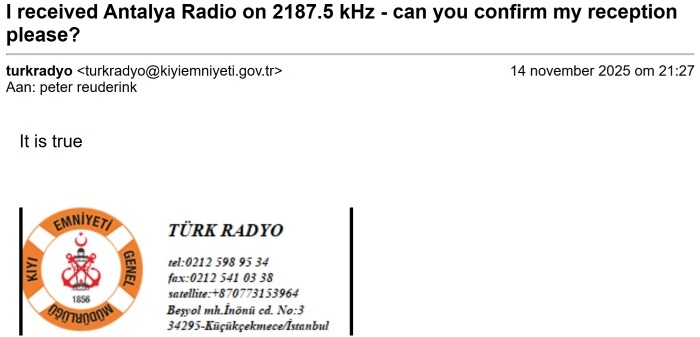
As far as I know there are 4 stations active on DSC watch 2187.5 kHz from Turkey. Earlier I received replies from Istanbul Radio, Samsun Radio and Izmir Radio. So when I received a test confirmation from Antalya Türk Radio on a test message of tanker ADRIA in the eastern Mediterranean I hoped to put a “crown” on my Türk Radio QSL collection.
Unfortunately contrary to the other QSLs which contained a polite and detailed confirmation, this one was just an “It’s true” message… More text than my Buenos Aires Radio QSL, that’s true… and if anything I’m grateful for the reply.
A very “to the point” QSL from Antalya Türk Radio on 2187.5 kHz
Radio Metropolis broadcasts with 1 kW from Trieste, Italy. Despite relatively low power it is not a difficult catch. And I have a soft spot for that deep voice announcing “Radio Metropolis”. The only thing I observe is that they are often subject to deep fading like the other low power Italian stations.
Radio Metropolis, Trieste, 1503 kHz as received on my QTH (with the antenna not really in the optimal direction: 120/300)
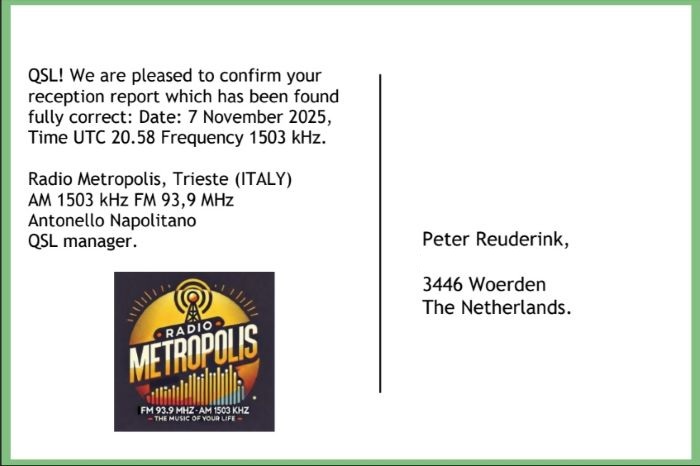
I tried to QSL them in the past, but I was never succesful. Until I learned last week that my friend Antonello Napolitano, known for his DX-fanzine bulletins, is hosting a DX show. And he was so kind to QSL my report.
QSL Radio Metropolis, Trieste, 1503 kHz
This is what Antonello wrote:
As you may be aware I am the producer and host of a DX show in Italian called “Bande Rumorose” carried over 5 italian MW stations (Radio Metropolis, Radio Briscola, Emmereci Radio or Media Radio Castellana, Power 927 and Radio centrale Milano). If you listen to “Bande Rumorose” on any of the above mentioned stations and send me a reception report I will verify it with a specific e-QSL.
For the sake of good order, let me add that reports based on reception via public remote SDR receivers (Twente, Kiwi and so on) will not be verified. The reason is simple: such reports are useless as we can check such receivers by ourselves. Last but not least, I want to recognize the efforts made by true DXers for picking up the signals from those Italian stations.
“Bande Rumorose” is also distrubuted via its channel on youtube which can be found at this link:
The program, which I describe as an old style DX show, consist of DX News, profile and/or history of both, MW and SW; stations from allover the world, interviews with DXers and shortwave personalities (for example Dino Bloise) and logs of recently received medium and short wave stations (some of them accompanied by good quality recording of their jingles or station identification announcements!).
“Bande Rumorose” is on air as follows (All times CET = UTC+1 hour):
• Emmerreci Radio, Castel San Pietro Terme (BO), Sundays, at 1100, Fridays at 2300 on 711 e 1098 kHz. • Power 927, Abbiategrasso (MI), Sundays at 1100, Mondays, Thursdays, Saturdays, at 2100 on 927 kHz. • Radio Briscola, Lenta (VC), Sundays, at 1100 e 1830 on 1449 kHz. • Radio Centrale Milano, Milano, Sundays, at 1030, Mondays, at 2300 on 1575 kHz. • Radio Metropolis, Trieste, Sundays, at 2205 on 1503 kHz and 93.90 MHz FM for the city of Trieste.
But I still received a nice new Transatlantic Station: WQBA from Miami!
1140 AM is the channel on which I typically receive CBI “CBC Radio One” from Nova Scotia, Canada. But this time I heard a few Latin American songs, and a clear ID “11-40 AM” in Spanish. I wasn’t sure about the station call though (in hindsight I didn’t recognize the American “Double – U” as I was focused on Spanish and so I didn’t even realize that the call sign was pretty well audible). The four songs I heard were all by singers from Puerto Rico. The only station from Puerto Rico on this frequency, WQII “Once Q”, was listed as “inactive”.
Recording of ID… once you know what to hear it is quite clear: “Double-U -Q-B-A 11-40 AM, El Pulso de Miami”!
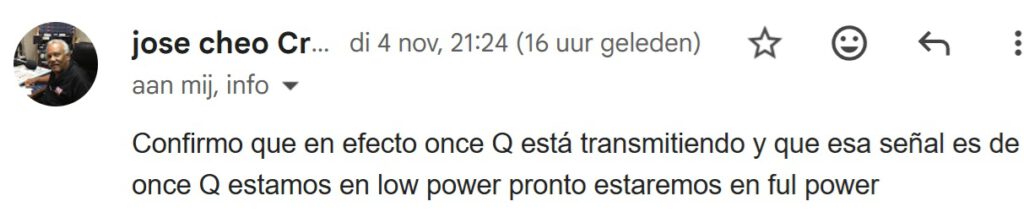
So as their website seemed “alive and kicking” I sent a report to Mr. Jose Cheo Cruz and received a confirmation within an hour… so it seemed that it really was “Once Q”, currently still at low power, soon to be heard a full power.
Now we might miss the traditional QSL card these days, but it is so much easier to connect with other DX-ers around the world. So I posted my “alleged” reception “for comments”. Both Mauno Ritola from MW-list and Guido Schotmans from the Benelux DX Club pointed out that it was WQBA “El Pulso de Miami” I heard. Mauno was so kind to include the recording below, and if you compare it to mine it is clear is was WQBA. As I experienced with other stations: “If you now what to hear, it is so easily recognizable”.
The WQBA ID in perfect quality… matches my reception
Disappointing? Maybe, but it is still a new Transatlantic station for me. The only thing is: will I get it QSL-ed?
Despite the annoucements on their website and enthusiastic replies from the owner, it remains to be seen if “Once Q” is really active, or even will become active on 1140 AM.(UPDATE: Mauno Ritola contacted Mr. Cruz: they are “on-air”, current power is 500 W and they want to go back to 10 000 Watts… so who knows if I will be able to hear them in future)
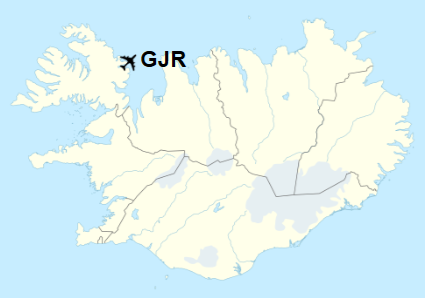
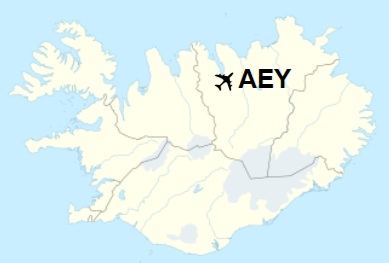
During the CLE-321 event I heard 5 new beacons from the north coast of Iceland. Beacons from the south and south-west are heard more often here in the Netherlands. My guess is that they benefit from transmission over water. This time there were excellent conditions to the Arctic regions allowing me to pick up these beacons including NDB 340-GJ Gjogur Airport.
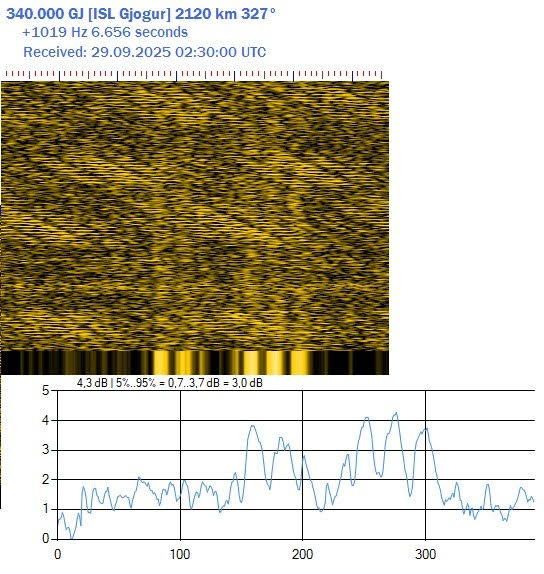
Gjogur –. .— on 340 kHz as registered with Pskov software
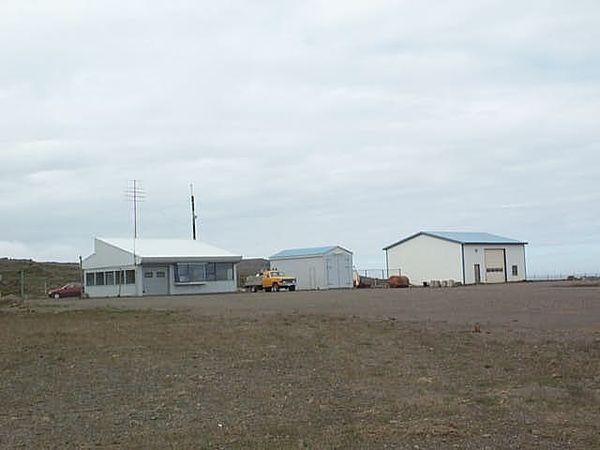
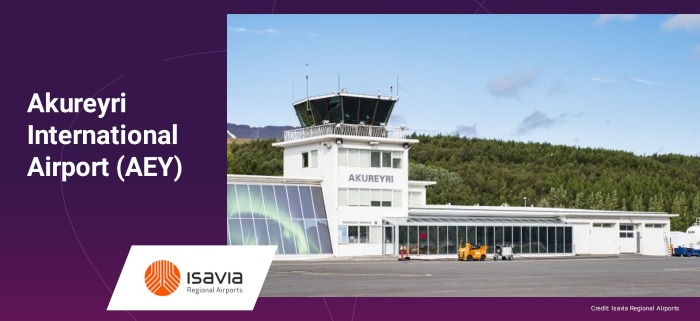
Earlier I wrote about the two beacons serving Akureyri Airport, a bigger international airport. This post is about 340-GJ for Gjogur Airport, or Gjögurflugvöllur.
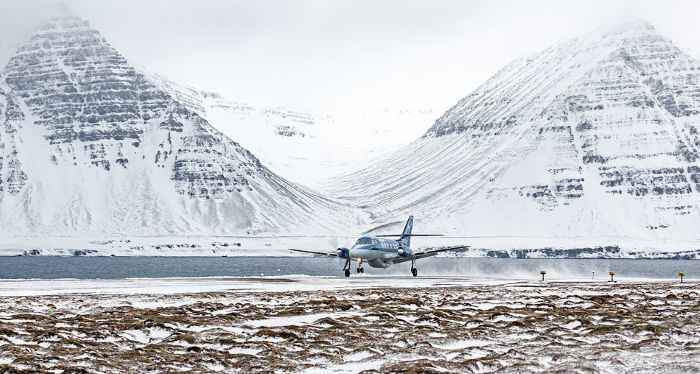
Gjogur is one of the airports that is purely there for the benefit of the local population, most likely sponsored by the Icelandic government. It is staffed part-time by an AFIS controller, and only opens for Norlandair flights, which are twice a week in the winter and once a week in the summer. In the winter, the airport is the only means of access to the entire district, as the access road is impassable.
There is a very nice slideshow “Descent into the Fjord” by Rajan Parrikar available on the internet that gives a nice impression of a flight to Gjogur Airport.
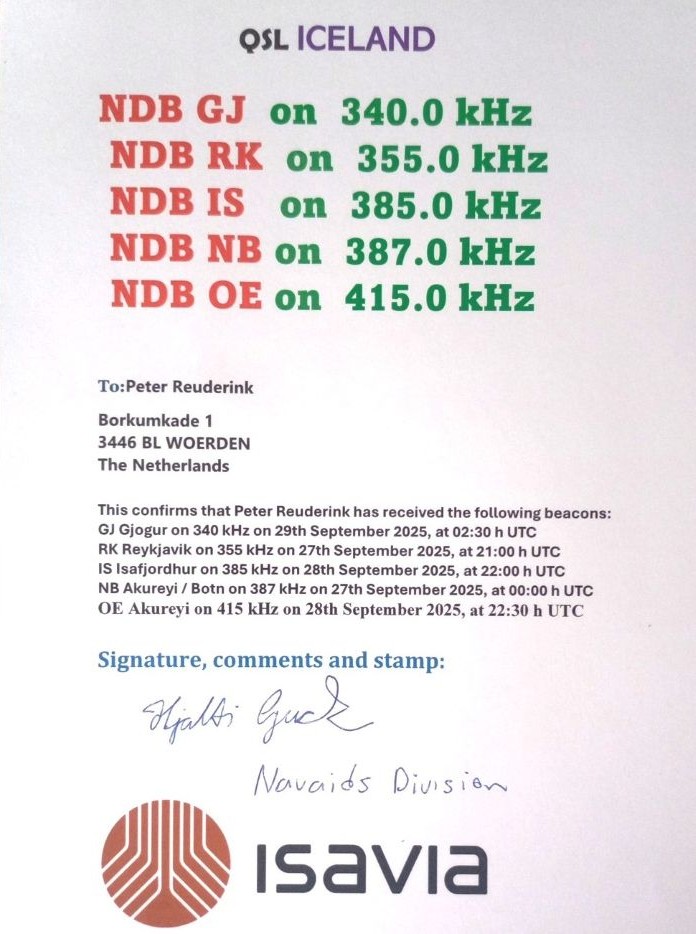
The weekend of September 27th I participated in a Collective Listening Event (CLE 321) of the NDB-list group. I just fitted my make shift antenna in the garden (5x5x5 delta with NTi Megaloop FX box). And stations came booming in… Not only did I receive 6 beacons from Nunavut (I will write about that later), but I also received 5 new beacons from Iceland. In hindsight I guess that exceptional conditions were more important than my antenna… but judging my other medium wave receptions my antenna is working well! Hjalti Guðmundsson from Isavia was so kind to confirm my reception.
eQSL for 5 NDBs from Iceland
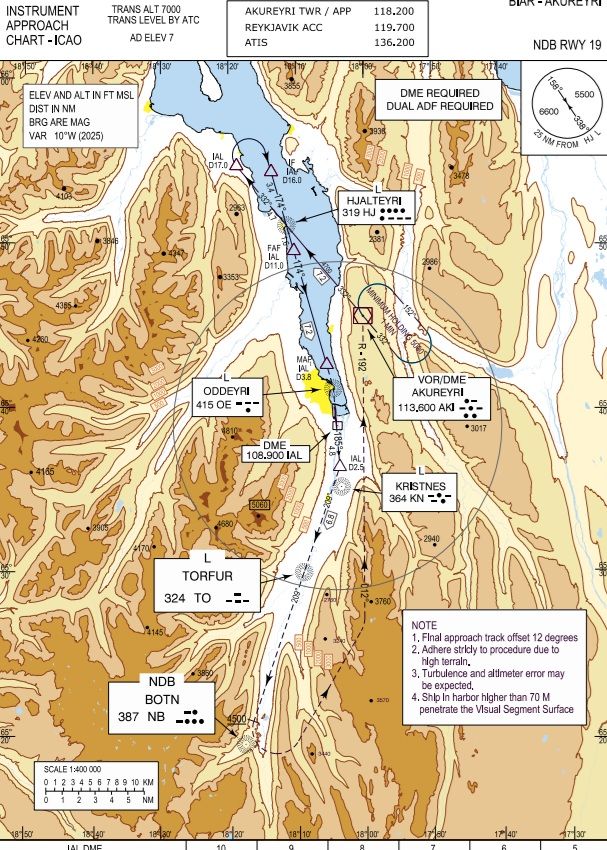
The first two beacons I’d like to comment on in my blog are NB on 387 kHz and OE on 415 kHz. Both are serving as navigation beacons for Akureyri Ariport. Akureyri Airport – or Akureyrarflugvöllur in Icelandic – was established in 1954. Already in 1928 there were flights to Akureyri, but those were seaplanes from Reykjavik landing on the fjord of Eyjafjörður. Today there are seasonal international flights from the UK, Switzerland and The Netherlands serving tourism.
I struggled a bit to find the location of both beacons, but I guess the map below is correct. I tried GoogleMaps to find a picture of the beacons… but so far I wasn’t successful. If you are… please let me know in the comments.
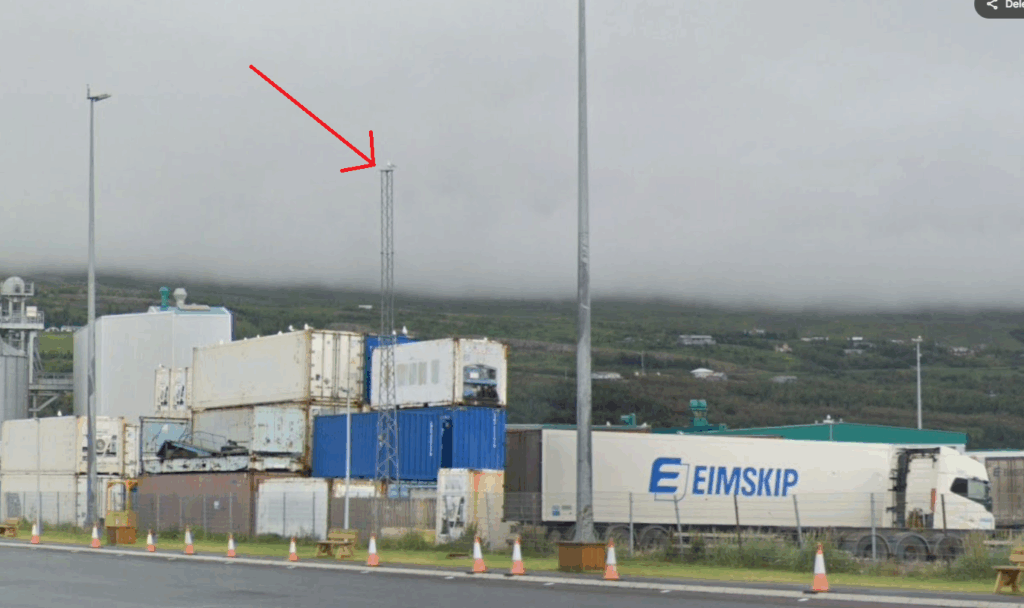
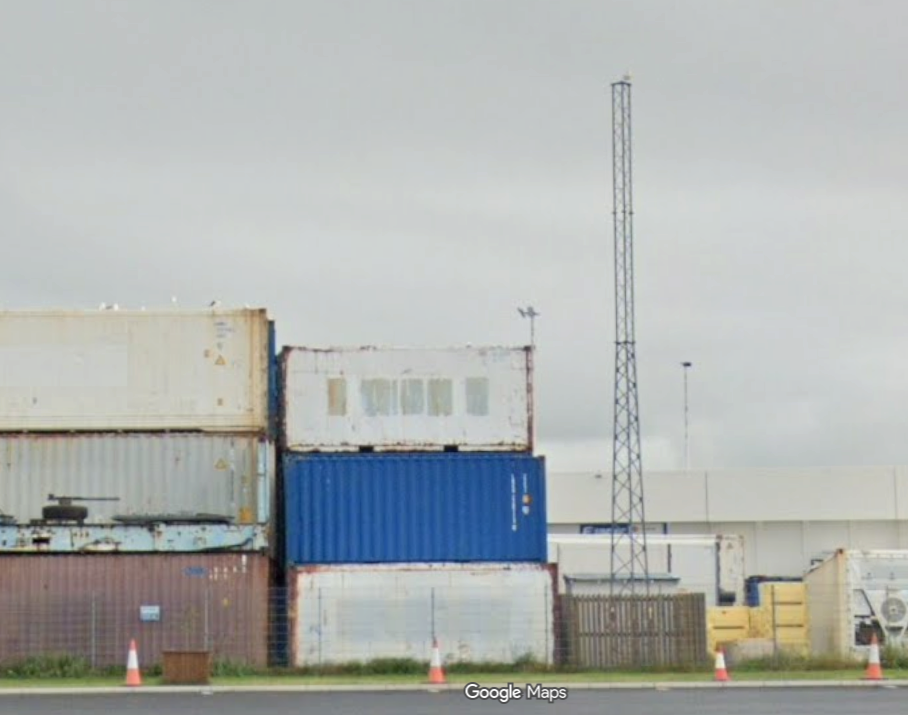
UPDATE: Patrick ON4CDJ informed me that by using the coordinates provided by several sources for NDB OE you end up on an industrial parking lot. Between the light poles there is one strange mast – occupied by a seagull. Is this NDB OE?
In June 2024 I listened to a program of Crusader Radio via Channel 292 on 9670 kHz. A few weeks ago (65 weeks later) I received a nice reply and confirmation for my report. Now I have to wait and see whether a “snail mail” QSL will reach my letter box.
Hi Peter,
thank you for your email and I can of course confirm that you received the program and it is a pleasure to do via email. Thank you very much for taking the time for the reception report. I have to apologise for the late reply. I am just wading through just short of 2000 emails of whom 95% are spam or scam.
The more refreshing it is to find a geniune email. You have added your address. We will soon be sending out real snail mail QSL cards I will make sure that yours will be in the batch to be sent out.
thank you very much again for your email.
Crusader Radio is broadcasting religious programs focusing on how to reach Salvation “through faith alone in our Lord Jesus Christ”.
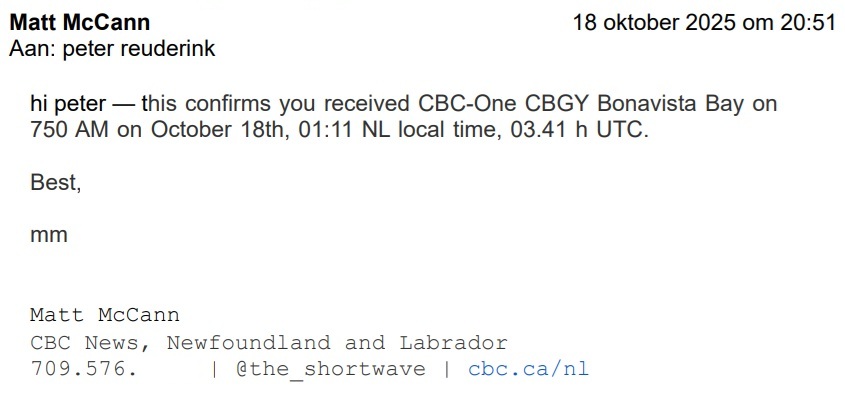
A QSL from CBGY CBC Bonavista Bay, Newfoundland, Canada on 750 kHz. I struggled to hear them earlier due to the presence of nearby MCB from Alphen aan de Rijn on 747 kHz. But now that one has move to 846 kHz I can hear CBC regularly.
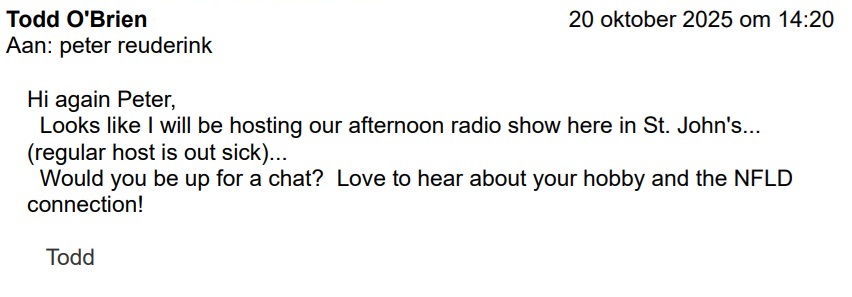
My report to radionews@cbc.ca received three different answers from people at CBC. One of them was Todd O’Brien who invited me for an interview in the afternoon show he was hosting. They replayed my recording of a topic on the Toronto Blue Jays and the original clip to show the listeners the difference is quality. How nice is that!
Since 2018 the Voice of Indonesia is back on shortwave. They are using frequencies in the 90 meter band (3325 kHz) from Palangkaraya on the island of Borneo and 60 meter band (4755 kHz) from Jakarta on this island of Java. A remarkable change of strategy as most broadcasters have left shortwave, and tropical band frequencies in particular.
According to Voice of Indonesia the reason is to promote Indonesian culture and government views, at relatively low costs and with the ability to reach areas where digital infrastructure is not as easily available as in other parts of the world.
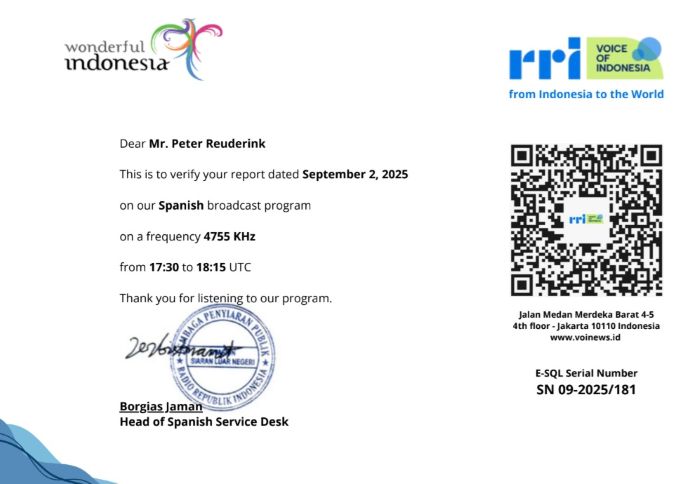
eQSL from RRI Voice of Indonesia on 4755 kHz
Via voilisteners@gmail.com I received a personal email and a beaticul eQSL card for my reception of their program on 4755 kHz. I listened to their Spanish and German program which could be received in reasonable quality at 17:30 and 18:00 h UTC respectively. They even have a Dutch program which I will try to receive on 3325 kHz in the coming months.
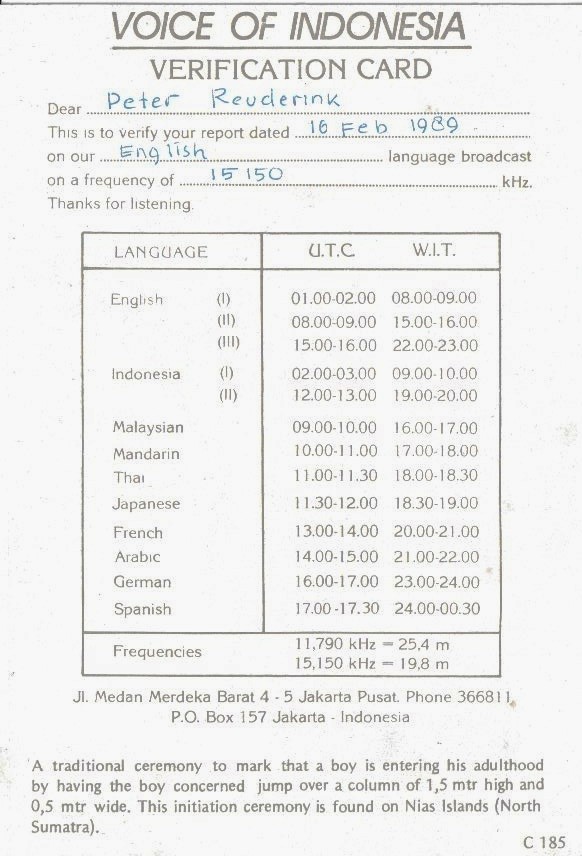
My first QSL from the Voice of Indonesia is from February1989. See below.
1989 QSL from the Voice of Indonesia
In those days they were still broadcasting in the 25 and 19 meter band, and despite their 100 kW of power I don’t recall it being an easy catch. Funny thing is that in those days they didn’t have a broadcast in Dutch.
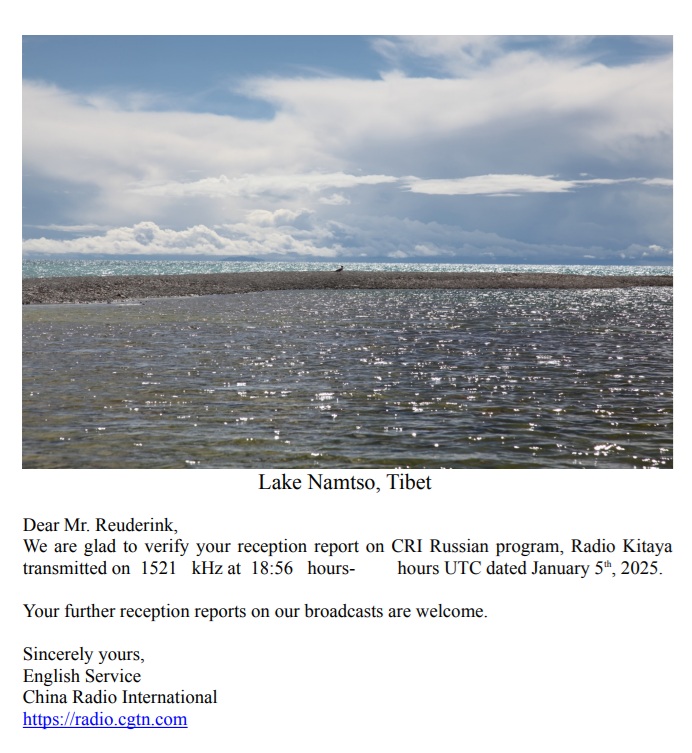
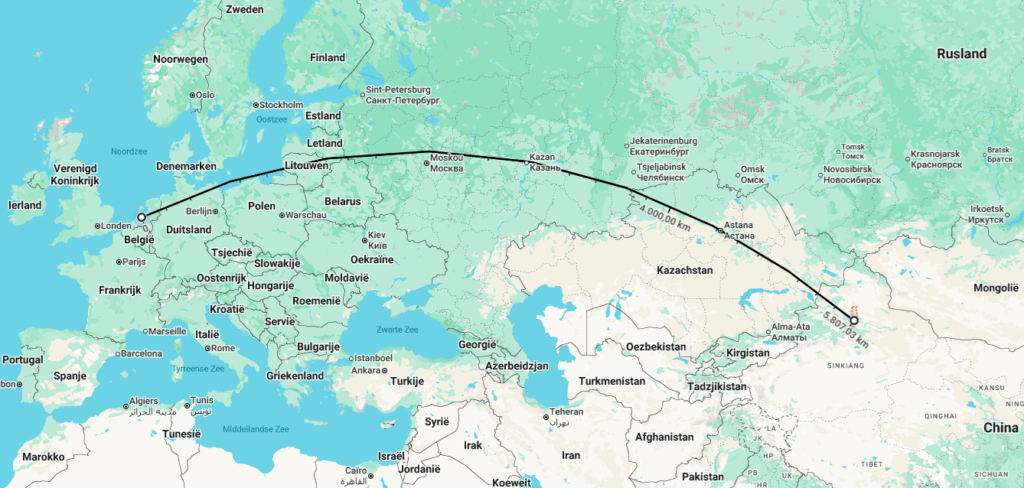
My first medium wave QSL from China! CTGN, or China Radio International is broadcasting in Russian language on 1521 kHz from Hutubi with 500 kW. Hutubi is located 60 kilometers from Urumchi, the capital of Xinjiang. Officially the Xinjiang Uygur Autonomous Region.
eQSl from CRI Radio Kitaya on 1521 kHz via English Service
On the audioclip below you can hear the familiar CRI tune, followed by a Chinese and Russian ID: “Govorit Mezhdunarodnoye Radio Kitaya (This is China Radio International speaking)”. I sent my report to crieng@cri.com.cn. After a recent reminder I received the e-QSL
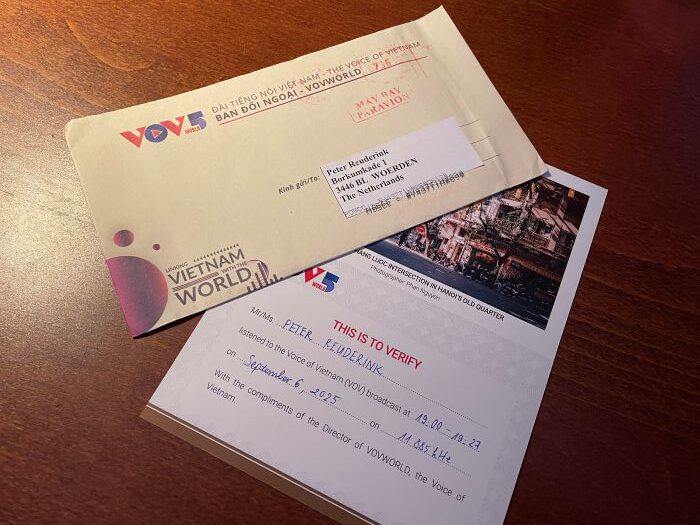
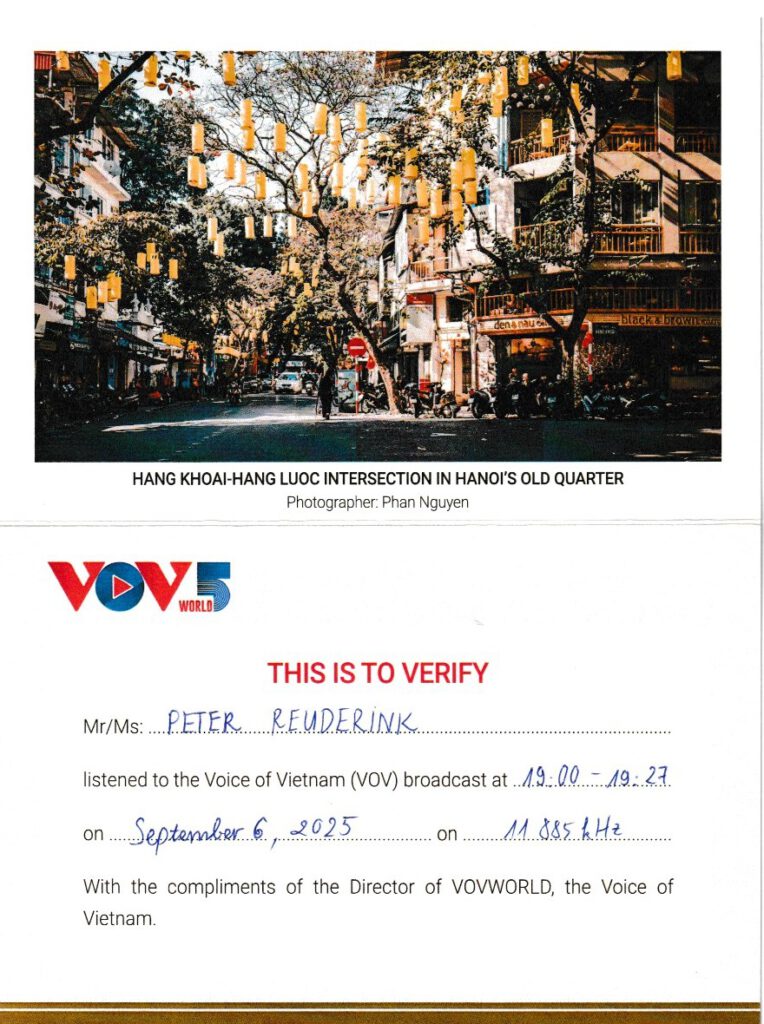
Earlier I wrote about the 80th anniversary of the Voice of Vietnam. My reception report to englishsection@vov.vn was awarded with a beautiful traditional QSL in a nice envelope:
BDXC : SWL 2262 PRe VERON : NL 14228 If you want to get in touch, just leave a message on one of my posts. Please note that I don't publish email addresses of verifiers which are not part of the public domain. So if you don't see the QSL address, just leave a message and I'll get back to you.
Feel free to copy anything on this weblog. I try to provide accurate information, but if I'm wrong: don't blame me! A link back to my site is appreciated when you copy info.