"It's not true I had nothing on, I had the radio on" - Marilyn Monroe

Tag: QSL (Page 39 of 54)

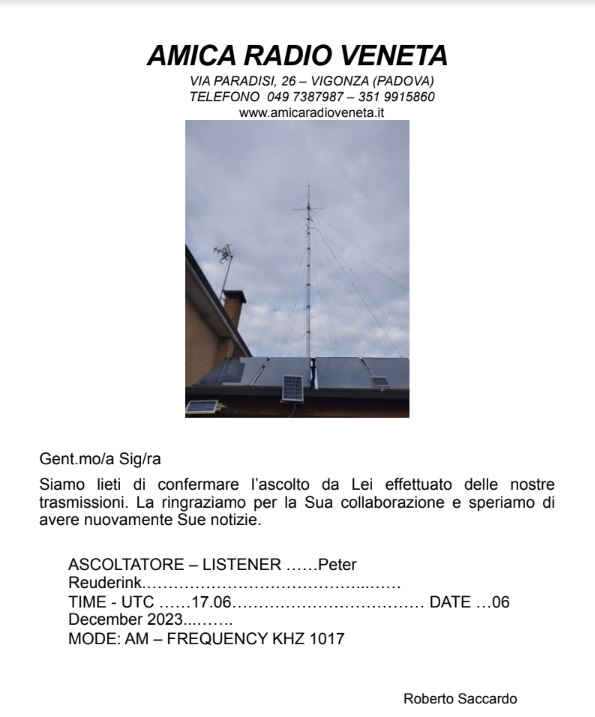
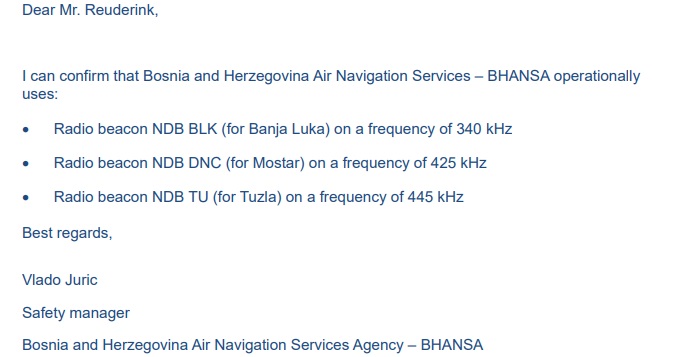
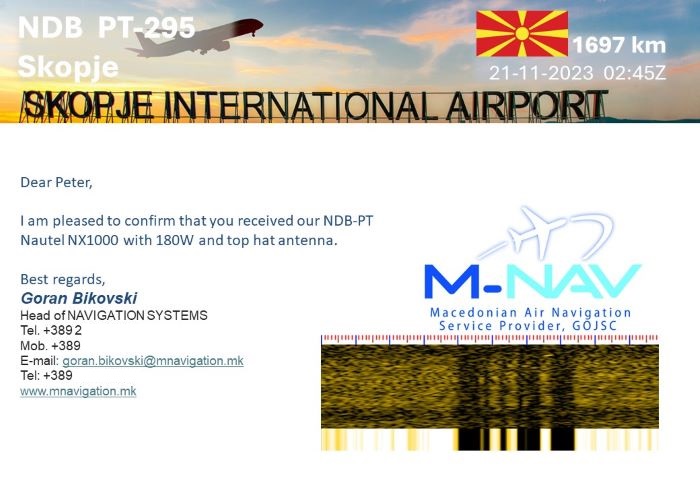
QSL NDB PT-295 Skopje. My 190th radio country!

Yes it is in! An email to QSL NDB PT-295 Skopje. My 190th radio country: North Macedonia! I sent my report to M-NAV, the company responsible for management and control of civilian air navigation in North Macedonia: info@mnavigation.mk .

My first QSL from Macedonia: NDB PT on 295 kHz from Skopje

The republic of North Macedonia declared independence from the Yugoslav Federation in 1991. But it took until 1993 before the country was recognized by the United Nations under the name “Former Yugoslavian Republic of Macedonia (FYROM)”. Which turned it into a new “radio country”. I tried to get a QSL from Radio Skopje, a station operating a 1000 (!)kW transmitter on 810 kHz in those days. But where I was never successful prior to independence, I wasn’t succesful after. Once again “NDB DX-ing saved my day”!

The name “Macedonia” was disputed by Greece. They feared that the new republic would lay a claim on the Greek region of Macedonia. The fact that the Vergina Sun featured on the flag of the new republic did not help. Nationalists proposing to depict the “White Tower of Thessaloniki” on the new banknotes aggravated the issue. Fortunately, in 2019 the two countries settled their arguments by signing the Prespa Agreement. The formal name is now Republic of North Macedonia.

A bit awkward maybe is the fact that the EDXC still uses Macedonia to refer to the country with ITU code MKD.

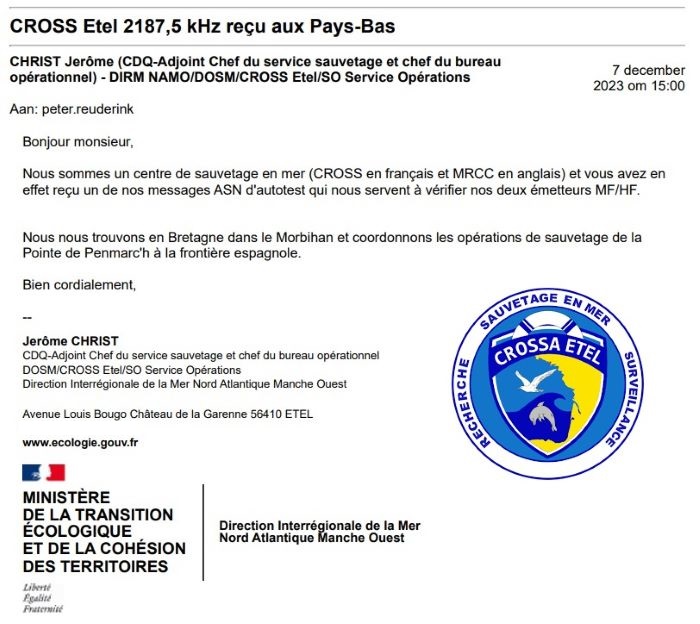
QSL CROSS MED La Garde, 2187.5 kHz

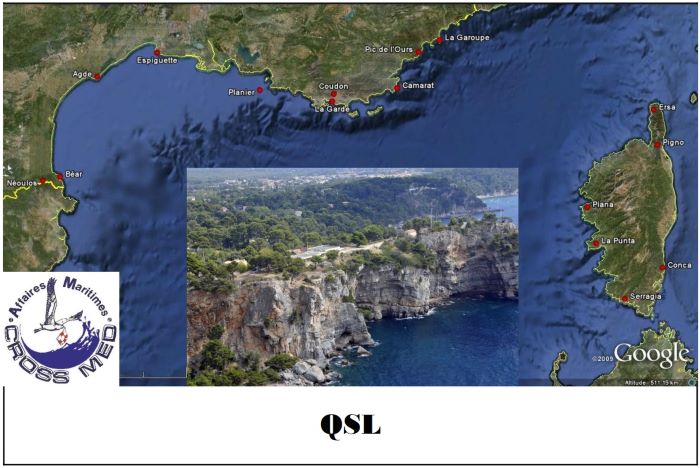
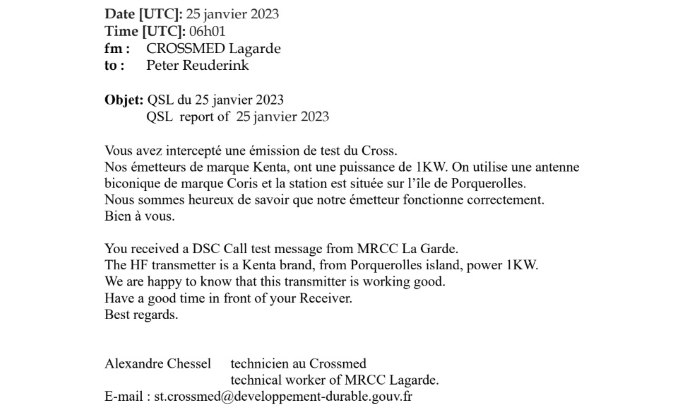
A nice e-QSL from CROSS MED La Garde, France, on 2187.5 kHz. A station that can be heard regularly with DCS messages.

QSL CROSS MED La Garde
e-QSL card CROSS MED Lagarde, 2187.5 kHz

I have to admit that I’m still trying to establish the link between the new DSC stations and what I heard some 40 years ago. Coastal Radio stations like Bordeaux Arcachon, Boulogne-sur-Mer, Brest-le-Conquest and Grasse are gone. But the current CROSS stations are not their descendants. They are the successors of the French Navy stations that were easy to hear in CW in the 80-ies, not only from France, but from all over the world… resulting in nice QSLs from countries like Reunion, Tahiti, New Caledonia and French Guyana for example.

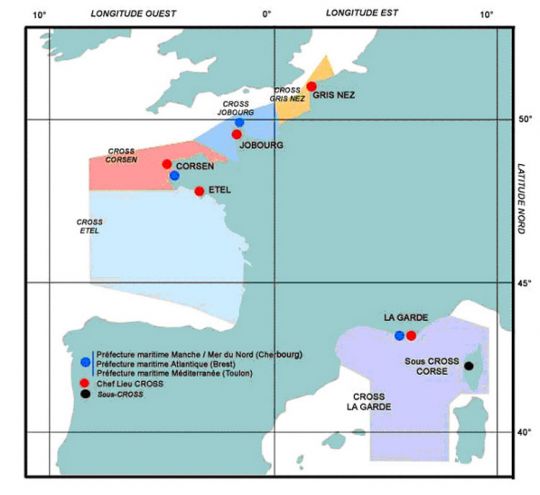
CROSS La Garde is one of 6 CROSS stations in France. The others are Jobourg, Gris-Nez, Étel, Corsen and Ajaccio. The latter, also known as CROSS Corse or “Aspretto” is a secondary station that heard less often. The community of La Garde is situated adjacent to Toulon, the most important French Navy harbor on the Mediterranean Sea (which also features in the movie “Napoleon” (2023))

QSL JRCC Piraeus 12577 kHz

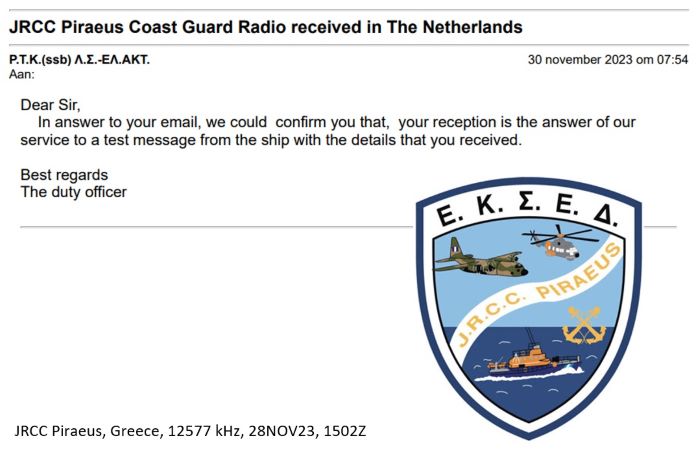
As far as I know JRCC Piraeus, Greece, is not heard too often with DSC messages, but this week the station was heard a few times on 12 and 8 MHz with DSC messages. I sent my report to contact@yna.gov.gr . Within a day I received an email from the Duty Officer to QSL JRCC Piraeus on 12577 kHz.

Email QSL for my reception of JRCC Piraeus with a DSC message on 12577 kHz

QSL JRCC Sweden 2187.5 kHz

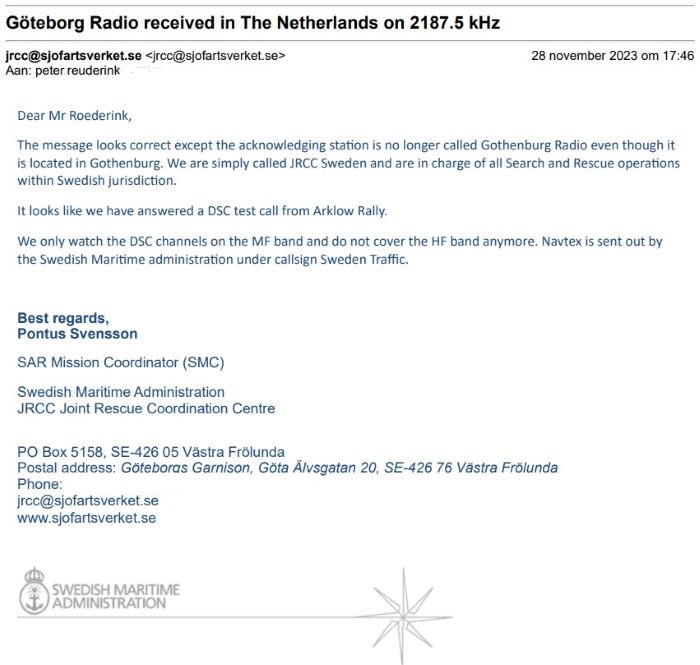
Göteborg and Stockholm Radio can be received regularly on 2187.5 kHz with DSC messages. As I already had QSLs from the 80-ies for I didn’t bother to send a reception report and QSL request for these two stations. But then I saw a QSL from Artur at MaresmeDX for JRCC Sweden. And I wondered how they are actually organized these days.

Within an hour of sending my reception report for a reception of MMSI 002653000, Göteborg Radio on 2187.5 kHz to jrcc@sjofartsverket.se I got an answer:

So it seems that everything on MF is now under the jurisdiction of JRCC Sweden. The HF band isn’t covered anymore. And I guess that the name Stockholm Radio is used for VHF DSC watch and weather broadcasts: https://stockholmradio.se/ .

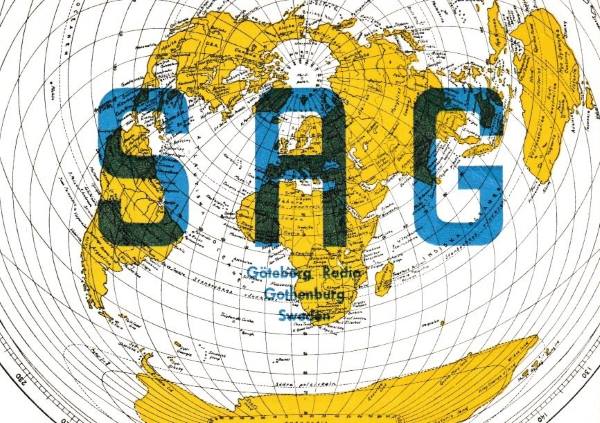
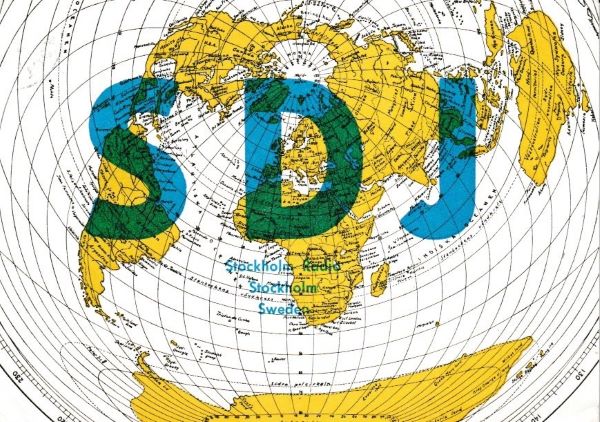
In the 80-ies you could listen to a couple of stations on MF. In addition to Göteborg (SAG) and Stockholm Radio (SDJ) I remember Karlskrona (SAA), Härnosand (SAH) and Tingstaede (Visby, SAE). The nice thing was that they had matching set of QSL cards. But although I heard all stations, I managed to get the QSLs for Göteborg and Stockholm Radio only…

1982 QSL Göteborg Radio SAG (1785 kHz)
1980s (I’ve two, both no details) QSL Stockholm Radio SDJ

QSL Radio Eli 1035 kHz

Things are a bit slow as I didn’t spend too much time behind the radio the last couple of weeks. But there are still some QSLs from a year ago that I didn’t post yet, as I received them before I started this weblog. This QSL for Radio Eli, Estonia on 1035 kHz is one of those.

QSL card Family Radio, Radio Eli
a very nice e-QSL card from Radio Eli, Estonia, 1035 kHz

Radio Eli aims to bring the gospel to the countries of the post-Soviet space as they write on their website. They started in 2001 with a two hour Russian program of Tartu Family Radio via a 50 kW transmitter on 1035. In 2008 power increased to 100 kW. Since 2010 they are working together with Trans World Radio (TWR) and power increased to 200 kW, but this seems to be used for TWR and Radio Liberty transmission only. Using the loop antenna to block Radio Lyca from the UK on the same frequency they can be received quite well here in The Netherlands.

QSL Radio Timișoara 630 kHz

I received a polite email from the English desk of RRI to QSL my reception of Radio Timișoara on 630 kHz. They thanked me for my report and they will mention it in the upcoming Listener’s Corner on RRI. Funny detail: the English desk is very clear in communicating that engl@rri.ro should be the only address to be used, but their replies still seem to come from different addresses. Anyway: engl@rri.ro it is for you!

Like other stations in Romania (see my post on Marosvásárhelyi Rádió) Radio Timișoara has a rich history. Timișoara is most important city in the region called Banat, which is currently split between Hungary, Romania and Serbia. The name itself comes from the original Hungarian name Temesvár, which means “castle on the river Temes”.

As early as 1930 there were plans to create a “Radio Timișoara”. These plans were approved in 1939, but WWII thwarted execution. After the war the first programs began to be broadcast from Timișoara in 1952. In 1956 regular broadcast in Serbian and German language began, each with a 20 minute program. Censorship from Bucharest increased over the years, but Radio Timișoara managed to stay “out of sight” until Ceaușescu ordered the closure of all regional radio stations to facilitate censorship from Bucharest in 1985 .

Personally I vividly remembered Timișoara as the city where the Romanian Revolution started in December 1989 (I was 17 years old at the time). This led to the demise of the Ceaușescu regime. Soon after the revolution Radio Timișoara resumed broadcasts, and the Hungarian language was added to the program in addition to German and Serbian. Today they feature broadcasts in Czech, Slovak, Ukrainian, Romani and Bulgarian as well.

QSL Varna Radio LZW 16804.5 kHz

Two weeks after sending my report I received an email with a QSL letter for Varna Radio, call sign LZW, broadcasting a DSC message on 16804.5 kHz. I sent my report to varnaradio@bgports.bg .

It is always interesting to see how coastal radio and GMDSS (Global Maritime Distress and Safety System) monitoring is organized. From what I’ve seen it is usually an integrated part of the Coast Guard, which is either integrated in a Department of Transport or in the National Navy. In the case of Varna Radio however the station is embedded in the National Port Authority: Bulgarian Ports Infrastructure Co.

QSL Letter Varna Radio LZW Bulgaria

The signature of the QSL was attached in a separate picture:

QSL Iqaluit Coast Guard Radio 12577 kHz

QSL Iqaluit Coast Guard Radio, Canada
e-QSL from Iqaluit Coast Guard Radio, Canada

For my reception of a DSC message I received this beautiful QSL for Iqaluit Coast Guard Radio on 12577 kHz. I sent my report to: IQANORDREG@innav.gc.ca .

The duty officer apologized for taking so long to reply (about 5 months) but they had a very busy season. Of course that’s no problem at all and I’m grateful for the service they provide to us listeners. They also wrote that they enjoy receiving letters from all around the world!

As far as I know all DSC communications on shortwave (4 MHz and higher) are coordinated via Iqaluit, the capital of Nunavut in Canada. The station in Prince Rupert seems to be the only exception to the rule. I’m not sure what the status of the Canadian mediumwave Coast Guard stations is these days. In the 80-ies and 90-ies I could regularly hear them in SSB on 2182 kHz. But I don’t see any of them listed with DSC. So my guess is that, like their counterparts in the USA, distress calls are no longer monitored on medium wave.

QSL CFGO Ottawa “TSN 1200”

Receiving Transatlantic medium wave stations is still one of the nicest aspects of the DX hobby. Rick Furniss, engineer at CFGO was so kind to QSL my reception of CFGO Ottawa, Canada, better known as “TSN 1200”. I heard them with a TSN network program, broadcasting the NFL game between the Las Vegas Raiders and the Detroit Lions.

In his email Rick wrote that he receives more reports for the 50 kW sister station CFRA on 580 kHz, most likely because the antenna direction is more favorable for Europe. So that is another challenge for this winter. Rick also sent two nice pictures with comments which I’d like to share:

“The first is one of the Current Main Tx, a Nautel NX50 sitting beside our old backup Tx a Gates 10kW full tube unit. The Nautel is about 5 years old and the Gates is built in 1962 from a 1959 Gate Corp. drawing. It was removed from service after a small electrical fire in the power supply cabinet about 5 years ago but it worked great right up till then. We have not owned it from new but we did buy it from the station that did. We have it’s complete documentation and log books since the day it went on air, Truly a museum piece today. We also have a Nautel ND50 Tx not shown that is our current backup Tx for this site.” (Photo Rick Furniss)

“The second picture is of the 6 towers in the CFGO antenna array in south Ottawa. I was waiting to go into the site while a thunderstorm passed (It had taken us off the air with an Hydro failure) and I noticed the rainbow.” (Photo Rick Furniss)

A big “thank you” to Rick for the QSL and the nice pictures!

QSL NDB MIQ-426 Ingolstadt

QSL NDB Mike for Ingolstadt
A postcard QSL confirming reception of NDB MIQ-426 Mike for Ingolstadt

It took 36 weeks, but worth waiting for: a real postcard QSL confirming my reception of NDB MIQ-426 “Mike for Ingolstadt”. I sent my report to DFS (Deutsche Flugsicherung) in Langen, Germany. The beacon is located south of Ingolstadt, and you can actually see it driving on highway A9 between München and Ingolstadt (east of the highway).

Not sure where the “for Ingolstadt” comes from. The beacon is close to Ingolstadt airport. But it is not aligned with the runways and serves as a high and low level enroute navigation beacon according to ourairports.com .

« Older posts Newer posts »

© 2026 Peter's DX Corner

Theme by Anders NorenUp ↑