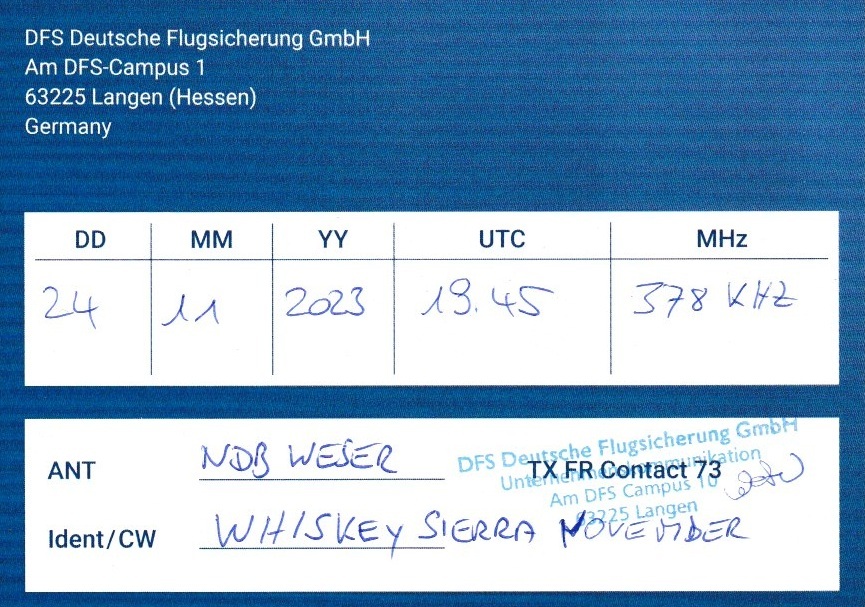
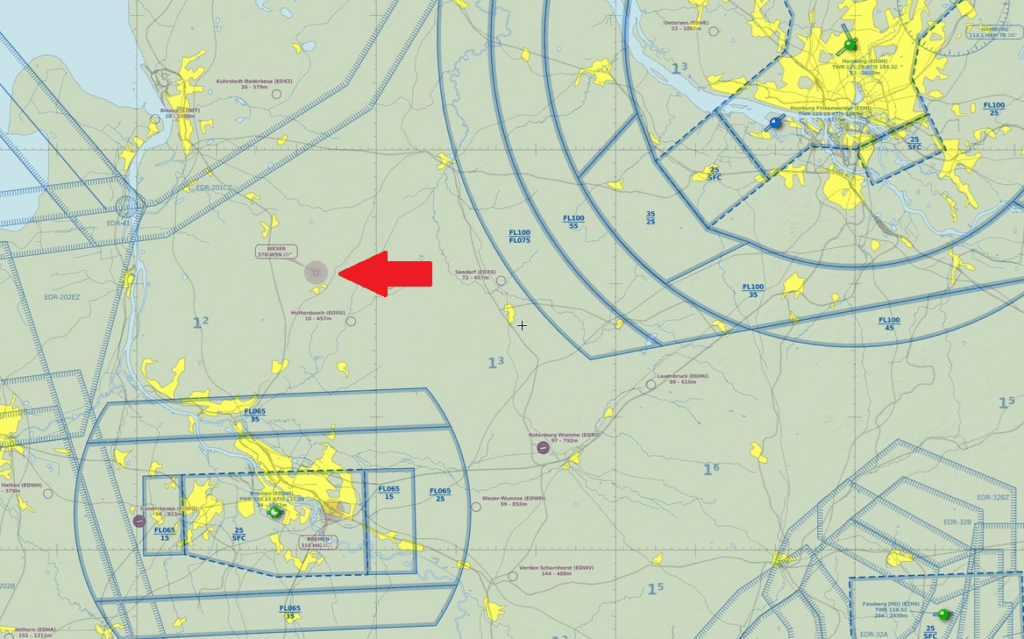
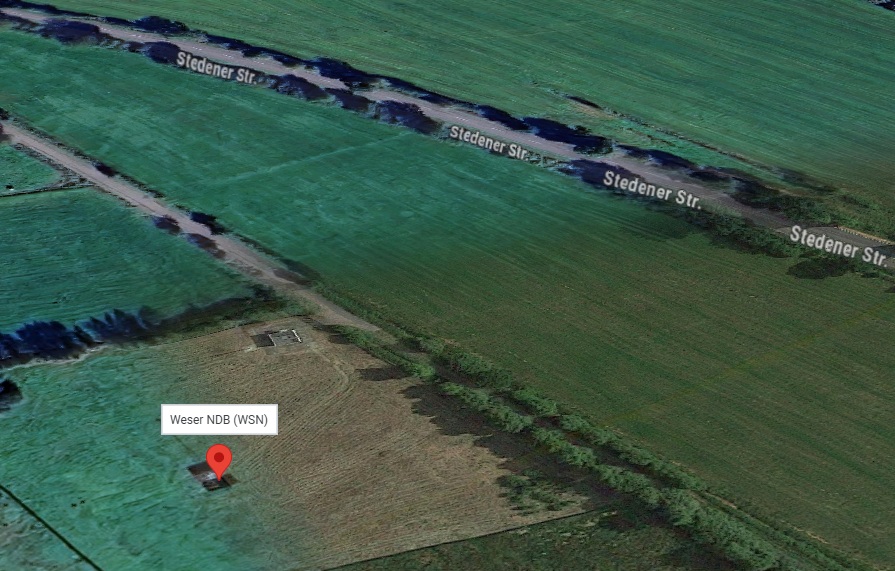
The function of this beacon is not immediately clear to me. I got no further than: primarily supports air navigation in the Bremen/Hamburg/Bremerhaven region of northern Germany. It is not aligned with any of the runways.
NDB WSN Weser located between Bremen and Hamburg (Skyvector)
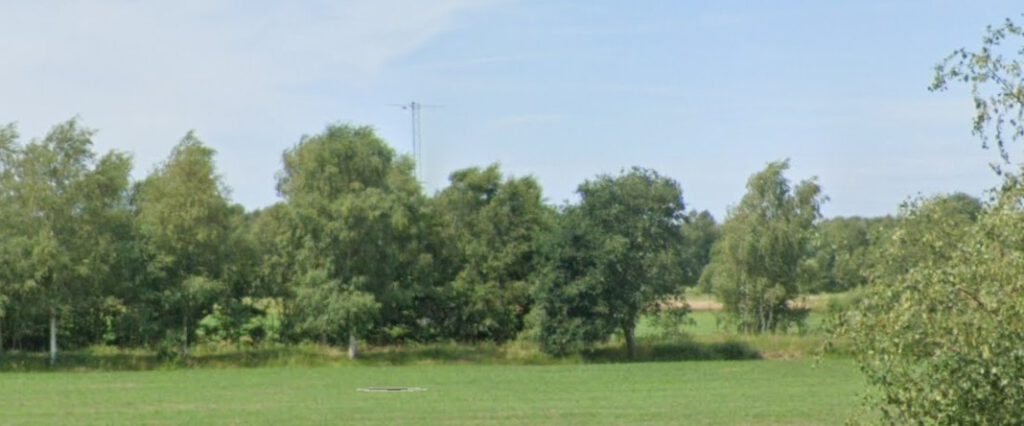
The beacon can be observed from some distance at Google Streetview, south of Holste.
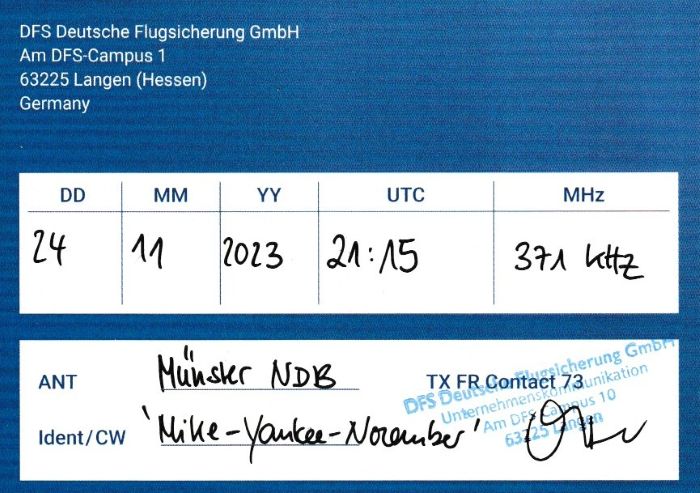
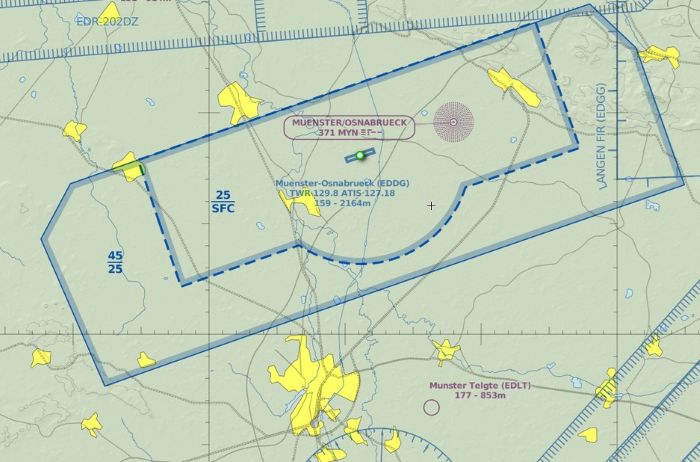
NDB MYN on 371 kHz, the navigation beacon for Münster Osnabrück International Airport, Germany, was among the 4 old school QSL cards I received after 2 years.
QSL NDB MYN Münster Osnabrück 371 kHz
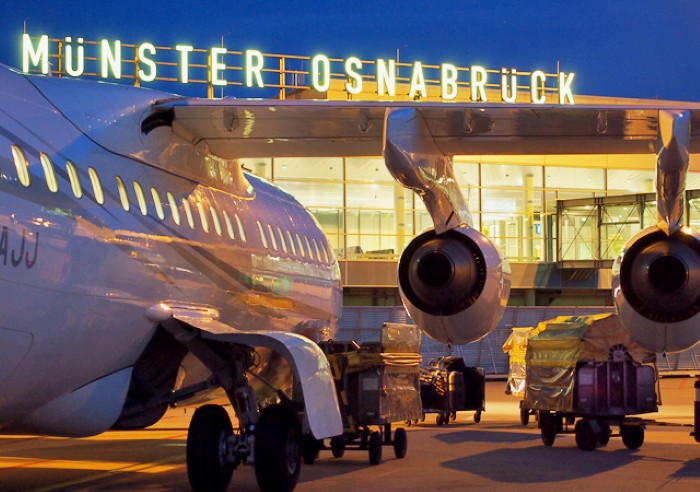
Münster Osnabrück Airport (FMO), traces its origins to 21 December 1966, when the cities of Münster, Osnabrück, and Greven, along with the districts of Münster and Tecklenburg, founded the Münster/Osnabrück Airport GmbH to serve the region’s growing transportation needs.
Construction began in 1968 with assistance from the British Army to clear the site for a runway. After five years of building, the airport officially opened on 27 March 1972, initially handling modest operations with propeller aircraft; the first charter flight followed in 1973. It gained international airport status in 1986 after runway extensions enabled larger jets like the Boeing 737, paving the way for Mediterranean holiday routes, while a new terminal opened in 1995 and Terminal 2 in 2002 to accommodate rising passenger numbers. Over the decades, FMO evolved into a resilient regional hub, achieving strong post-pandemic growth to exceed 1.25 million passengers annually by the mid-2020s, bolstered by leisure and domestic flights despite occasional setbacks.
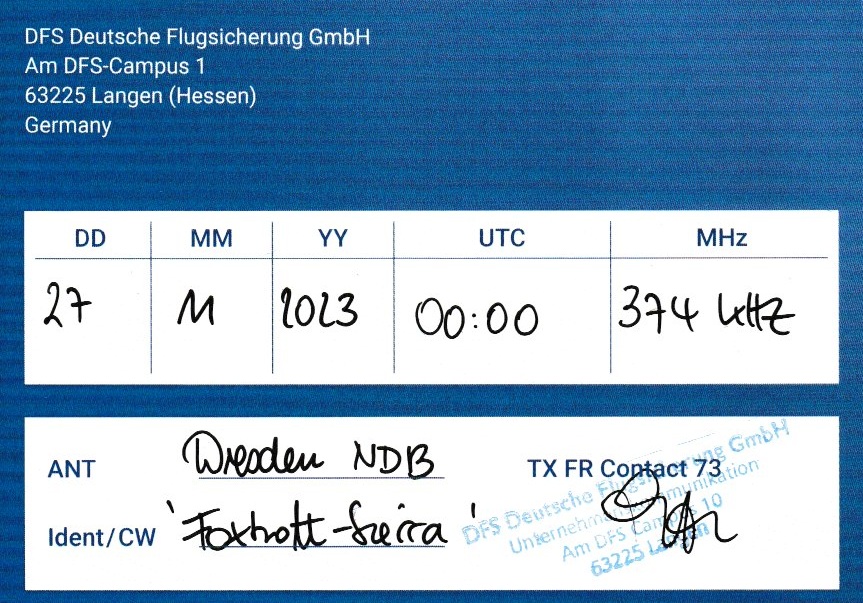
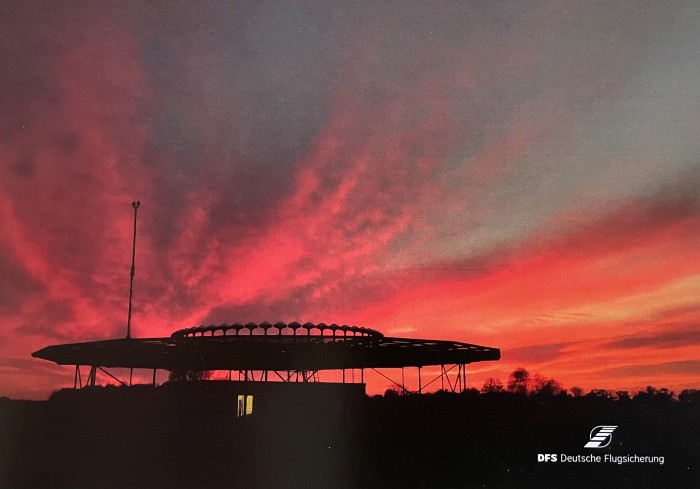
Two years after I sent my report I received a beautiful QSL card from Deutsche Flugsicherung confirming my reception of NDB FS-374 Dresden.
A traditional QSL card for my reception of NDB FS 374 Dresden
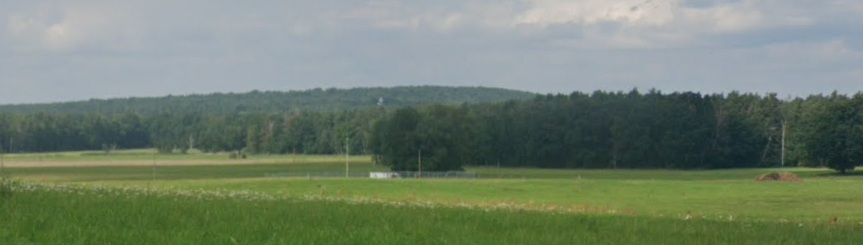
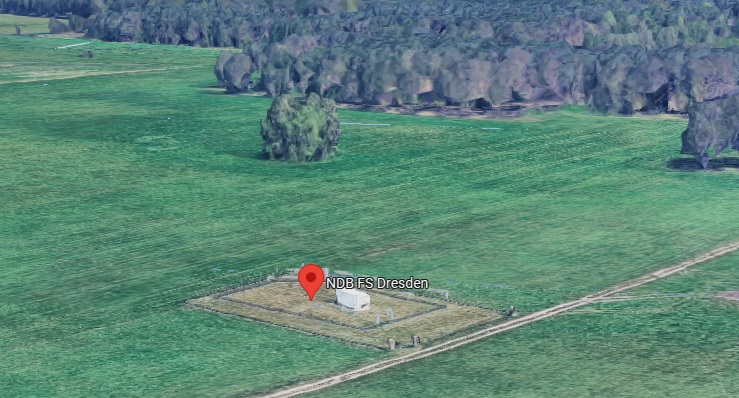
There are still quite a few NDBs operational in Germany, even for large commercial airports like Dresden. NDB FS is located 4.5 miles (7.5 km) NE of Dresden International Airport in line with the runway. Below the Googlemaps images of the location:
Googlemaps pictures of NDB FS Dresden
Dresden Airport opened to commercial traffic on July 11, 1935. Driven by Germany’s rearmament program after 1933 it served as both a civilian and military airfield. Although initially designed for commercial use, its military significance grew rapidly during the Third Reich, and it served exclusively military purposes during World War II, including supporting an airlift to Breslau in 1945. After Soviet occupation at the war’s end, the airport remained under military control until extensive reconstruction and negotiations enabled the resumption of civilian operations on June 16, 1957, in the German Democratic Republic. International flights to Eastern Bloc countries restarted in 1959. Following German reunification in 1990, the airport modernized significantly—with a new terminal in 2001, runway extension in 2007, and rebranding as Dresden International—transforming into a regional hub serving tourism, business, and seasonal destinations.
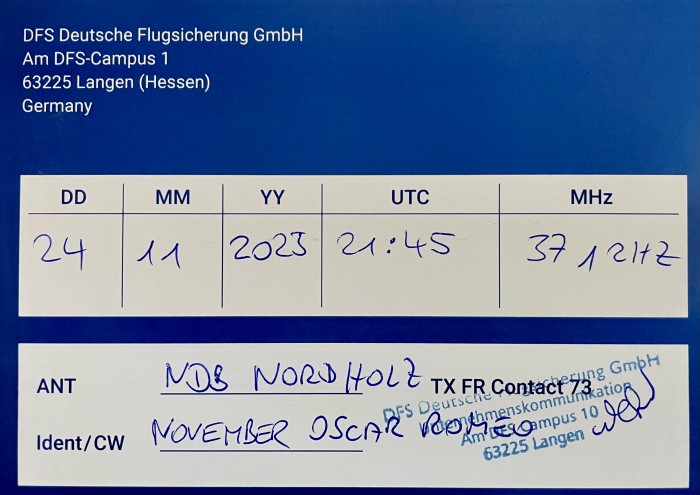
To my big surprise I received 4 QSL cards, the real stuff, by mail, from the Deutsch Flugsicherung. I sent my reception reports in 2023… 2 years ago. But they were worth waiting for:
DFS has a new QSL card
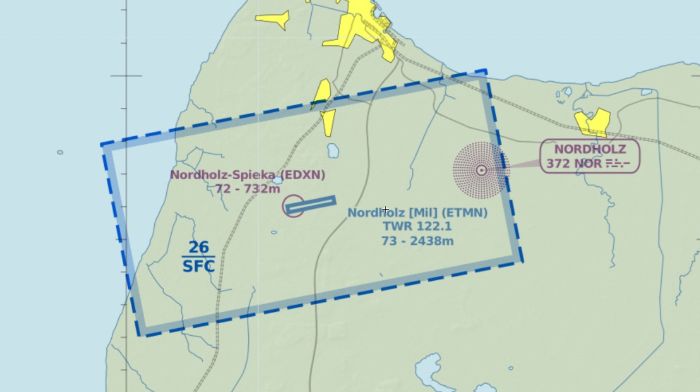
The first one was for NDB NOR on 372 kHz. This beacon belongs to the Nordholz Naval Airbase. Or in proper German: “Fliegerhorst Nordholz”. I like this “Horst” as it translates as “Nest of a predatory bird”, although I recognize that since WW2 it suffers a bit from a certain connotation.
NDB Nordholz and Nordholz Airport (courtesy: Skyvector)
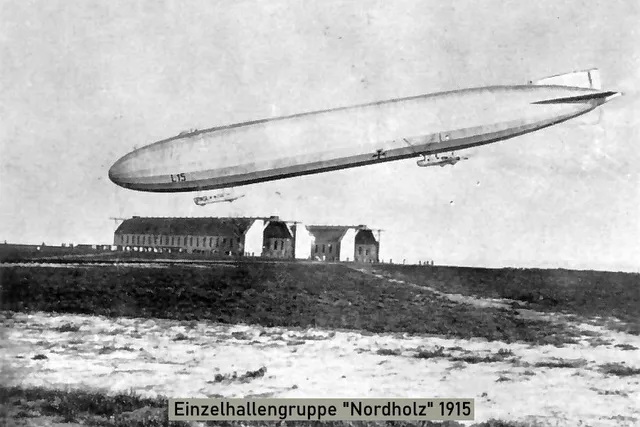
Fliegerhorst Nordholz stands as one of Germany’s oldest aviation facilities, with its origins tracing back to December 17, 1912, when the Imperial German Navy established it as a key site for naval aviation. The base was initially serving as a major airship port for Zeppelins during World War I. It housed units for both the Navy and Army, supporting reconnaissance and bombing missions with rigid airships like the famous Zeppelin L 3 making early landings there.
Zeppelin at Fliegerhorst Nordholz
After the war, in compliance with the Treaty of Versailles, several Zeppelins were destroyed on-site by their crews in 1919. The interwar period saw shifts in control, and during the 1930s, the Luftwaffe repurposed and expanded the site under code names like “Neckar,” using it for fighter and other operations throughout World War II. Post-1945, the base fell under American occupation briefly, hosting U.S. fighter units like P-47 Thunderbolts before being handed to the RAF, which dismantled much of the infrastructure.
Today, in 2026, Nordholz remains the central hub of the German Navy’s Marinefliegerkommando (Naval Air Command), hosting Marinefliegergeschwader 3 “Graf Zeppelin” and Marinefliegergeschwader 5. Marinefliegergeschwader 3 operates Lockheed P-3C Orion maritime patrol aircraft (with the transition to the advanced P-8A Poseidon underway, as the first examples arrived in late 2025) alongside Dornier 228NG for pollution control and surveillance. Marinefliegergeschwader 5 handles helicopter operations, including the NH90 Sea Lion for transport and the new NH90 Sea Tiger for anti-submarine and anti-surface roles, with deliveries progressing to replace the aging Sea Lynx fleet.
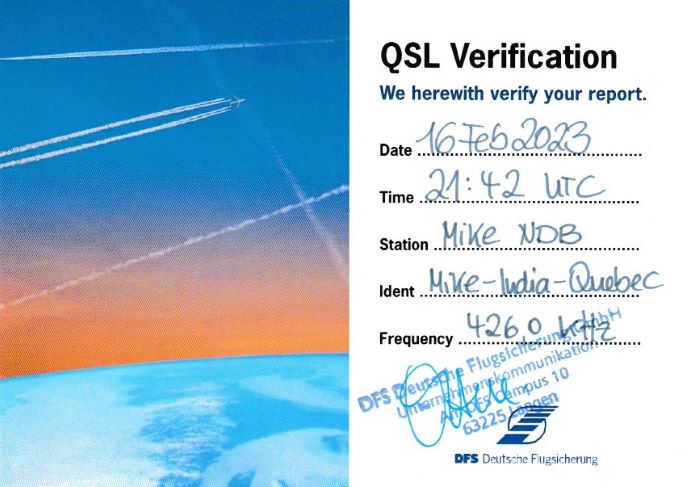
A postcard QSL confirming reception of NDB MIQ-426 Mike for Ingolstadt
It took 36 weeks, but worth waiting for: a real postcard QSL confirming my reception of NDB MIQ-426 “Mike for Ingolstadt”. I sent my report to DFS (Deutsche Flugsicherung) in Langen, Germany. The beacon is located south of Ingolstadt, and you can actually see it driving on highway A9 between München and Ingolstadt (east of the highway).
Not sure where the “for Ingolstadt” comes from. The beacon is close to Ingolstadt airport. But it is not aligned with the runways and serves as a high and low level enroute navigation beacon according to ourairports.com .
BDXC : SWL 2262 PRe VERON : NL 14228 If you want to get in touch, just leave a message on one of my posts. Please note that I don't publish email addresses of verifiers which are not part of the public domain. So if you don't see the QSL address, just leave a message and I'll get back to you.
This is just a hobby site. Feel free to copy anything on my weblog. A link back to my site is appreciated when you do so. I try to provide accurate information, but if I'm wrong: don't blame me! I'm also not responsible for the use of sites I provide links to. I try to respect copyright rules, but should you think I made an infringement: just let me know via a message on the corresponding post and I will act accordingly.