
Top 10 DX presents itself as the World’s largest SWL contest. I think they have organized it since 2017. So as posted earlier I decide to participate. Now I knew that I didn’t have a lot of time to spare as we were preparing our move to a new house. So I spent more time packing boxes than behind the radio. But in the true Olympic spirit: “Participation is more important than winning”.
The contest is about logging 10 stations from different countries between 2300 and 30000 kHz. Points are awarded using this formula: distance (in km) / power (in kW). WRTH data are used as reference.
In addition to the rule above there was multiplier of 3 to boost your score for stations from a different continent. Here I probably made my first mistake I tried to log stations from different continents and only missed Antartica. But in hindsight I think you get a multiplier bonus for each station from a different continent than your own…
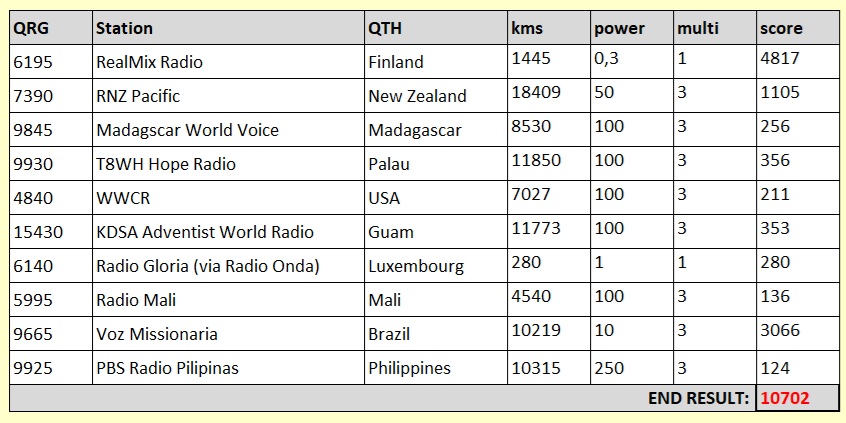
Below the 10 stations and points I collected (it differs somewhat from the 10918 points I was officially awarded, as my distance estimates might be slightly off).
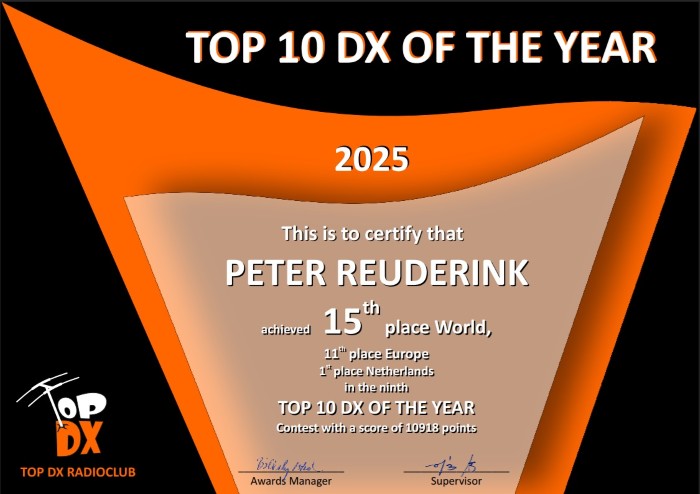
This resulted in a 15th place among 36 participants Worldwide, 11th place in Europe and as I was the only Dutch participant: 1st place in The Netherlands. The winner was “ace DX-er” Christoph Ratzer from Austria with 545863 points, of which 318513 points were picked up for 1 catch! Congratulations! I was very pleased to see my DX friend Patrick Robic picking up 3rd place with 194204 points!
Now I have to say these scores made me aware of the real challenge of this contest. It is called Top 10 DX… but from the scoring I get the feeling that low power is more important than distance (DX). And so a relatively easy catch for me like RealMix Radio resulted in more points than stations from Palau and Guam which, subject to propagation, are not always easy if you also have to write down some proper details.
So that makes you wonder… Christoph knew how to log a station which yielded over 300000 points. Outside Europe that is a station at say 10000 kms with 100 Watt only (10000/0.1 x 3). Inside Europe you are looking for say 3000 kms with 10 Watt only (3000/0.01). DX-ers in the top 4 reported 10 catches with an average between 13000 and 23000 points. So that’s 10 stations with max 1-3 kW at a average distance of 10000 kms. The problem with Top 10 DX is that they don’t disclose which stations were received by any of the participants. Frankly, I’m not sure I like that as it doesn’t help me to get better as a DX-er by learning from others.
My conclusion: if you want to get a high score in the Top 10 DX contest you have to research which stations less than 3 kW outside your continent can be received (and less than 0.3 kW when on your continent). Those are the ones to target, anything else barely adds a significant number of points.
“Will I participate next year?” The answer is “maybe…”. If time permits I will invest in putting together a shortlist of stations that would result in at least 5000 points each. If that is a set I consider viable logging at my QTH I might give it another try. It might also be that I decide that this is just not my type of contest as noise levels block the reception of the few weak stations you need to have for a proper result and I can’t compensate for that by putting in more time and improve my score by adding some – slightly higher powered – stations. And again, the fact that the results of my “betters” are not made public plays a role as well: I do like competition, but more than that I do like helping fellow hobbyists to become better.
So we’ll see. That said, a big thank you to the organizers, it is always good to create challenges for the serious DX-er, and I do know that you also rather spend time behind the radio than processing spreadsheets of contest participants.




Good evening Peter,
I am an avid radio listener.
I live in the south of France, near Montpellier.
I am contacting you about two things:
1/ The DX TOP 10 OF THE YEAR contest:
I finished 16th, just behind you.
This was the first time I had taken part in this contest.
I agree with your comments.
We have no chance of winning this contest.
While doing some research on the internet, I saw that the winner has a 200-meter long wire antenna and the runner-up has a 260-meter long wire antenna…
So we can’t compete.
For my part, I have an MFJ 1886 loop antenna located on my roof, 9 meters above the ground, and a 25-meter wire antenna.
2/ Radio Philadelphia:
This is a Greek pirate radio station that I picked up on Saturday, March 7, on 1611 kHz.
Do you know where their transmitter is located and how powerful it is? Do you have an address where I can send them a listening report and, of course, get a QSL card?
Thank you in advance for your response and for the quality of the information on your website.
Best regards.
Philippe LEIZE
Hi Philippe,
Thanks for your interest in my site. It is always nice to connect with fellow DX-ers around the world.
Don’t be too harsh on the Top 10 DX. I agree with you that it is difficult to win this contest, and so it should be in any contest. And of course, at the end of the day your location makes a big difference. What is the space available for an antenna, and more importantly: how low is your noise environment. That’s all fine, but in this contest a single low power station yields more points than all my 10 logs combined. The bias to low power seems to favor the DX-er in a low noise environment, which is difficult to compensate for by putting in a lot of time hoping that you receive that long distance signal thanks to favorable propagation conditions. That’s just my personal view, and since I am moving to a house on the countryside with less noise and more opportunities to test various antennas, we’ll see. Just compare it with pro-cycling: Matthieu van der Poel also knows that he should compete in classics and not in mountain stages.
On you question about Radio Philadelphia: I wish I knew. I do hear a lot of these pirates, including this one. I wouldn’t be surprised if their power is 1 kW given the fact that I hear them every night, even more so than for example Voce Sperantei from Romania. I don’t get the impression they are interested in reports, let alone send QSLs, as I don’t see a lot of posts on the internet. And thus I consider them a nuisance mainly (apologies if this sounds a big negative).
If I can help you with Dutch pirates just let me know. They are often very DX / SWL friendly.
Kind regards, Peter
Still some time to make up our minds … 😉
https://www.topdx-radioclub.com/top10dx.html
True. In autumn I will start preparing a target list. Hopefully the new house is in a low noise location, and with a little luck I should have a decent antenna installed. Who knows.