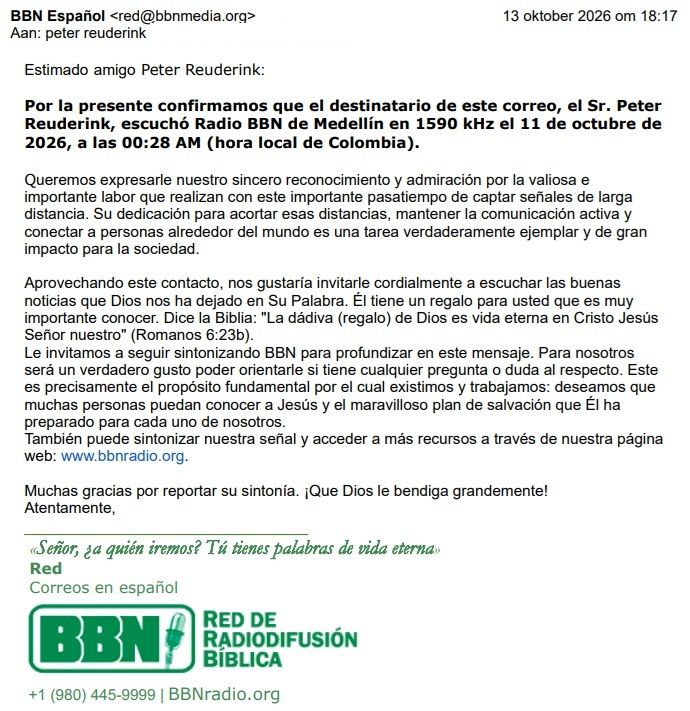
A QSL from BBN (Bible Broadcasting Network) broadcasting from Medellín on 1590 kHz. My report to red(at)bbnmedia.org was answered with in a day.
Below a brief audioclip of my reception:
BBN is may less know that stations like TWR or AWR among DX-ers. The main reason being that the station doesn’t broadcast on shortwave.The first time I received a BBN (Bible Broadcasting Network) radio station was in 2024 during my stay on the island of Curacao when I heard BBN Bogotá, Colombia on 1100 kHz. One year later I heard BBN Caracas, from Venezuela on 1250 kHz, again from Curacao. With a much improved antenna I finally managed to hear BBN at my home QTH in Woerden in december 2025, this time from Panama on 1350 kHz.
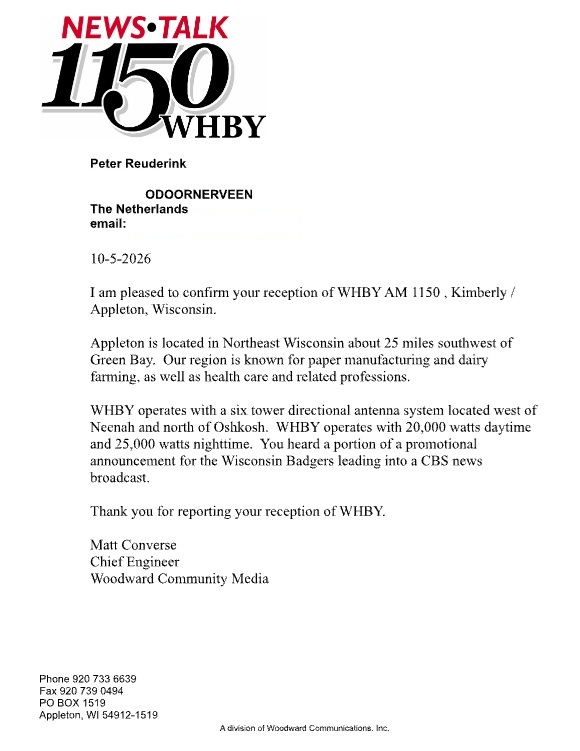
A nice letter sent by email to confirm my reception of WHBY 1150 AM broadcasting from Kimberly with studios in Appleton, Wisconsin, USA.
WHBY went on air as early as April 5th, 2025, licensed in Kimberly, Wisconsin, serving the Appleton–Fox Cities and Green Bay area. As a commercial station it initially broadcast on 1200 kHz, with the randomly assigned call letters that inspired the slogan “Where Happy Boys Yodel.” After surviving early regulatory reviews by the Federal Radio Commission, it remained a local outlet at 100 watts (later authorized for higher daytime power), shifted to 1230 kHz under the North American Regional Broadcasting Agreement in 1941, and gradually centered its operations in the Fox River Valley, including a move toward Appleton in the mid-1930s. Woodward Communications acquired the station in 1975 and steered it further into news, talk, and sports; in 1991 the company bought WYNE on 1150 kHz for $965,000 so WHBY could move to that frequency and raise its power, eventually reaching 20,000 watts by day and 25,000 at night.
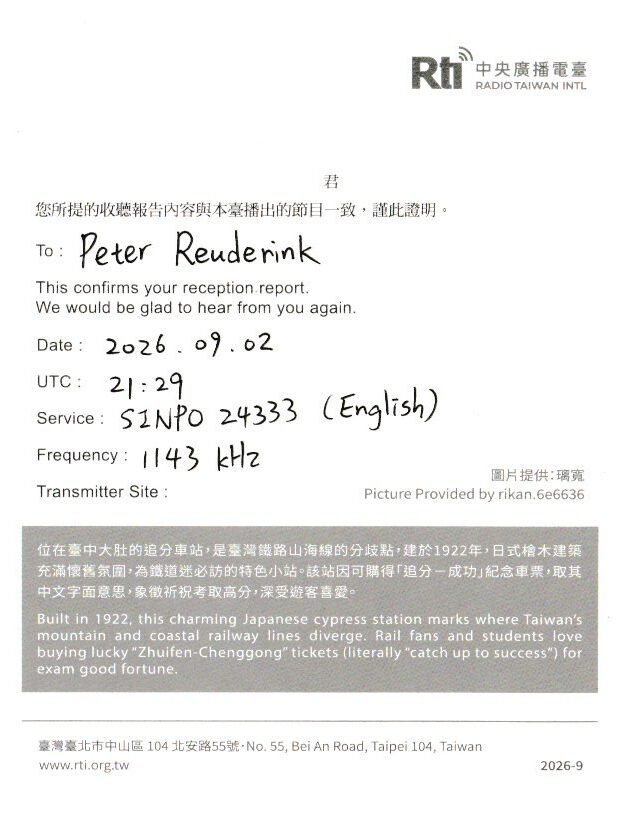
When I received Fishery Radio Station Taiwan on 1143 kHz with an English program from Radio Taiwan International I sent RTI a reception report as well. It was answered with this colorful QSL card that arrived in 2 weeks by mail. For more information and audio recordings please check the post on my reception of Taiwan Area Fishery Radio Station from two weeks ago.
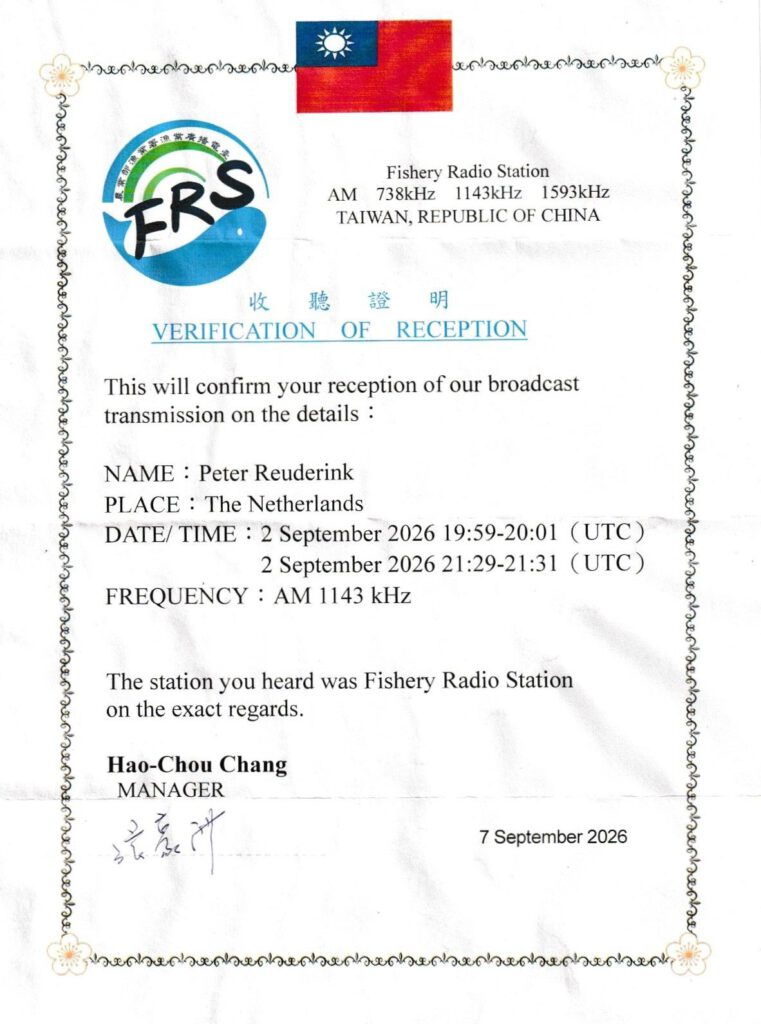
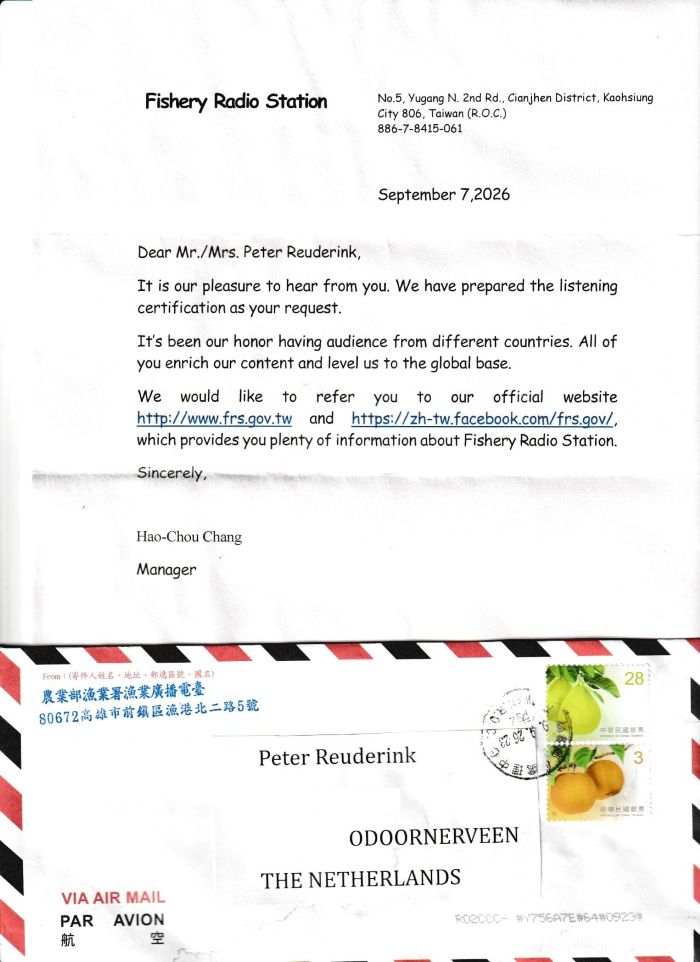
A QSL letter from Taiwan Chu Yuyeh Kuangpo Tientai, 台灣區漁業廣播電台 (Táiwān Qū Yúyè Guǎngbō Diàntái). Also known as Taiwan Area Fishery Radio Station on 1143 kHz. With 100 kW they also broadcast on 738 kHz. I couldn’t copy them there unlike other Benelux DX Club members. Their third frequency is 1593 kHz but that one has 3 kW only.
It is always a pleasure to receive a nice envelope that has traveled halfway around the world:
I heard them at 19:59 h UTC with time pips and a female ID for Fishery Radio:
Much stronger was the reception a later that evening with a Radio Taiwan International program:
By the way: Radio Taiwan International confirmed my reception as well with a f/d email and promised a dedicated QSL card. Let’s see.
Taiwan Area Fishery Radio Station (now Fisheries Radio Station, or FRS) is a government-run mediumwave service created to keep fishermen at sea informed and safe. It broadcasts 24 hours a day on AM 738 kHz and 1143 kHz from Penghu and 1593 kHz from Yilan. Programs are also carried in parts of eastern Taiwan by partner stations.
Taiwan is surrounded by sea and has a large fishing industry. In 1980 the Ministry of National Defense’s General Political Warfare Headquarters asked the Intelligence Bureau to plan a dedicated station that would deliver timely, accurate marine weather and related information so crews could protect lives and property and make better use of ocean resources. Trial weather broadcasts began on 1 July 1983. After provincial government reorganization in 1999 the station moved under the Fisheries Agency. It has belonged to the Ministry of Agriculture’s Fisheries Agency since 1 August 2023.
Programming also includes general information and entertainment and is produced in Mandarin, Taiwanese, Indonesian, Vietnamese, Filipino, and indigenous languages to reach both local fishermen and foreign crew members. Mediumwave was chosen because it travels well over water and can be received on simple shipboard radios far from shore.
A QSL for my reception of WMLB 1690 Avondale Estates, or WMLB 1690 AM Atlanta as this is what they themselves advertise. My first QSL for an AM broadcaster from the state of Georgia! I received a ‘simulcast’ of a program from WCPT, with the WMLB station ID on the hour:
As the WRTH provided links to WCPT Heartland Signal sites only I left a message on their website. Rodney Gibbs, General Manager confirmed my reception report. He states that they recently launched the station and are preparing to add local programming soon:
As far as I know WMLB 1690 is not (yet) owned by Heartland Signal. The FCC licensee is still John Fredericks’ Disruptor Radio, LLC.
Most of the news talk stations I have received so far voice a conservative opinion (like WXKS for example). Heartland Signal however brings a progressive voice. The format is “live, local & progressive”: discussions with activisten, journalists and politicians from the MidWest, with news from the digital newsdesk of Heartland Signal.
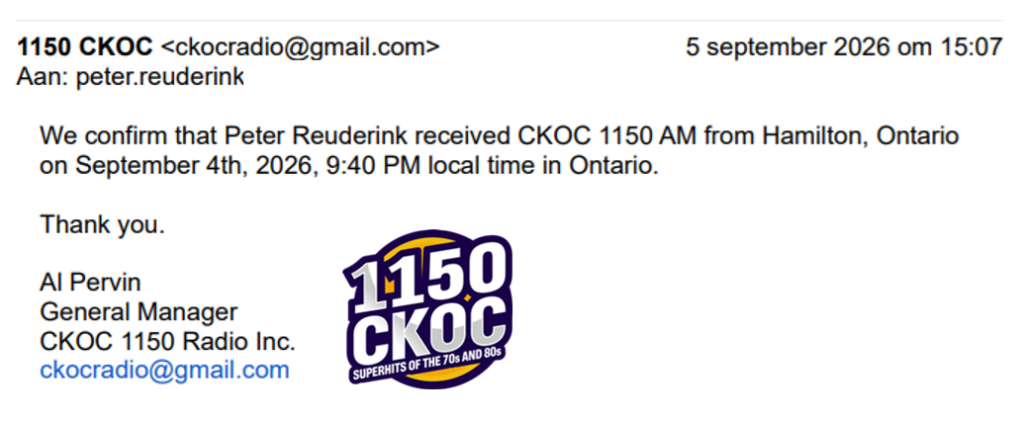
A QSL for CKOC Hamilton 1150 AM, Canada’s oldest continuously operating radio station. A station that has adapted through more than a century of broadcasting while remaining a local voice. Station CHAB, in Moose Jaw, Saskatchewan, began broadcasting a week earlier and is still on the air today, but was shut down for a period of time in 1933 before re-opening.
Recording of my CKOC 1150 AM reception, resutling in the first QSL on my new QTH
My reception report was confirmed within hours by Mr. Pervin, General Manager of the station. It is nice to be able to add this Canadian radio icon to my QSL Collection. And it is the first QSL from my new QTH!
A brief history of CKOC
Signed on May 1, 1922, by Herb Slack and George Crawford of Wentworth Radio and Auto Supply, the station began as a modest way to sell radios. Its call letters come from the original owner’s parent company, Ontario Cycle. Early broadcasts were limited, and the station hopped frequencies—including 880, 630, and 1120 kHz—before settling on 1150 AM in 1941. It served as a CBC affiliate from 1936 to 1962.
CKOC became a regional powerhouse during its Top 40 years from 1960 to 1992, competing with Toronto stations and earning a reputation as “The Busy Bee.” In 1992 it flipped to oldies as “Oldies 1150,” briefly using the CKMO calls before listeners demanded the original CKOC letters back in 1993. In 2013 the format changed scope from “Oldies” to “Classic Hits”.
Bell Media bought the station in 2013, and changed the format to sports talk in 2015, joining the TSN Radio network as TSN Radio 1150. In 2021, Bell Media ended the TSN Radio formats at CKOC as it did with CFRW Winnipeg and CKST Vancouver. CKOC continued as BNN Bloomberg Radio.
When Bell Media put the station up for sale in 2024 amid broader AM cutbacks the CINA Media Group acquired CKOC (along with sister station CHAM). In August 19, 2024, the new owners relaunched it as 1150 CKOC with a classic hits format branded “Superhits of the 70s and 80s.” The station now pairs that music with local news, including weekday morning newscasts and a simulcast of CHCH-TV’s Evening News at 6 p.m.
CKOC facilities
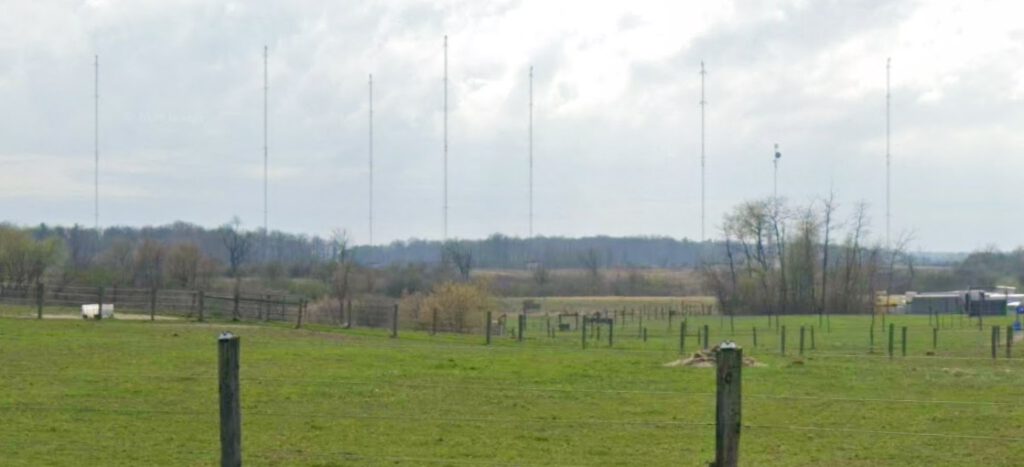
The CKOC transmitter site near Empire Corners (Google Street View)
Technically, CKOC is a Class B regional station with 50,000 watts daytime and 20,000 watts at night from a six-tower directional array near Empire Corners in Haldimand County, about 25 kilometres south of Hamilton. The signal covers the Greater Toronto and Hamilton Area. Its website is 1150ckoc.com.
On June 19th I received COPE Lugo broadcasting a message inviting listeners to switch to 90.0 FM if they wanted to continue to listen to COPE. So another one bites the dust…
Below my recording of their announcement which is somewhat compromised due to heavy thunderstorms as well as the fact that my loop is in a fixed 90/270 degrees position.
With 1000 kW the Roumoules transmitter is one of the most powerful mediumwave transmitters in the world. Built in 1987 it served Radio Monte Carlo broadcasts until March, 2020. The antennas are located in France, but the frequency is assigned to Monaco.
The religious broadcaster TWR has always used Radio Monte Carlo facilities, and since 1987 they also used Roumoules. And they continued doing so even when RMC seized their operations.
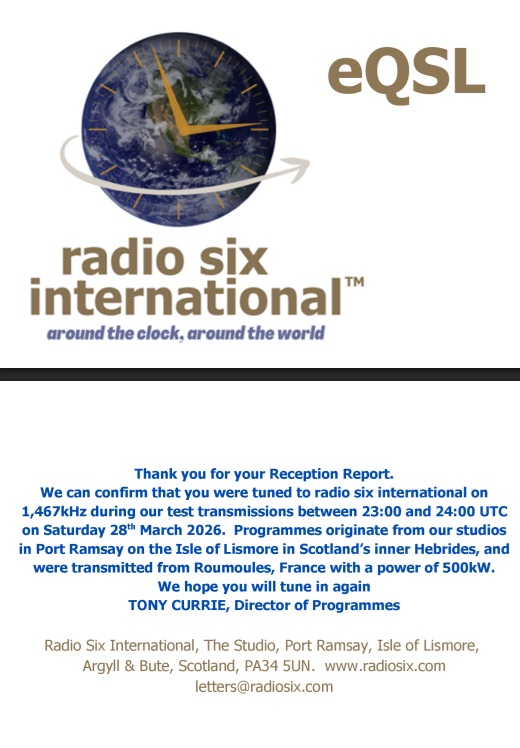
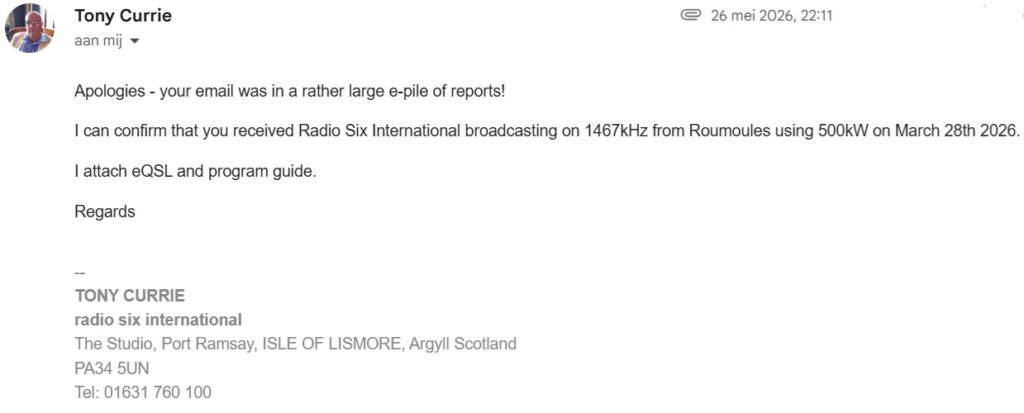
Since March 2026 the Roumoules facility has been made available to other parties. Radio Six was one of the first to launch a program “Midnight Rendezvous” and they were so friendly to QSL my reception report.
Below the recording I made of the program opening. Quality might be a bit compromised as my MW loop antenna had a fixed direction 90/270 degrees which I couldn’t change.
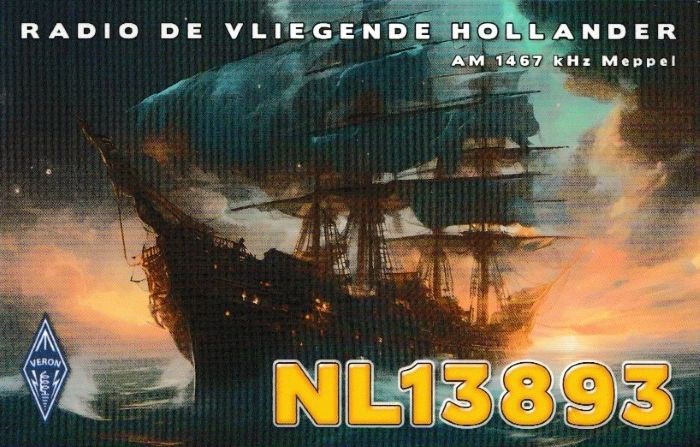
Radio De Vliegende Hollander (“The Flying Dutchman”) from Meppel, The Netherlands, can be heard quite well here in Coevorden on 1467 kHz. No surprise as the distance is only 37 kilometers. This LPAM station is broadcasting with 50 Watts, slightly lower than most Dutch LPAMs. At my previous QTH in Woerden I was never able to receive this station, as Radio Paradijs from nearby Utrecht was dominant. The first time I heard this station was on a clip my friend Arild Skalmeraas sent me to help with the station identification. Which means that Radio Vliegende Hollander already made it to Norway!
In the audioclip below you can hear the Radio Paradijs ID at 14 seconds, and much louder, the Radio De Vliegende Hollander ID at 22 seconds: “Dit is Radio de Vliegende Hollander, AM 1467 kHz, vanuit Nederland. Wil je meer informatie over ons, surf dan naar www.radiodevliegendehollander.nl . Radio de Vliegende Hollander te horen op AM, 1467 kHz, vanuit Meppel brengen we je het laatste nieuws”
Radio De Vliegende Hollander ID
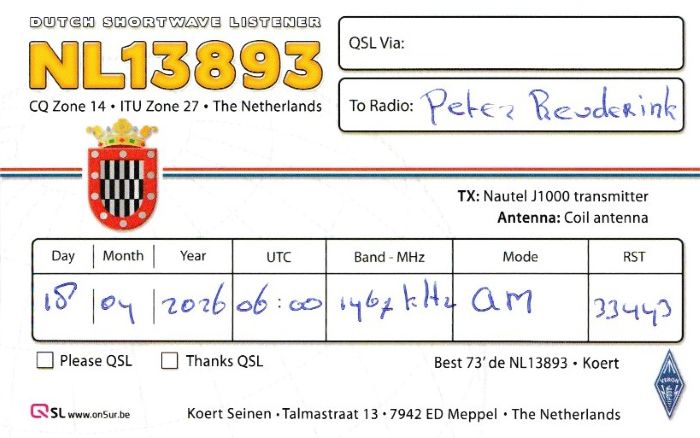
My reception report sent to 1467am(at)radiodevliegendehollander.nl was answered by Koert who is the station owner. Koert happens to be a member of the VERON as well as the Benelux DX Club, just as I am. And therefore maybe no surprise that reception reports are awarded with a beautiful old school QSL card. Big thanks to Koert!
Old school QSL card from Radio De Vliegende Hollander (which is Dutch for Flying Dutchman)
Fully detailed QSL card for Radio De Vliegende Hollander
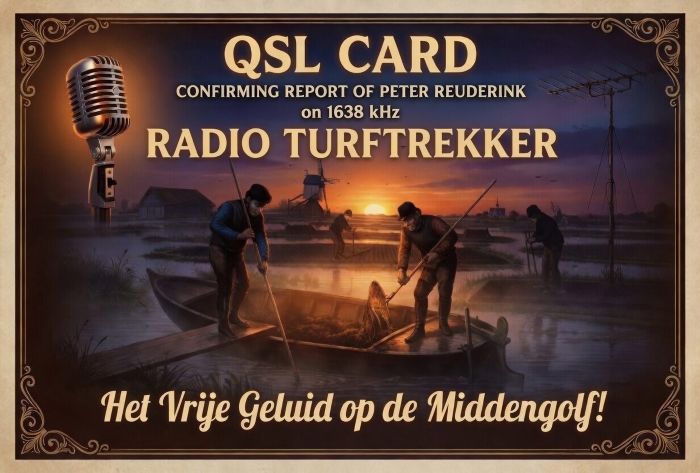
DX-ing mediumwave pirates is nice because sometimes you have email correspondence with fellow radio enthusiasts. I received Radio Turftrekker on 1638 kHz. Operator Jeroen wrote that he was ‘spoon-fed’ with mediumwave pirate radio as his father is also a mediumwave pirate. As a small child, he was listened in. Occasionally he was allowed to say something on the radio.
But it is also nice because some of the station names used remind you of the heritage of the Netherlands. Radio Markies is an example. And so is Radio Turftrekker. While the next paragraphs are not really about radio or DX, I just enjoyed writing them. Skip it if you want, but if you like it, please leave a comment!
About the name of Radio Turftrekker
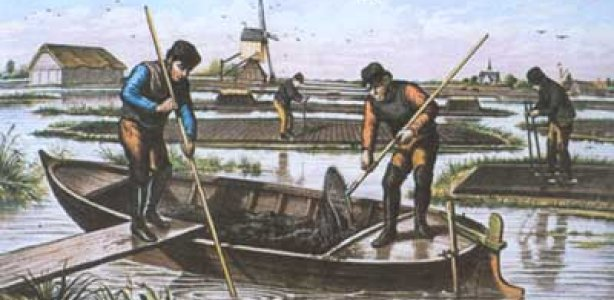
A “Turftrekker” or “Peat Puller” was a worker that extracted peat using a scoop with a net attached. Peat was used as a fuel to heat houses before we switched to coal (and Holland what late in doing so). However, with the peat being extracted, deep pools of water formed in Holland.
“God created the earth, except for the Netherlands, for the Dutch did that themselves” is a well-known Dutch saying referring to the polders and reclaimed lands. But what is often forgotten is that the same Dutch first lost almost half their country due to peat extraction.
“Turftrekkers” extracting peat. A picture from 1895 used in schools.
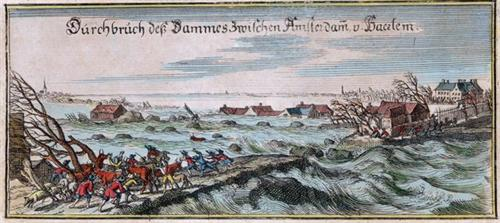
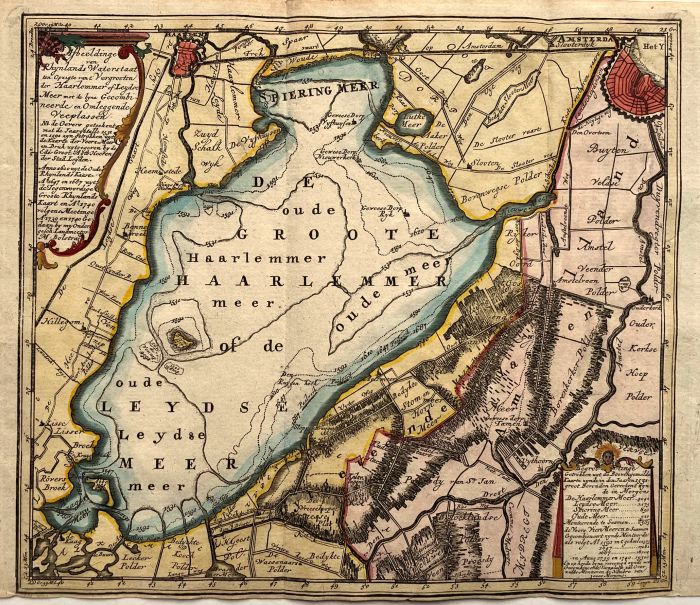
The prime example is the Haarlemmermeer (Haarlem Lake), the polder in which Schiphol (Amsterdam International) Airport is situated today. In the Middle Ages four lakes were formed as a result of peat reclaiming. Additional illegal reclaiming and storms resulted in the collapse of dikes, allowing the lakes to merge into what became the Haarlemmermeer. That lake was so large that it became an inland sea, and with southwesterly storms, it expanded ever further in the direction of Amsterdam.
The collapse of the dike between Amsterdam and Haarlem
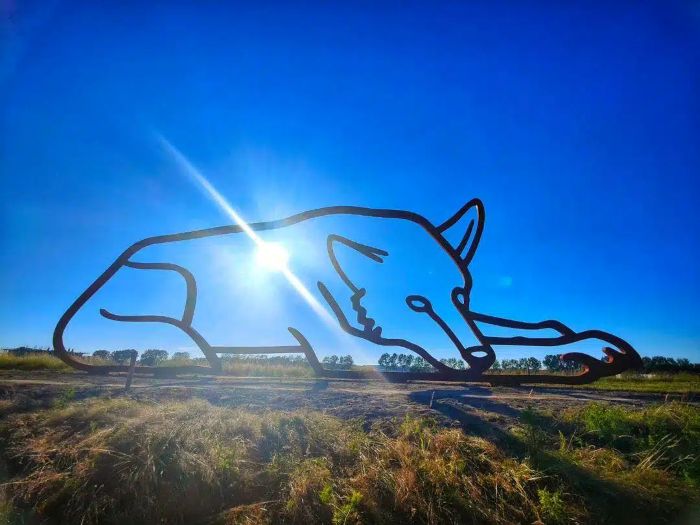
The Haarlemmermeer acquired the nickname “Waterwolf” as the water consumed more and more land. A beautiful artwork created in 2024 visualizes this. The Waterwolf seems to be at rest in this statue, as is the Haarlemmermeer.
The “Water Wolf” statue in the Haarlemmermeer. Finally at rest after 4 centuries.
Plans were made to reclaim the Haarlemmermeer as early as the 18th century. However, by then the lake was too large to be drained with windmill technology applied in the Beemster, Wormer, and Schermer polders. And so nothing could be done and devastating storms in 1836 caused parts of Leiden and Amsterdam to flood.
The Haarlmemermeer in 1740, top left the city of Haarlem, top right Amsterdam
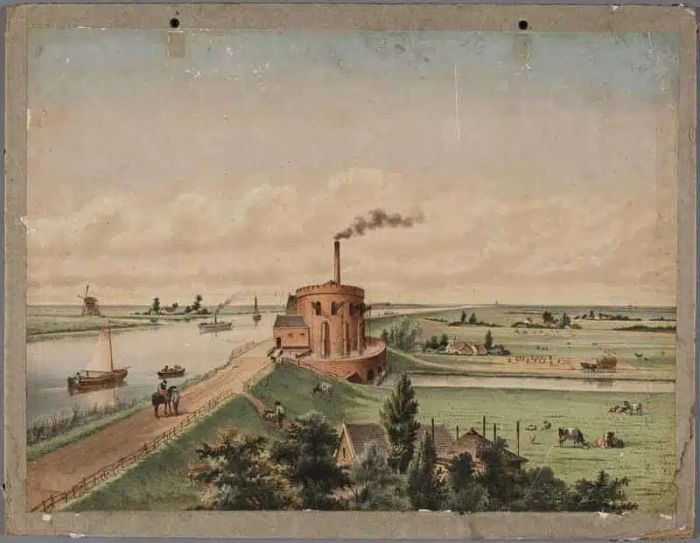
But fortunately there was the introduction of the steam engine. In May 1840, thousands of laborers began digging a 60-kilometer-long ring canal and constructing a ring dike with shovels and spades. Three steam pumping stations were built: De Leeghwater, De Cruquius, and De Lynden. On July 1, 1852, the Haarlemmermeer was completely drained, and the development and parcelling of the more than 18,500 hectares of new land could begin.
One of the steam engines draining the Haarlemmermeer
Back to Radio “Turftrekker”. Jeroen mentioned he didn’t have a QSL card. I proposed this design based on the school picture shown above. What do you think?
BDXC : SWL 2262 PRe VERON : NL 14228 If you want to get in touch, just leave a message on one of my posts. Please note that I don't publish email addresses of verifiers which are not part of the public domain. So if you don't see the QSL address, just leave a message and I'll get back to you.
This is just a hobby site. Feel free to copy anything on my weblog. A link back to my site is appreciated when you do so. I try to provide accurate information, but if I'm wrong: don't blame me! I'm also not responsible for the use of sites I provide links to. I try to respect copyright rules, but should you think I made an infringement: just let me know via a message on the corresponding post and I will act accordingly.