"It's not true I had nothing on, I had the radio on" - Marilyn Monroe

Tag: Ireland

QSL Radio North 846 AM

I tried this one two years ago earlier, but without success. But maybe Radio North has a new QSL manager in Chrissy, who was so kind to confirm my report via radionorth846mwads(at)gmail.com with a very nice fully detailed eQSL.

Radio North is broadcasting from Redcastle, Ireland with 3 kW. The station is unlicensed. And I know this led to annoyance with Dutch LPAM stations as they have to pay quite a hefty fee for their license allowing them to broadcast with 100 W max, only to find that a relatively high powered unlicensed station is causing interference on a frequency allocated to the Netherlands. It was one of the reasons why Album AM went off the air. MCB from Alphen aan de Rijn has taken over operations on 846 AM since.

I listened to oldies, but at 0300 h UTC they brought a Gospel broadcast from father John Morrison. These are heard quite often on Radio North. Chrissy had to print my email for him, as father John is old school and doesn’t have email. Below a brief clip of my reception:

QSL Energy AM Dublin 1440 kHz

A month ago I already thought I’d received Energy AM on 1440 kHz, but it turned out to be Radio Argus. But this time I received them in reasonable quality with a full ID. Energy AM is an unlicensed station from the Dublin area in Ireland, active on weekends. They used to operate on 1395 kHz (as you can still see in their logo), but since late last year they switched to 1440 kHz.

Energy AM confirmed my report via Facebook Messenger and provided some details:

Peter,

It was indeed Energy AM you heard last night on 1440 khz .

We were running 425 watts into our T antenna 20 metres vertical and 33 metres of horizontal.Slight loading at top of vertcal 7 turns.Transmitter isa Hercules 1 kilowatt but not running more than 500 watts as any more power cause local breakthrough interference on a smoke alarm.

We also use a D&R mixing desk, Rode mic, technics sl 1200 turntable ,Tascam cd 401 mk2 cd player ,and a dell PC with playout one radio program. audio is processed with orban digital am optimod. If you require any further information i would be happy to forward it to you.

Thanks for your reception report from all at Energy Am.

Below you can hear the jingle with the “Energy” identification:

UPDATE: as I noticed they still had their old frequency in the logo I made a new one. And got a nice “Thank You” in reply:

QSL Radio Cuckoo 6295 kHz

A traditional QSL postcard from Radio Cuckoo on 6295 kHz. Radio Cuckoo is a pirate station broadcasting from Ireland using a home-built tube transmitter. They broadcast popmusic from the 80-ies. Reception quality suffered from some noise, but the way “Cuckoo” was pronounced made it easy to catch the identification.

I received their new QSL (see below) as well as their old QSL card plus sticker within a week after sending my report to radiocuckoo(at)yahoo.com . Thank you Dave!

QSL card from Radio Cuckoo on 6295 kHz

QSL Malin Head Radio 518 kHz

A fully detailed QSL letter from Malin Head Radio 518 kHz. Watch officer Mc Dermott was so kind to confirm my report within minutes. I sent my report to: mrsc.malin@transport.gov.ie . Its my second QSL from Malin Head Radio. The first one was from 31 years ago for a USB transmission on 2182/1677 kHz.
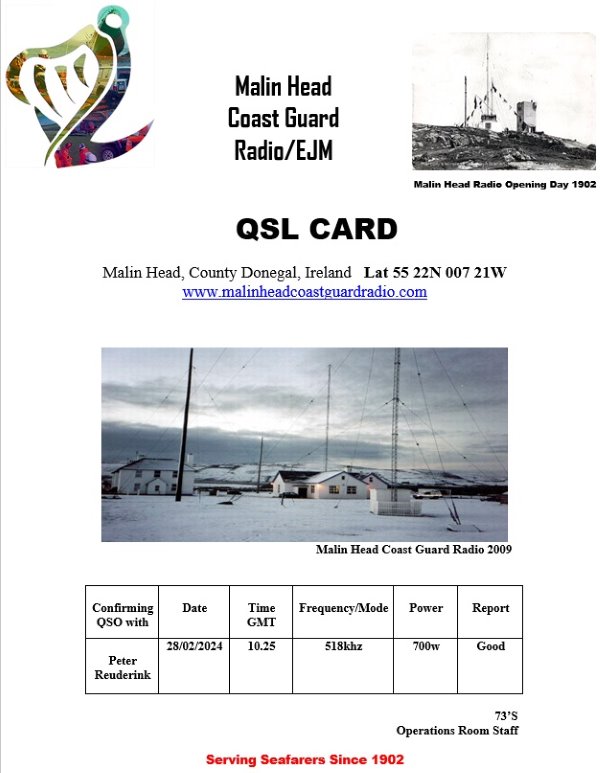
QSL Malin Head Coast Guard Radio
fully detailed e-QSL letter from Malin Head Radio on 518 kHz

Malin Head Coast Guard Radio has a nice facebook page posting their current activities. But I also found a “facebook legacy site” with some interesting information:

The station was opened in 1902 by the Marconi Marine Company on behalf of Lloyds. Located at the northernmost tip of Ireland, this station was ideally positioned to communicate with shipping coming across the Atlantic or from northern waters. But already in 1805 Lloyds had a signal station on this location.
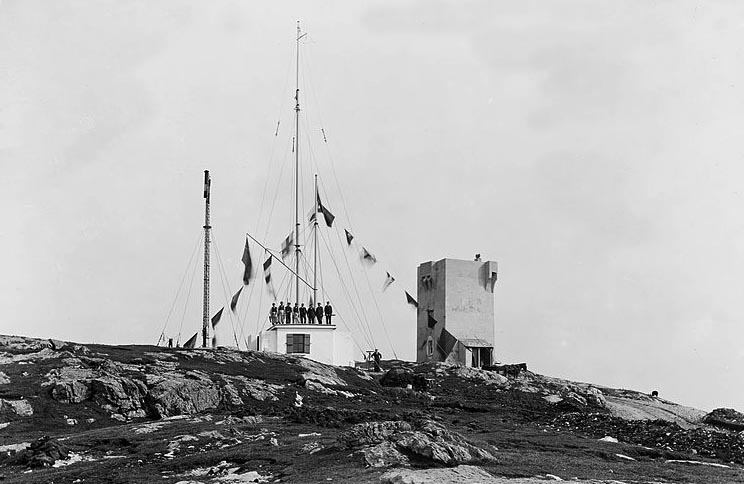
Mailn Head Radio at the opening in 1902. The old signal tower on the right.

In 1988 the morse code services from Malin Head on 500 and 421 kHz were discontinued. That turned out to be a bit early. There was one instance where the station’s 500kHz automatic alarm receiver, which remained on watch, was activated by the signals of a sinking ship far out in the Atlantic. Malin Head Radio was the only station able to copy the weak signals from the ship’s lifeboat. With the station’s transmitters dismantled, return transmissions had to be made by her sister station Valentia Radio – not the most ideal means of conducting a distress situation.

Thanks to the team of Malin Head Radio for issuing QSL to us DX folks. And once again I learned something just by listening to the radio!

RTE ends long wave service 252 kHz

Next Friday RTE (Raidió Teilifís Éireann) from Ireland will end their long wave service on 252 kHz. Operation on 252 kHz started in 1989 when a joint venture of RTE and RTL started as Atlantic 252. With its powerful transmitter it easily covered Ireland and the UK. The BBC and Independent Local Radio complained about the station as they considered it a “commercial pirate”.

Initially the station was on air between 6 am and 7 pm, as listeners were encouraged to tune to Radio Luxembourg in the evening hours. Radio Luxembourg was the station that – following the demise of the North Sea pirate stations – you listened to for the latest popmusic. From 1991 Atlantic 252 it was on the air 24 hours a day, making it an easier catch for DX-ers around the world.

Popularity of the station reached a peak in the mid 90-ies. But commercial radio on FM, with better sound quality, gained popularity in the UK. From over 6 million listeners the audience declined to less than 1 million in 1999, and in 2001 the station went off the air. For a few months in 2002 Teamtalk 252 was aired via this frequency, after that RTE used the transmitter for RTE 1 programmes directed to the Irish expat community.

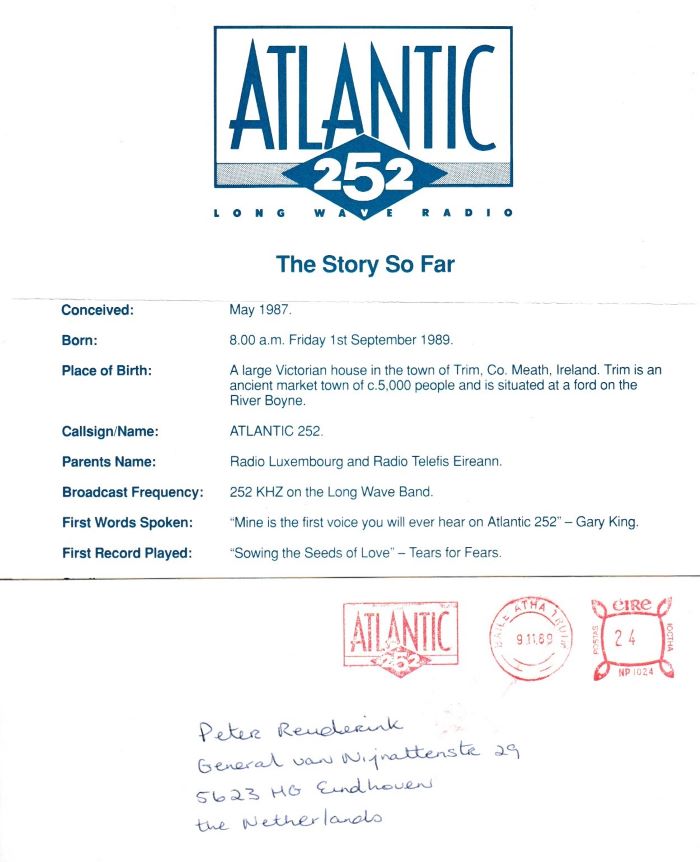
Below you can see my QSL from 1989, a few months after the start of Atlantic 252. It’s a pity that following the closure of the Beidweiler station of JV partner RTL another LW station bites the dust. On the other hand, given the costs and pressure to save on the huge energy consumption of such transmitters, it is understandable.

Information Letter Atlantic 252
QSL folder (1989) for Atlantic 252, Ireland

© 2026 Peter's DX Corner

Theme by Anders NorenUp ↑