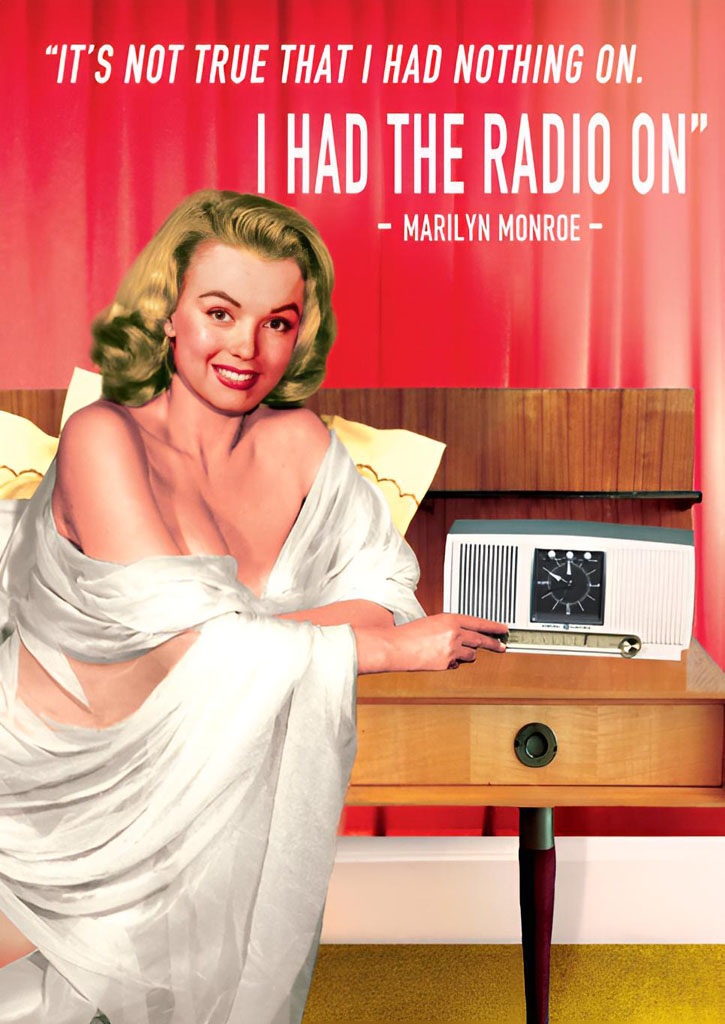
"It's not true I had nothing on, I had the radio on" - Marilyn Monroe

Tag: Closure

Closure of the Droitwich 198 kHz transmitter: the end of an era

The BBC Radio 4 long wave service from the Droitwich transmitting station has come to a quiet but historic end. For decades, the powerful 198 kHz signal beamed out from the iconic Wychbold masts near Droitwich in Worcestershire, reaching across the UK and deep into Europe. Together with auxiliary transmitters at Burghead and Westerglen in Scotland, it formed a resilient national network that ensured Radio 4 could be heard in remote areas, at sea, and even in parts of Ireland and mainland Europe where other signals faltered.

My recording of the last minutes of BBC4 via the Droitwich Long Wave transmitter

The closure on 27 June 2026 at 01:00 BST marked the final broadcast after the Shipping Forecast and “Sailing By,” followed by a poignant sign-off. A looped retuning message played briefly before the transmitter was powered down permanently on 30 June. This brought to an end 92 years of long wave transmissions from the site, which began in 1934 with the BBC National Programme and later carried the Light Programme, Radio 2, and finally Radio 4 from 1978. The aging equipment, including hard-to-replace high-power valves, had simply reached the end of its operational life, prompting the BBC to prioritise cost savings and digital alternatives.
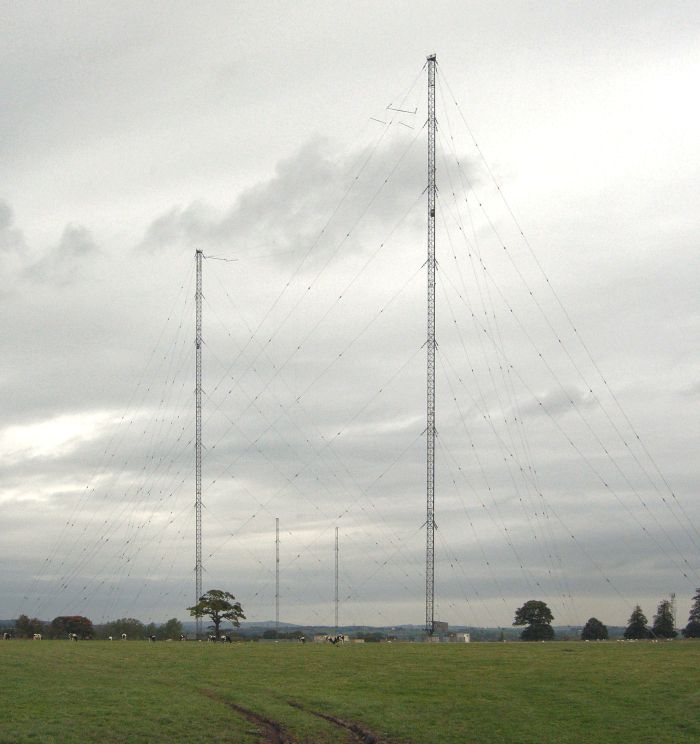
The Droitwich 700 ft antenna masts

This switch-off represents the end of an era for British broadcasting. Long wave offered unparalleled coverage and reliability for generations of listeners, from wartime audiences to farmers checking the Shipping Forecast or night-shift workers tuning in. Its low-frequency waves could travel hundreds of miles by hugging the ground and reflecting off the ionosphere, a technological marvel in its time. While FM, DAB, and online streaming now dominate, the loss of this analogue lifeline has prompted nostalgia and even a campaign to heritage-list the towering 700-foot masts as symbols of a bygone broadcasting age. Droitwich’s silence closes a chapter that began nearly a century earlier, reminding us how technology evolves while leaving behind a rich auditory heritage.
Gold 1548 kHz off air end-September

Other Gold mediumwave stations closed already in June this year. Gold 1548, servicing London from the Saffon Green transmitter, will follow end-September (source: Ydun’s Medium Wave Info).

Before the merger of many independent local radio stations in the United Kingdom this was the transmitter of Capital Radio. With 97.5 kW this station was significantly more powerful than other ILR stations and easy to receive here in The Netherlands. The higher power probably has to do with the size of the London area and the urban environment.

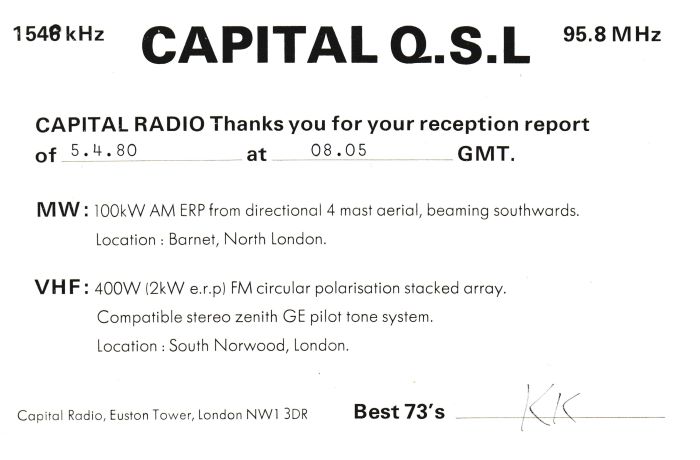
In the 1980s I had a lot of fun chasing the different ILR (and BBC) local radio stations. The stations all had their own local identity and studios and hadn’t merged into larger conglomerates yet. Below you can see the Capital QSL I received in 1980. Had it been a post stamp it would have been a collector’s item given the apparent misprint of the frequency. Truth be told, I regularly get confused with the 1458, 1485, 1548 and 1584 frequencies myself.

My QSL from Capital Radio 1548 in 1980

RTE ends long wave service 252 kHz

Next Friday RTE (Raidió Teilifís Éireann) from Ireland will end their long wave service on 252 kHz. Operation on 252 kHz started in 1989 when a joint venture of RTE and RTL started as Atlantic 252. With its powerful transmitter it easily covered Ireland and the UK. The BBC and Independent Local Radio complained about the station as they considered it a “commercial pirate”.

Initially the station was on air between 6 am and 7 pm, as listeners were encouraged to tune to Radio Luxembourg in the evening hours. Radio Luxembourg was the station that – following the demise of the North Sea pirate stations – you listened to for the latest popmusic. From 1991 Atlantic 252 it was on the air 24 hours a day, making it an easier catch for DX-ers around the world.

Popularity of the station reached a peak in the mid 90-ies. But commercial radio on FM, with better sound quality, gained popularity in the UK. From over 6 million listeners the audience declined to less than 1 million in 1999, and in 2001 the station went off the air. For a few months in 2002 Teamtalk 252 was aired via this frequency, after that RTE used the transmitter for RTE 1 programmes directed to the Irish expat community.

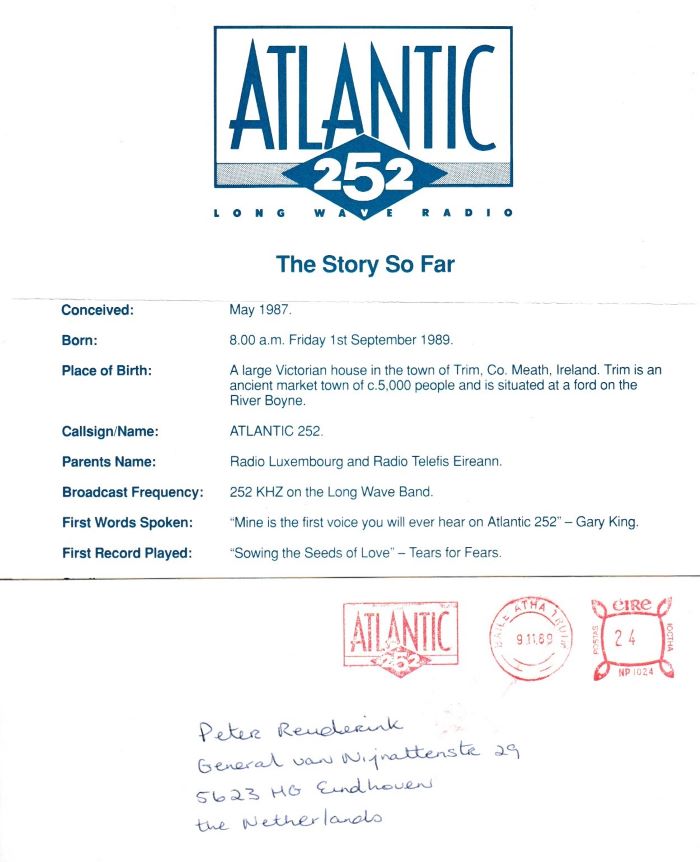
Below you can see my QSL from 1989, a few months after the start of Atlantic 252. It’s a pity that following the closure of the Beidweiler station of JV partner RTL another LW station bites the dust. On the other hand, given the costs and pressure to save on the huge energy consumption of such transmitters, it is understandable.

Information Letter Atlantic 252
QSL folder (1989) for Atlantic 252, Ireland

© 2026 Peter's DX Corner

Theme by Anders NorenUp ↑